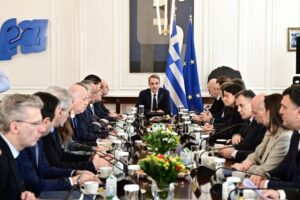
The coming week promises to be a defining moment for Greek politics, as Prime Minister Kyriakos Mitsotakis prepares for a major government reshuffle while the parliamentary inquiry into the Tempi train disaster takes shape. With political parties recalibrating their strategies based on the latest polling data, the political battlefield is set for significant shifts.
Resetting the Government’s Political Narrative
Following a successful defense against the no-confidence motion, Mitsotakis is eager to reset the government’s political trajectory. The anticipated cabinet reshuffle—expected before the end of the week—aims not only at policy adjustments but also at a symbolic fresh start. The extent and depth of these changes will inevitably shape the opposition’s response, especially as SYRIZA intensifies its focus on the parliamentary inquiry, targeting key government figures beyond just Christos Triantopoulos over the Tempi disaster.
Early in the week, the composition of the 27-member inquiry committee—where the government holds a 14-seat majority—will be announced. The opposition is determined to keep the Tempi tragedy at the forefront of public discourse, at least until summer, using it as a lever for political pressure. Meanwhile, the government seeks to prevent a repeat of past parliamentary investigations that spiraled into chaotic political theater.
Polling Shockwaves: The Rise of Zoe Konstantopoulou
Beyond government maneuvering, the latest MRB poll has sent shockwaves across the political spectrum. Zoe Konstantopoulou’s Plefsi Eleftherias (Course of Freedom) has surged to third place with 12%, narrowing the gap with PASOK to just 3.4 percentage points. This surge not only alarms SYRIZA but also rattles the broader progressive bloc, as her party draws support from across the ideological spectrum—9% from ND, 9% from SYRIZA, 2.3% from PASOK, 7.4% from KKE, and 2.5% from Greek Solution.
Adding to the concern, Konstantopoulou ranks second in prime ministerial suitability at 8%, trailing Mitsotakis at 20.8%. Crucially, she leads in popularity among political leaders regarding the Tempi inquiry, with 51.1% of respondents viewing her stance favorably—outpacing even KKE’s Dimitris Koutsoumbas and Mitsotakis himself.
Presidential Transition and Institutional Reforms
Beyond electoral calculations, institutional changes are also on the horizon. The five-year term of President Katerina Sakellaropoulou is coming to an end, with former Parliament Speaker Kostas Tasoulas set to take over on March 13. This transition could mark the final countdown to the reshuffle, as the government shifts focus to key reforms, including judicial appointments, ministerial accountability, Article 16 on private universities, and public sector evaluations.
SYRIZA and PASOK are expected to outline their positions on the upcoming constitutional revision, especially as Mitsotakis challenges PASOK on private universities—an issue that has already sparked internal turmoil within the center-left party.
A Defining Political Moment
With the government seeking a fresh start, the opposition sharpening its attacks, and new political players disrupting the balance, this week could prove to be a turning point. Whether the reshuffle resets the narrative or simply fuels further polarization remains to be seen. One thing is certain: Greek politics is entering a period of heightened volatility.
Ask me anything
Explore related questions