





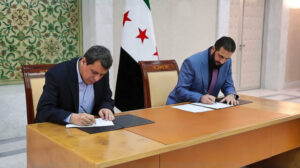
The surprise agreement between the new regime in Damascus and the Kurdish SDF fighters may, under certain conditions, lay the groundwork for the normalization process in Syria. However, everything depends on the details and its implementation.
The agreement was signed between Al Sharaa and the SDF chief, Maslum Abdi, shortly after the visit to the Kurdish-administered region by the US CENTCOM supreme commander, General Kurila, to the Kurdish-administered region. The latter met with M. Abdi, a move believed to have contributed to the deal.
Al-Saraa has every reason to be satisfied, as this shows that he is addressing one of the most serious problems with an ethnic minority whose armed factions occupy northeastern Syria. At the same time, it is trying to change the negative impressions created last week in Latakia by the pogrom against Alawites, after government-controlled jihadists were attacked by supporters of former President Assad. By thus containing a real danger and threat to the country’s territorial integrity, it also strengthens its legitimacy in the international community, especially vis-à-vis the West, which remains highly suspicious of it because of its jihadist past.
The deal buys time and at the same time shows that it meets the demands of Erdogan for disbanding the SDF, withdrawing all PKK foreign fighters from Syria and abolishing the autonomous region. For Turkey, the prospect of dismantling the SDF is of extreme importance as it will appear as a result of both their inability to confront Turkey and Ocalan’s call for the dismantling of the PKK which is currently a top priority for Erdogan. At the same time, such a development would remove one of the most important thorn in the side of US-Turkish relations at the moment.
For the Kurds of the SDF, the agreement was also the result of the pressure they have been under lately, mainly from Arab and neighboring countries, but also from the EU, as they were accused of operating against the reconstruction course of the country, serving forces seeking to dismember Syria and being used as a lever for Iran to restore its influence in the region.
The SDF, with this agreement, hopes to ensure that at least immediately it will not be attacked by Turkey, as this would torpedo the whole process.
Despite the initial impression given that the SDF was joining the government army, which has the jihadist organization HTS as its core, Mazlum Abdi himself said that he accepts Al-Saraa as president, one flag, territorial integrity and a unified army, but clarified that his forces will only join the Ministry of Defence if they have a say in policy and decision making. He is essentially talking about integration of the SDF forces, not their assimilation or, much less, their disbandment.
M. Abdi also said that “some governmental powers should be distributed to the regions, not just to the SDF” and that “Kurdish political and cultural rights should be safeguarded when drafting the constitution, including language and regional governance issues“, sending the message that the abolition of the autonomous region is not imminent.
Regarding control of the areas that currently make up the autonomous Kurdish region, the SDF maintains that HTS government forces will not enter its territory, but will only take over border crossing points. At the same time, there will be no other change, beyond a possible involvement of the Damascus government in guarding the prisons where ISIS fighters are held.
The Kurds know that their great diplomatic weapon is their role in dealing with ISIS. The Americans have invested in this by assuming their support and sending an American force into their region, which has also been the great shield against Turkey and the Assad regime.
Turkey is pressing Al Sharaa to force the surrender of the prisons to government forces and to secure a convincing argument in its negotiations with the new US administration. At the same time, it will find an opportunity to neutralize Kurdish armed forces in the region.
The question of how the Damascus government will gain access to natural resources, especially the oil fields in the Kurdish-controlled eastern regions, also remains open. Reports indicate that a model is being sought for the SDF to maintain control of the oil fields but supply oil to Damascus.
All indications, however, are that this agreement, which was welcomed by all, remains on paper for the time being. Everything will be judged by its implementation, as suspicion between the various ethnic and religious groups in Syria is high. Al-Saraa, especially after the events in Latakia, will have to convince by deeds that he can lead the country to a comprehensive reconstruction.
Ask me anything
Explore related questions




