





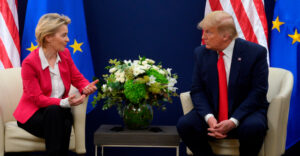
The European Union has found itself in a battle position to respond to the trade war unleashed by the President of the United States of America, Donald Trump. The tariffs he has imposed on most countries around the world, with the exception of states such as Russia, are causing a chain reaction, both economically and politically.
As European Commission President Ursula von der Leyen has said, the EU, though unwilling, is ready to fight back, with Europeans already hit by customs tariffs on steel and aluminum (25% announced on February 10) and then on cars and parts (25% announced on March 26).
Why is the US imposing tariffs on the EU, as a whole, and not on its member states;
The EU abolished tariffs between its member states when the customs union was created in 1968. Goods imported into the EU from the rest of the world are subject to tariffs that follow World Trade Organization rules and principles. In this context the EU has the largest single market in the world with 450 million citizens.
In practice, the customs union means that the customs authorities of all 27 EU member states work together as if they were one authority. They apply the same tariffs to goods imported into their territory from the rest of the world, and do not impose tariffs within. At the same time, under the Common Commercial Policy, member states have accepted that the EU’s trade relations with third countries are the exclusive competence of the European Commission, not national governments. The reason was (and remains) to give the EU as a whole greater bargaining power vis-à-vis third countries.
Why are tariffs now imposed on the EU?
The US president’s intention to impose tariffs on the EU is nothing new,. Already in his first term, Donald Trump had started the process when he imposed tariffs on EU steel and aluminium, to which the EU retaliated with tariffs on US products of around $3.3 billion. However, back then (in 2019) the European Commission was presided over by a real “dinosaur” of European politics, who was present at the signing of the Maastricht Treaty and also at Trump’s first election. The reason is Jean-Claude Juncker who went to the White House and managed to impose a temporary “truce” between Washington and Brussels.
How the Trump administration calculated the tariffs it imposed
Despite the US administration’s statements that these are “retaliatory” tariffs, in practice it is a punitive policy that has as its main objective (but according to European sources possibly not only….) to reduce the US trade deficit. The calculation equation used by the US government initially seemed complicated to the uninformed, but to the experts it is relatively simple.
What is this equation?
Tariffs (Dt1) are calculated as follows. Imports into the US from a country A (m_i) . Exports from the US to the same country (x_i): bilateral trade deficit (m_i – x_i /2) ∆τ_i (i.e. tariffs) is the result. In short, the trade deficit for the US in goods with a particular country is divided by the total goods imported from that country, and then the quotient is divided by two. However, these values focus on trade in goods, not services, which (i.e. services) could slightly increase the deficit. At the same time there are other parameters, which are not relevant to the EU and that is why the US has imposed tariffs on islands inhabited only by penguins…
Why 20% in the EU?
In 2024 the EU recorded a trade surplus with the US of $235.6 billion, while total goods imported by the US reached $605.8 billion. According to the US calculation, tariffs in the EU should reach more than 38%. Divided by 50% and rounded up, it came to 20%.
Which EU member states are most affected
Under the EU’s Common Commercial Policy, member states both benefit and are mutually disadvantaged. Based on the equation used by the US administration, Greece and France are among the “losers”. Our country, strange as it may seem, has a trade surplus with the US of around $268 million, as we export more to the US than we import from it. The same is true for France, which in 2014 recorded a trade surplus of $83 billion with the US. However, the two countries would face tariffs of 10% (Greece) and 13.55% (France) if they were not EU member states. Germany with a trade surplus of about 70 billion would face a 25.1% tariff, while the big loser would be Italy, which if it were not an EU member, Washington could impose tariffs of up to 31.8%.
How much money does the EU make from customs tariffs and who does it impose them on?
Customs duties paid on goods imported into the EU account for around 14% of the EU’s total budget as part of its “traditional own resources”. As far as customs duties are concerned, the European Union follows the principles and rules laid down by the World Trade Organisation (WTO), of which it has been a member since 1995.
All EU member states are also part of the WTO in their own right. One of the main principles of the WTO is known as most favoured nation treatment. This means that countries cannot normally discriminate between their trading partners. However, certain exceptions are allowed, for example for imported products that are subject to unfair competition from certain third countries.
How is the EU preparing to respond initially?
According to sources in Brussels, the tariffs imposed by the Trump administration are directly estimated at €26 billion, with the EU, along with other key trading partners such as Canada and Mexico, most affected. Again according to the same sources, the EU will impose countermeasures on the US which will apply to steel and aluminium but also a range of other products such as “nuts, juices, cranberries, bourbon, boats, and marine engines, motorcycles and textiles”. According to these European Commission sources, the EU executive is working on a list of US goods that would be subject, under certain conditions, to retaliatory tariffs of 21 billion euros.
Ask me anything
Explore related questions




