Clouds of war appeared in the Syrian skies again as Israel, with the bombing of the T-4 military base and Palmyra on March 21 and 25, had sent the first message that it would not accept Turkey‘s military presence in the troubled Middle Eastern country, nor would it allow its air superiority in the region to be challenged.
The Israeli Air Force, with new leveling bombing of the T-4 base, Hama and the outskirts of Damascus, sent another stern warning message about who is the “boss” in the region’s airspace and dispelled any doubts about its reaction to any attempt to deploy foreign forces on Syrian soil.
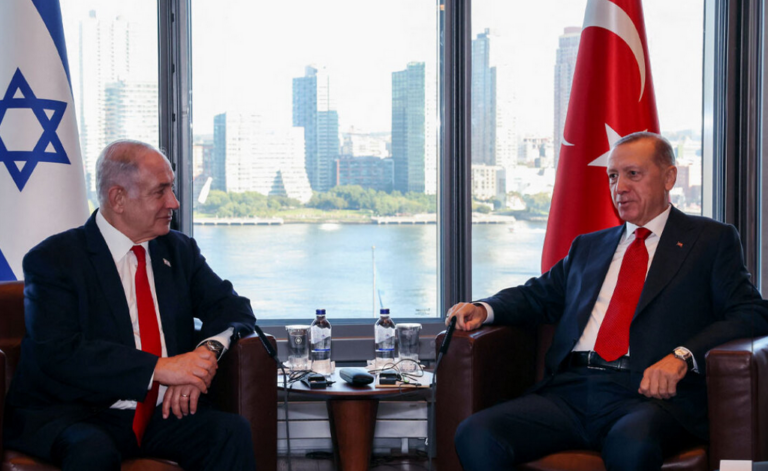
Tayyip Erdogan‘s reference to the end of Ramadan – “May Allah destroy the Zionist state of Israel” – sounded more like an exhortation and a slogan for the Muslim world and came to confirm to Israel the existence of a Turkish threat, which the Nagel Commission’s report on Israel’s security strategy had been projecting as early as January.
“Turkey’s ambitions to reestablish its Ottoman-era influence may lead to a peak in tensions with Israel, possibly escalating into conflict,” the report said, warning that Israel should be prepared for a direct confrontation with Turkey. It also recorded that “the threat from Turkey’s alliance with Syria’s factions poses a new and significant threat to Israel’s security, even more dangerous than that of Iran.”
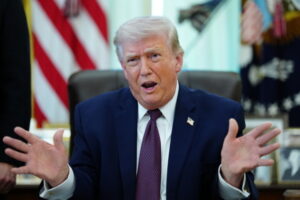
Last Monday, US President Donald Trump during his meeting with Israeli Prime Minister Benjamin Netanyahu at the White House, after reiterating the “very, very good relationship with Turkey and its leader“, he praised Erdogan for his actions on the Syrian issue: “I told him how he did what no one had achieved for 2,000 years, he took control of Syria, let’s give him that.”
On Turkey-Israel relations, against the backdrop of Syria and Israel’s concern about Turkish influence in the country, Trump had another message to send: “If they have a problem in Israel with Turkey, I think I can solve it, as long as you are reasonable, he said, addressing Netanyahu.
Will Ankara dare?
The big question, amid reports that Turkey is insisting on exploiting its relationship with the new regime in Damascus and installing forces at the T-4 base, is whether Ankara will dare to take such a step.
Retreating from its goal of a military presence in Syria, weakening its influence on the al-Saraa regime and more generally in the Middle East and Arab affairs, would be a blow to President Erdogan. At the same time, however, everyone realizes that direct confrontation and challenging Israel’s air superiority could lead to disastrous results for Turkey.
Israel considers Turkey’s deployment of air units or anti-aircraft weapons on Syrian territory to be a threat to its national security. For this reason, Prime Minister Benjamin Netanyahu convened a Security Council on March 23 to examine the threat of Turkey’s possible expansion into Syrian territory.
S-400 transfer?
The reports, which however have not been confirmed by an official Turkish source, said that Turkey intends to transfer Turkish Hisar missiles to Syria, and there were even scenarios of Turkish F-16s being transferred to the T-4 base in Palmyra. In addition, rumours have been circulating about the transfer of the S-400, which Turkey has purchased from Moscow, and their installation in Syria. Some Turkish analysts have even argued that this would relieve Turkey of the problem that keeps it locked out of the F-35 program, while providing strong anti-aircraft coverage in Syria.
Of course, this is something the Americans will hardly accept, while the Israelis will not allow the deployment of Turkish S-400s on Syrian soil. The Israeli Air Force has proven in its recent attacks against Iran that it has the means to neutralize even this type of powerful air defense.
For Turkey, the challenges are great, especially when analyzing its efforts in the recent past to gain at least partial control of Syrian airspace, as well as the outcome of Russia and Iran’s efforts to compete with Israel by securing Syria’s air defenses.
Moscow’s consent
Russia, after shooting down the Su-24 that had violated Turkish airspace in 2015, effectively put a complete ban on the Turkish Air Force by transferring the S-400 Triumf system to Syria. Even after the normalization of relations, Turkey sought Russian permission to conduct operations against the Kurds in 2016, 2018 and 2019. In contrast, Moscow appeared to cooperate with Israel throughout this time, effectively allowing Israeli Air Force operations against targets on Syrian soil, mostly involving Iranian facilities and equipment.
Even Iran, during its close relationship with the Assad regime, tried to strengthen Syria’s air defenses, but without success. The Israeli Air Force, in raids, destroyed the Russian TOR missile system once it was installed at the T-4 base, and later failed in its attempts to develop sophisticated Iranian missiles.
This situation gave Israel air superiority over Syria. Turkey has the second largest F-16 fleet in NATO and the third largest in the world, but it is behind Israel, which ranks second in the world in number of F-16s and has a large fleet of F-15s, as well as a strong fleet of F-35s, two types of aircraft that Turkey does not have.
Although Turkey has developed a strong defense industry and is building an air defense system, the “Steel Dome,” as things stand today it does not have the deterrent capability against the Israeli F-35s.
Eurofighter and Meteor
Turkey is seeking to increase its air capabilities with the acquisition of the Eurofighter Typhoon and the long-range Meteor air-to-air missile. However, the implementation of these orders will take a long time and by the time they are completed, Israel will have already procured more F-35s and the even more advanced F-15s. In 2024, Israel signed an agreement to purchase 25 more F-35s, which will increase its fleet to 75 aircraft, and to acquire 25 new F-15EXs.
The situation as it is unfolding on the ground is currently acting as a deterrent to a direct challenge to Israel’s air power, which of course directly affects Turkey’s regional ambitions. Therefore, Ankara will be forced to move on other levels in order to maintain its influence in Syria and not present an image of weakness…
The diplomatic puzzle
Against this backdrop that is taking shape, and as there is still no concrete sign of Donald Trump’s intentions regarding Turkey, Israel has also formed a diplomatic framework, which has survived despite the Gaza war.
With Arab countries, despite aggressive statements, diplomatic relations and contacts have been maintained and it is known that it remains Trump’s priority to complete the Abraham Accords to reconcile Israel with the Arabs. In his forthcoming visit to Riyadh, Trump will put on the agenda this new security architecture in the Middle East, which will probably pave the way for ending the conflict in Gaza and for the implementation of major projects such as that of the IMEC Corridor, which, it should be recalled, bypasses Turkey.
For Israel, of strategic importance is also its relationship with Greece and Cyprus, the two European countries in the region, which, among other things, offer a strategic route to the Mediterranean to an Israel “surrounded” by unfriendly neighbors. Turkey’s revisionist policy against Greece and Cyprus de facto brings Israel closer to Athens and Nicosia, as there is now a channel of understanding to prevent the uncontrolled expansion of Turkish influence in the Eastern Mediterranean region.
This relationship becomes even more substantial and deeper with the announcements for the supply of state-of-the-art Israeli defence systems and even co-production with Greece, which will form the backbone of the Greek anti-aircraft shield, while Nicosia has already purchased Israeli anti-missile systems for the first time.
The fluid situation that is taking shape requires a continuous and systematic effort to maintain relations as, in the future and with the intervention of the US, a compromise between Ankara and Tel Aviv may be attempted – as has been done in the recent past. There are, after all, voices in both Israel and the US calling for a minimum scope for understanding and cooperation between the two major US allies in the region.
Until then, however, and as the gap between the two countries becomes deeper and deeper, acquiring both ideological and geopolitical characteristics, Greece and Cyprus have every interest in investing in this web of relations, which tends primarily towards Israel, but also towards the Arab Gulf countries and Egypt.
Turkey’s showdown with Israel for regional dominance will be a tough one, with Israel currently having the upper hand, and its outcome will shape the new scenario in the wider Eastern Mediterranean and Middle East region, which is of course of vital importance for Greece as well…
Ask me anything
Explore related questions