





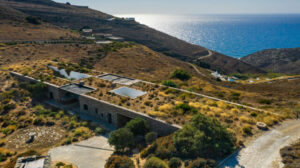
The route to Antiparos’s new… settlements is unlike any other. Narrow dirt roads winding through steep slopes lead to secluded areas. Our car almost gave out on us—a small victory for local geography over urban naivety. It took on-the-spot improvisation, prayers, repeated reversals, and alternate paths to get to the area, proving that access isn’t just limited—it’s nearly impossible.
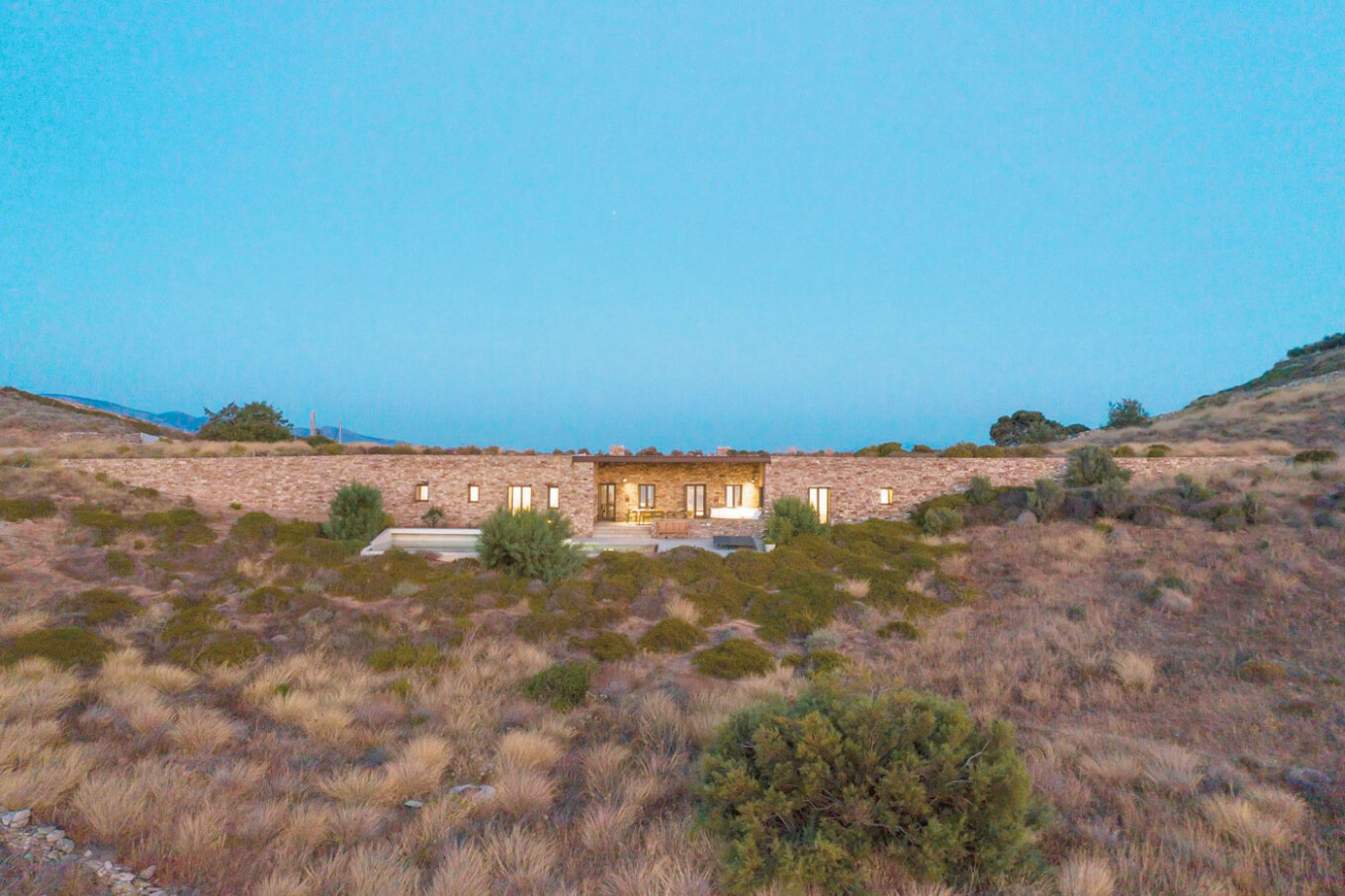
It’s all part of the “package” that comes with luxury and seclusion in an Antiparos that’s changing face, often uncharted. In spots where there was no electricity just a few years ago, underground houses of striking design are now literally sprouting from the earth. These are villas spanning hundreds of square meters that are invisible from afar. Rather than dominating the landscape, they melt into it. Their rooftops are covered in natural vegetation, their walls match the color of stone, and their pools reflect the sky like lakes in a cave.
Isolation Palaces
The architectural lines lean more towards futuristic concepts than traditional Cycladic structures. Their common trait? Seclusion. The owners—mostly affluent foreigners—choose to remain unseen. They visit the island a few times a year, arriving by helicopter or speedboat and heading straight to their homes.
They keep a low profile and do not engage with island life. Their Range Rovers stay parked in underground or open-air garages, and the residences serve as sanctuaries of privacy. The emergence of these underground structures signals a new era for Antiparos.
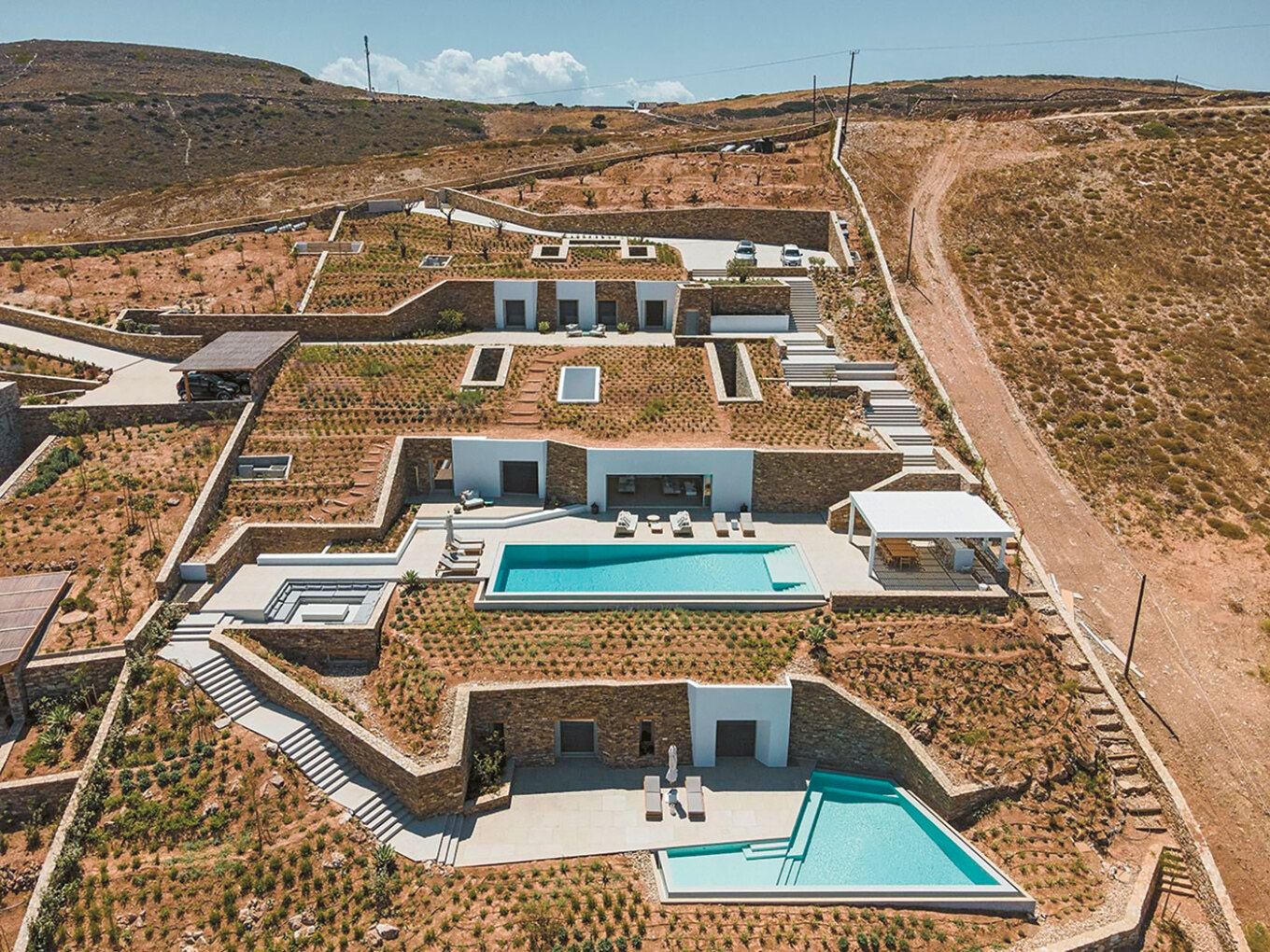
The areas where these residences are built are often off the grid, literally uncharted by public authorities, with poor or nonexistent road access, making construction monitoring a complicated affair.
The Powerful Developer
The construction wave, according to local residents and professionals, began thanks to one man: the most powerful developer operating on the island in the past two decades. We reached out to him for this report, but he declined to comment. Since the early 2000s, this businessman is said to have been buying plots from locals in remote areas at prices reasonable for the time, developing them with modern architecture, and selling them to foreign buyers at high returns.
He ensured his constructions were technically flawless, with an emphasis on quality, detail, and full integration into the landscape. His activity is seen by many as a catalyst for the overall shift in the island’s identity.
The “Loophole”
Until a few years ago, underground structures were closely tied to traditional architecture in Santorini. There, natural need for shelter from the elements and the volcanic terrain led to carved homes nestled in the slopes. These dwellings arose organically and respectfully from the landscape.
Today, however, the term “underground” is used with a completely different mindset and purpose. In Antiparos and other Cycladic islands, underground homes are no longer designed to blend with the environment—but to bypass legal building restrictions, using the 2012 New Building Code (Law 4067/12) as a green light.
Architects familiar with the Cyclades stress that instead of limiting visual pollution, the measure has become a loophole for erecting massive villas. Often, land with steep slopes over 30% is selected, allowing owners to justify underground construction and effectively double their buildable area. Excavations are often extensive and irreversible, fundamentally altering the natural topography.
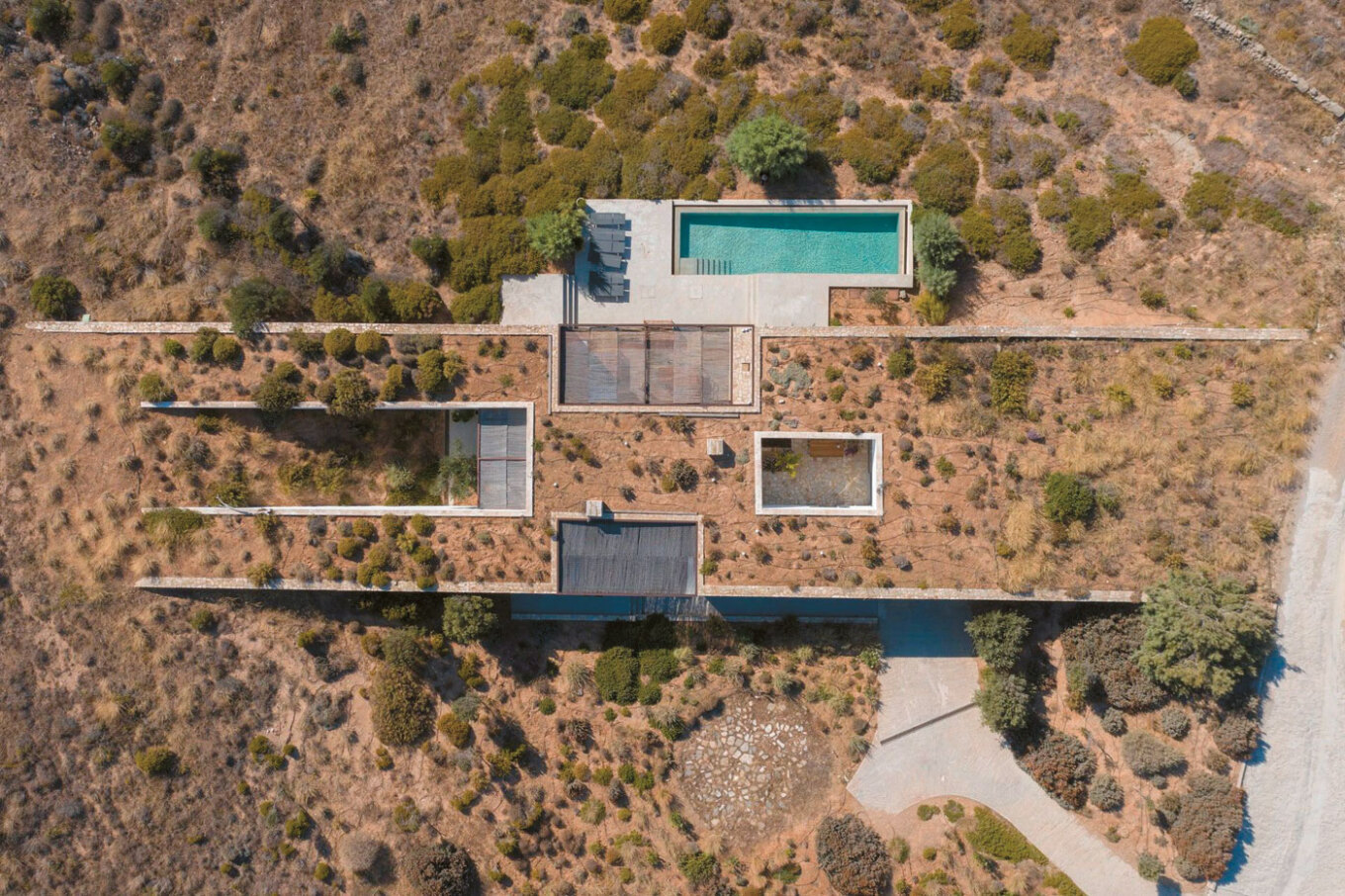
An experienced engineer working on projects in Paros and Antiparos points out that the primary goal of most owners is to push—and sometimes exceed—urban planning limits. As he explains, underground construction allows them to build homes far larger than the legally allowed square footage. Some examples include villas over 400 or even 500 square meters on plots that would legally permit only half that size.
Another architect experienced in high-end property deals confirms that the value of plots has soared because of this “hidden” overbuilding potential. In the name of ecology, legislation offers perks that lead to aggressive construction. What began as an innovation has, according to most professionals, become a key factor in the distortion of the Cycladic landscape.
Tom Hanks and Obama
The arrival of Tom Hanks and the publicity around his connection to Antiparos cemented this transformation. The island now draws celebrities every year, like in June 2023 when former U.S. President Barack Obama and his family stayed at the Hollywood actor’s home for four days. Even one of the world’s richest men, billionaire Jeff Bezos, stopped in Antiparos in July 2021 during a cruise around the Greek islands on his mammoth yacht.

Thus, Antiparos has gradually shifted from a low-profile tourist destination to a playground for the wealthy, with multimillion-euro investments and properties not intended for the general market. Nowadays, as locals say—half-jokingly, half-seriously—“you can’t even buy a stone unless you’ve got seven figures in your bank account.” Land demand has skyrocketed, plot prices have multiplied, and the island’s image is constantly changing.
But the concern isn’t just financial. A broader question arises: what kind of tourism model is Antiparos adopting? Underground luxury, however impressive, brings a certain degree of isolation. A closed-door lifestyle, with no interaction with the local community. Growth isn’t the problem, say experts—growth without planning and respect is. The challenge is whether the island can preserve its authentic character while balancing the lure of investment with the need to remain accessible and vibrant for all.
€12,800 per square meter
Antiparos seems to be cementing its reputation as a hotspot for high-income buyers, with property prices skyrocketing in recent years. For example, in the Kambos area, a 117 sq.m. house with two bedrooms and basic amenities is on the market for €1.5 million, reflecting the general trend of land appreciation on the island.
That puts the price per square meter at €12,800—a figure normally reserved for beachfront luxury properties of the highest standards. The house lies less than a kilometer from the sea and qualifies for the Golden Visa program, making it especially appealing to non-EU buyers, which further boosts its market value.
Just outside the town (Chora), another villa is for sale: 583 sq.m. on a privately owned 4,590 sq.m. plot, priced at €6.7 million. It features bioclimatic design and energy efficiency, with a price per square meter of €11,500. While it checks all the boxes of modern architecture and luxury living, the price proves a wider trend: in today’s Antiparos, a property’s value hinges less on its technical features and more on its location, buyer profile, and the scarce availability of land.
Rising demand, especially from foreign buyers, is reshaping a market that’s increasingly diverging from other Aegean islands, forming a financial reality that excludes many traditional buyers.
This is also evident in listings by Greek properties on international real estate platforms. In one agency, Antiparos, with 24 available properties, surpasses Mykonos, which has 23. Leading the list are Kea with 48 and Paros with 35. As for ever-popular Santorini, it lists just 7 properties—half of what’s available on up-and-coming Kythnos, which has 14. Another agency shows 28 listings for Antiparos, 37 for Mykonos, 5 for Santorini, and over 100 for Paros. Among them is “Evolution 2,” an underground villa of 480 sq.m. on a 5,000 sq.m. plot with a 95 sq.m. pool, offered by Engel & Völkers for €3.5 million (€7,292 per sq.m.).
Back in Antiparos, even smaller vacation homes of 75–80 sq.m. are being sold at €6,900–8,500 per sq.m.
Examples abound. Like a circular single-family home of 807 sq.m. on a 9,620 sq.m. plot, marketed by Barnes at €7.5 million, or Villa Consha, under construction in the Soros area, expected to be completed before summer 2026. Designed by VOIS Architects, it will feature 585 sq.m. of space on an 8.8-hectare plot and is offered by Sotheby’s International Realty for €4.95 million. Also from Sotheby’s: Villa Calma, 300 sq.m. in the Agios Georgios area, completed in 2024 and selling for €3 million (€10,000 per sq.m.).
Building Frenzy
Construction activity in the Cyclades shows major variations, with Paros and Antiparos seeing intense growth, while Mykonos is showing signs of saturation and decline. According to the most recent data, Paros ranks third nationwide for the number of new building permits issued in 2024. A total of 349 new permits were granted, 37 of which were for additions to existing buildings.
The total approved buildable area reached 95,903 sq.m., confirming the construction frenzy gripping the island. In comparison, Antiparos issued 80 new permits in the same year, with total buildable area hitting 25,010 sq.m. These figures—especially for Antiparos—are considered high, given its size and limited spatial capacity.
Ask me anything
Explore related questions




