





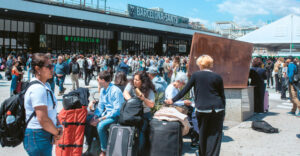
The enigma of the Iberian blackout resists every attempt at resolution, as all theories so far about what happened on April 28 have been challenged as insufficient—or even debunked one by one. While awaiting a final report from the competent authorities in Spain, the attribution of blame to factors such as abrupt atmospheric changes or overload of the grid due to the increased share of Renewable Energy Sources, among many other hypotheses, follows a meteor-like trajectory: they appear, briefly capture global public attention, and then vanish into the background after being refuted by some expert presenting documented or at least plausible objections.
However, this does not apply to the possibility of a cyberattack, which Spanish judicial authorities are reportedly still thoroughly investigating—even several days after the incident last Monday, when for about 16 hours the electricity grid across the Iberian Peninsula was in a state of shock and total paralysis.
This indirectly confirms the sense that today’s energy networks are excessively complex, even for their own operators—hence their inability to precisely determine why they sometimes collapse, and on a scale that transforms the daily lives of tens of millions into a vast, chaotic nightmare. This impression is reinforced by the Spanish authorities’ decision not to rule out the scenario of a cyberattack—i.e., a hacking of the control system through a remote, malicious, and highly targeted digital interference.
What would happen in Greece?
Also, almost as a reflex, a question arises for Greece—something like: “If the worst blackout in modern Spanish history remains unexplained, even though Spain is a frontrunner in modern Renewable Energy Sources, then could the corresponding threat for Greece be even greater?” On this matter, the opinion shared with “To Vima” by Professor Stavros Papathanasiou, of the Electric Power Division at the National Technical University of Athens, School of Electrical and Computer Engineering, is especially interesting.
Specifically, Professor Papathanasiou believes that: “I wouldn’t necessarily say that Greece is more vulnerable than Spain. It’s true that the penetration of RES (Renewable Energy Sources) in Spain and Portugal began earlier than in our country. However, I can say that Greece has now surpassed Spain in RES. We are far ahead—with all the benefits but also the risks that this entails. I don’t see any reason to be alarmed. We are not more exposed than the Spaniards or the Portuguese to blackouts. Such incidents have occurred everywhere: in Italy, Switzerland, France, the USA—as well as in our own system. We remember, for example, the major blackout just before the 2004 Olympic Games, which happened at a very bad time for the country’s reputation.”
Regarding any common characteristics, Professor Papathanasiou points out that “we share, I would say, a rather ominous similarity with Spain. The Iberian system is connected to the European grid via interconnection lines with France. These connections are relatively limited in capacity compared to the size of the system. During the April 28 event, these lines were disconnected, thereby becoming part of the problem that led to the system’s collapse.”
“Iberia is relatively isolated, much like Greece. Both are countries on the periphery of Europe, with limited connection capacity to the North and West. This creates vulnerability and is one of the key concerns for European grid operators—to increase cross-border interconnections, both to enhance system security and to support the integration of the European energy market.”
“Dinosaur” Networks
More broadly, Professor Papathanasiou observes that “electrical systems are living organisms—they are highly complex and inherently vulnerable. Furthermore, the transformation of both production and demand is occurring at a very fast pace, while the speed at which we understand these developments is limited. Power grids are like ‘dinosaurs’—they have high inertia and are systems that evolved over 100–150 years. And now we are witnessing a transformation that’s happening in just a few years. For example, in five years, the share of RES in the Greek system has doubled.”
“The nature and characteristics of the networks are changing rapidly, as conventional generation units are being replaced quickly by RES, mainly wind and solar. These units have a fundamental difference: grid operators were traditionally trained to manage networks built around a small number of large power plants—maybe just a few dozen. Today, however, we have tens of thousands of small units, which requires completely different approaches to manage the grid effectively. The nature of demand is also changing, for instance, with the spread of electric vehicles. As a result, the complexity of supervision and control increases significantly. There are solutions, and technology is advancing in this area, but the pace of change is often so fast that we must not only try to keep up—but also anticipate the challenges and risks that emerge from this rapid evolution.”
Professor Papathanasiou concludes: “Blackouts happen even in the best of families, as the saying goes. The causes can stem from many and varied factors—ranging from the technical characteristics of each network, to climate change or even cyberattacks. But I would by no means say that Greece is unprotected. Of course, the probability of something extreme happening might be low, but it is never zero. There is no system completely immune to collapse. We are always talking about reducing probabilities. You always do your best to be ready for the worst.”
From the side of Greece’s primary grid operator, ADMIE (Independent Power Transmission Operator), the possibility of a blackout similar to that of the Iberian Peninsula is met with composure.
ADMIE Vice President Yiannis Margaris states: “Greece has nothing to do with what happened in Spain and Portugal. Nor was our country affected in any way. What happened in Iberia stopped at the French border, which managed to isolate the issue. However, we always remain alert, especially during periods of low consumption—like spring—when we often have much more production than we need due to RES.”
“At ADMIE, we ensure this extremely sensitive balance between generation and consumption is maintained down to the fraction of a second. This includes, among other things, directly notifying producers to disconnect their units from the system whenever deemed necessary. So, there is no reason for concern.”
In the case of the Iberian blackout, the term “cyberattack” immediately suggests the involvement of a state entity. However, what characterizes the murky landscape surrounding the investigation of the incident is the distinction being drawn between a cyberattack and digital sabotage. Efrén Varón, a Spanish expert in cybercrime and cybersecurity, argues that “a terrorist act is much more likely to be the cause of the blackout than a cyberattack—as is a technical failure in the system unrelated to human intervention.”
Mr. Varón further explains that “you can’t just flip a switch and cut off electricity to all of Europe. That’s not possible because power grids are interconnected—both within each country and on an international level. The same goes for their protection systems. In Spain, for example, we have what are called ‘honeypots’—fake electricity generation units that are deliberately advertised as critical infrastructure. They exist precisely to monitor criminal activity—how each would-be intruder tries to infiltrate in order to cause damage.”
Thus, Mr. Varón concludes: “I do smell a digital attack, but it’s almost impossible to shut off power in so many countries, on such a wide scale, simultaneously. The only ones who could have the necessary information to do something like that are those with access to the data of the CNTIC (National Center for Critical Infrastructure of Spain, a body under the Ministry of the Interior and part of the country’s national security apparatus). Therefore, if we rule out a cyberattack, what remains is the scenario of a terrorist strike by ‘hacktivists’—anti-system anarchists, radical opponents of globalization, climate change activists, etc.”
Israel, Russia…or Kim?
While the official resolution to the blackout mystery is still pending, and the possibility of a cyberattack by an unidentified hostile force lingers in the air, the field of public discourse around the Iberian mega blackout remains unguarded against conspiracy theories.
The conspiracy frenzy surrounding “El Cero” (“The Zero,” as the unprecedented blackout of the previous Monday was dubbed) reached such heights that Spanish Prime Minister Pedro Sánchez felt compelled to urge his fellow citizens not to believe or spread everything they see on social media—such as the notion that the prolonged outage was retaliation and a show of force by Israel. Allegedly, this was because Spain had canceled a deal worth around €7.5 million to purchase munitions from Israeli manufacturers just days before the blackout.
Alternative theories about who was behind the alleged digital sabotage—besides Israel—arbitrarily targeted North Korea, Morocco (despite the fact that the country rushed to assist Spain), and others. Of course, Russia stood out as a usual suspect in such cases. In fact, amid the chaos and confusion, rumors spread that Ursula von der Leyen herself had explicitly blamed Russian “hacktivists.”
However, there was no such attack by the President of the European Commission against Russia. That was yet another piece of fake news surrounding the power outage in Spain and Portugal. Moreover, European Commission Vice President Teresa Ribera stated to the media that “there is no indication that the blackout was the result of a deliberate, premeditated act.”
Nonetheless, Russia’s recent history is particularly incriminating. On one hand, Russian hackers possess the expertise to cause power grid disruptions of such scale and severity—as demonstrated by attacks on Ukraine in 2015 and 2016.
Spain’s official cyberdefense body, the INCIBE institute, is reportedly aware that the BlackEnergy malware used by the Russians to paralyze power plants in Ukraine’s Ivano-Frankivsk region had also been detected in attempted attacks on Spanish facilities. In general, Spain is considered a target country for cyberterrorists, with hacker attacks reaching around 110,000 incidents per year.
Political Electricity
Naturally, any cyber-terrorist—especially one who has managed to plunge at least two countries the size of Spain and Portugal into chaos—would claim responsibility for the attack. But that hasn’t happened in the case of “El Cero,” at least not officially or so far. Among the more realistic and relatively grounded theories explaining the blackout, the opposition in Spain, from the early hours of the crisis, has relentlessly attacked the Sánchez government.
They have accused it not only of incompetence but also of malice, of attempting to cover up a scandal, and so on. Amid heightened tensions, the government’s energy policy has been criticized for blindly and unilaterally promoting Renewable Energy Sources at the expense of nuclear power generation, which, according to the opposition, is much more cost-effective and reliable—a view that finds many supporters in today’s Spain.
In any case, the blackout is being exploited as a prime opportunity and a powerful weapon in the context of intense political confrontation. The darkness of April 28 may have already dealt a fatal blow to the fragile party coalition governing Spain under Socialist leader Sánchez. In trying to refute the accusations and defend his resolutely green energy policy, Sánchez raised a key point: the speed at which the power outage was restored.
The 5 Seconds of Destruction
Certainly, in recent years, there has been ongoing and persistent debate among Spain’s political factions regarding the country’s future energy mix. Still, Sánchez’s argument isn’t baseless. At the very least, on Monday, the blackout resulted from the sudden and unexpected loss of 15 gigawatts—almost 60% of the electricity load—from the grid for five seconds, and the drop in transmission frequency below the internationally accepted threshold of 50 Hz (Hertz, or cycles per second).
Although five seconds of abnormal electricity flow through transmission lines may seem brief, it was more than enough to trigger a chain reaction of self-protection by the power grid. To oversimplify, breakers tripped across the entire Iberian Peninsula—plus part of France—as the Spanish grid was automatically disconnected from the European network. However, the combined output of Spain’s five nuclear power plants is 7.4 GW, meaning they could only have replaced about half of the lost energy.
The Green Gamble
The financial damage to Spain from the prolonged blackout is estimated at €1.6 billion. At the same time, however, the debate over the pace of integrating Renewable Energy Sources into the existing power grid, the speed of decarbonization, and the overall momentum of the shift toward a green energy economy has reignited—not only within Spanish society but in the broader public sphere.
At the moment of the grid’s collapse on Monday, April 28, in terms of clean energy share, Spain was being powered 60.64% by photovoltaics and 12% by wind farms. Another 11.6% came from nuclear energy. According to one version of events, the domino effect of the breakdown began with some kind of short circuit—possibly an overload at two photovoltaic facilities in the southwestern part of the Iberian Peninsula.
However, Beatriz Corredor, president of REE (Spain’s electricity grid operator), made every effort to shut down any discussion linking the blackout to the national green energy policy. In her view, it was pure coincidence that renewables were contributing over 70% of the grid’s energy when the relay tripped—and the entire Iberian Peninsula was plunged into total darkness.
Corredor, by definition and quite predictably, finds herself at the center of the storm—for various reasons. Some media accuse her of a profound lack of energy-sector expertise, of being merely a pawn of Sánchez—she has served as a Socialist official and minister—and of earning half a million euros a year to parrot the government’s narrative.
Even so, Corredor’s passion in defending green energy may not be enough to fend off the fierce criticism that Spain rushed too quickly to set a target of producing 81% of its electricity from renewables by 2030, having already reached 58.95%.
No Batteries
However, because renewables are connected to the grid in a completely different way from conventional power plants—with much lower adaptability and control capabilities during sudden grid disturbances—green methods carry a heightened risk of causing overloads, failures, and thus, power outages.
At the same time, the grid itself lacks resilience reinforcement, since investments are directed primarily toward renewable energy sources rather than the proper adaptation of transmission lines, control systems, etc. Critically, there is also a shortage of sufficient storage systems (battery parks), which could play a crucial role in temporarily storing excess energy, significantly reducing the risk of overloads and blackouts.
The counterargument to all the above is not operational or technical—but economic. Spain has risen to the top among European countries as the most environmentally friendly electricity producer—and, naturally, the most competitive, thanks to exceptionally low wholesale electricity prices.
Therefore, even under the pressure of a nightmarish blackout, it is rather unlikely that Spain will reverse its energy policy or slow down its decarbonization process.
Ask me anything
Explore related questions




