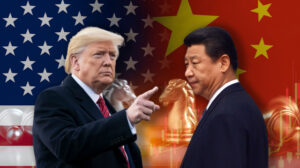
Donald Trump Donald Trump hinted on Friday that he may soon reduce the high tariffs it has imposed on China, currently hovering at 145%, although this does not imply that the two countries are any closer to a comprehensive trade deal.
Trump’s alleged intention to ease tariffs on China, limiting them to 80%, coincides with US Treasury Secretary Scott Bessend‘s upcoming meeting with Chinese officials in Geneva this weekend. However, such a retreat or other similar moves are not expected to immediately revive bilateral trade, as imports of Chinese goods into western US ports continue to collapse. Analysts say Chinese Vice Premier He Leifeng, who is leading the talks from Beijing’s side, is not expected to offer any major concessions. According to Politico, estimates are converging that China will not rush to reach a deal as it seeks to understand the Trump administration’s ultimate goals and protect its own interests.
“He will probably be mostly in a listening phase and will take the information he gathers to President Xi,” said Christopher Adams, former senior coordinator for Chinese affairs at the US Treasury Department. “I assume they’ve looked at various strategic options, but I don’t think he has the authority to make decisions at the negotiating table.”
While some Trump allies acknowledge that the tariff reduction proposals are more symbolic in nature, they see them as an important first step toward achieving a broader de-escalation in the trade war between the world’s two largest economies.
“It’s not so much about the practical effect as it is about the sign of progress,” said a person with knowledge of the negotiations quoted by Politico. “Markets may react positively to the slightest sign of progress in trade relations with China.”
The concern of markets and businesses
However, business leaders, MPs and economists are already warning that even if there is some progress this weekend, it will not be fast enough to prevent serious economic repercussions. “A 65% tariff cut may sound generous, but in reality it remains a wall, not a gateway,” commented a former Trump administration official, who also requested anonymity.
Bilateral trade between the US and China totaled $582.4 billion in 2024, of which $439.9 billion was Chinese exports to the US, according to the US Trade Representative’s office. Trump’s tariffs have virtually stopped shipments of Chinese goods to US ports in recent weeks, prompting companies trading toys, household goods, tools and clothing to increase prices, exacerbating problems for US manufacturers.
At the same time, import volumes at western U.S. ports have declined, limiting the export potential of U.S. companies. Small businesses are worried about the possibility of closure, while major retail chains warn that if the tariffs remain, consumers could face product shortages by late summer.
Forecasts for price rises
Even if the tariffs are reduced, many businesses have already been hit, as they are currently stocking up on supplies for back-to-school sales in late summer,which is being delayed due to uncertainty about future orders. Economists are predicting price increases by June or early July, as stocks that businesses had built up before the tariffs were imposed begin to run out.
This weekend’s meeting is expected to be just the beginning of a long negotiating process that could take months or even years to reach a final outcome.
“Trump is convinced that the Chinese need us more than we need them. And I think the Chinese are equally convinced that we need them more than they need us,” said William Raids, a former senior U.S. trade official and senior adviser at the Center for Strategic and International Studies. “This is not a view that leads to a quick resolution.”
That makes this weekend’s meeting more of an exchange of positions that could lead to more focused future negotiations.
“See it more as confidence-building measures taken early on in a difficult negotiation to signal, diplomatically and politically, that there will be mutual concessions and that there can be real negotiation,” said Emily Kilchrist, a former deputy assistant to the U.S. trade representative at the end of Trump’s first term and the beginning of former President Joe Biden’s tenure.
Beijing appears determined to withstand Donald Trump’s tariffs pressure, believing it can better manage an economic slowdown than the US, where consumers are already facing high inflation after the Covid-19 pandemic and consumer confidence has fallen dramatically in recent months.
At the same time, Beijing has hinted that it is interested in a deal that could offer some relief, offering earlier this week exemptions from high retaliatory tariffs on key US imports such as microchips, pharmaceuticals and aircraft engines, while maintaining tough rhetoric.
For its part, the White House is seeking to highlight any signs of progress in the talks as part of its broader effort to reassure consumers and stabilize volatile financial markets, which have been affected by the US president’s tough trade policy and multiple new tariffs.
Trump told reporters on Friday: “I think we’re going to come to a fair deal for both sides, for China and for us.” However, he added that he would not be disappointed if Besent returns without a deal.
Ask me anything
Explore related questions