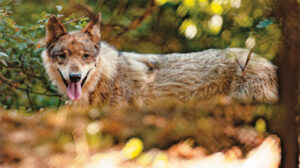
In the tale of Little Red Riding Hood in the Dark Forest, the conclusion of “and they lived happily ever after” comes only with the elimination of the Big Bad Wolf. In the real story, starring the red deer in the Parnitha forest, the wolf finds himself accused and in danger of being… arrested by order of the prosecutor. But is he the villain of the story? But… will everyone live happily ever after after the “capture” of the wolves in the area?
“We will open the Aeolus box if we remove the wolves from Parnitha,” say scientists, who “predict” a nightmare future: the wolves of Parnitha are being moved to northern Greece, where they are being exterminated by the “local” packs as “invaders”. In the national park, in the absence of the wolf, wild boars breed uncontrollably, “taking over” residential areas and attacking people, while the deer, whose population is growing, “break” the regeneration of the forest, which, after a fire, turns into a cranium. Meanwhile, wolves from neighboring areas “sniff” the void and “move” to Parnitha, mating with stray dogs. The resulting hybrid lacks the wolf’s natural fear of humans, so it approaches residential areas and starts attacking people. The nightmare has only just begun…
The Counterpoint
So are scientists and people from environmental organisations like Callisto (which is involved in European projects for Parnitha and its wolves) a bunch of… “crazy environmentalists who leave wild animals in our forests”, as the old folk myth goes? And why are they so opposed to the transfer of the 50 or so wolves of Parnitha? As explained to”THEMA,” the general coordinator of the “Callisto” organization, Spyros Psaroudas, “the wolf is a top predator and, as such, controls populations of mainly herbivorous ungulates, such as wild boar, deer, and elk. It is therefore valuable to ecosystems and cannot simply be removed. Because, if removed, the damage to the ecosystem is incalculable.
In Parnitha, we already have evidence that the recovery of the wolf population has helped the regeneration of the forest.” In the lush mountain next to the bustling Greek capital, Psaroudas says, much the same thing is happening in Yellowstone, the US national park that has become a global scientific example of how a wolf pack can lead to a triumph of life in an ecosystem.
So in 1995, at Geloustown – which is located in Montana, USA, covers an area of about 9,000 square kilometres and is the world’s first national park – scientists released 31 grey wolves they had captured in Alaska. The species had been extinct from the area since 1900 due to hunting and, after decades of research, scientists began to understand the beneficial and important role wolves play in the ecosystem as the top predator, realizing that their absence may be leading to collapse or dramatic changes in the entire ecosystem. What followed the release of the wolf pack was astonishing.
Before the wolves were reintroduced into the ecosystem, the deer population skyrocketed because coyotes, as the top carnivores there, were unable to kill large deer. The deer were eating the poplars and all available green vegetation. Without the support of riparian plants, the river banks eroded and led to shallower and wider rivers. As wolves entered Yellowstone, they began to hunt buffalo and especially deer. These, in turn, began to avoid areas where they would be easy prey. Their absence from these areas led to the growth of vegetation, with shrubs and trees such as poplar and willow. The fruit from these plants and the plants themselves attracted insects, which, in turn, attracted a range of birds, such as mallards and woodpeckers.
Very quickly ,the area also saw the return of birds of prey, which had originally been attracted to the remains of the carcasses of the wolf hunt. The raptors were then able to feed on other species that had returned to the area, such as wild birds and mammals.
Beavers also returned to the area, due to the growth of trees and the presence of timber, and their population more than doubled. Beavers are used to building dams in rivers using timber, which dams attract otters, water rodents and various reptiles. Not only the beavers’ dams, but mainly the vegetation, eliminated erosion on the banks of the rivers, which now became narrower and deeper. Not only did the geography of the park change, but it also favored the proliferation of the 13 species of fish found there.
Experts realized that in the absence of predators, deer were congregating in huge herds on the lush riverbanks to feed, their massive hooves causing erosion of the banks and preventing beavers from building dams to live in. Without the protection of dams, fish, amphibians and otters suffered even more.
At the same time, as the wolf pack – as a competing species, regulated the coyote population, killing large numbers of coyotes, Yellowstone saw an increase in rabbits and mice, which attracted red foxes, ferrets, badgers and hawks to the park. From the first day of the wolves’ reintroduction to the park, grizzly bears began feeding on the carcasses left behind by the pack and staying away from populated areas, since they could now easily feed in the wild. The absence of large numbers of deer led to taller trees (up to five times larger were grown within six years of the wolves’ return) and more berries – the bears’ favorite food.
Scientists quickly realized that with the disappearance of the main predator of moose, their numbers more than doubled, leading to overgrazing (grasses, shrubs, trees), disrupting the natural balance of the ecosystem. Mammals such as mice and rabbits could not use plants to hide from predators and their populations declined dramatically. Grizzly bears suffered as deer devoured their berry stores, which they urgently needed to build fat before hibernating. Pollinators, such as bees and hummingbirds, had fewer flowers to feed on, and songbirds had fewer and lower trees to build their nests.
Today, the park’s wolves have multiplied to 100, while the number of deer has dropped from 17,000 in 1995 to about 4,000. Also multiplied are the – happy – people because of the wolves in Yellowstone. The authority that manages the park estimates that more than 100,000 people visit each year just to see the “famous” wolves that surprised scientists, and also to spend some time in the beautiful – albeit beautiful – national park. The local economy (population roughly the same as the wolf visitors) benefited with $30 million per year (due to these visitors) which helped raise the quality of life. Contributing to this was the fact that Montana residents are now drinking cleaner water.
Go away, go elsewhere
Could something similar to this amazing story of triumph of life brought to Laughstone by the wolf pack happen in Parnitha? “Yes,” say the scientists. The “detail”, however, is that it is very likely that something similar to … Parnitha will happen in the huge American park. There are dozens of petitions calling for the wolves to be removed from the park in Yellowstone, as it is feared that they will drive the area’s deer to total extinction. Which has led the District Attorney’s office and Athens to request the removal of the wolves.
The bitter truth is that if the situation is left “as it is”, without any intervention, we are faced with the danger of the deer disappearing from Parnitha. The fires in the Parnitha fir forest in 2007-2008, although they caused casualties to the deer, benefited their population in the long run, as they created openings in the forest, small meadows, which are the type of habitat that the deer prefers. The problem, as the Callisto people explain to “THEME”, is that in forest regeneration, the deer eat the sprouts, stopping them.
When the deer population reached the maximum carrying capacity of Parnitha (about 1,300), the wolf appeared, following wild boars and because of the presence of deer, in a natural way (it goes where the prey goes). Due to familiarity with humans and the absence of a predator, the Parnitha deer became easy prey for the wolf, which is an opportunistic hunter. Somehow, according to the OFYPEKA data, the population dropped from 1,300 to 150 to 200. Callisto scientists, using the latest technology, using telemetry and fecal analyses, found the “culprit”. They found that the wolves of Parnitha are 65-70% fed on deer.
“The number of deer has dropped dramatically, but it is good today,” Psaroudas tells “THEMA”. “This, of course, is not to say that the red deer of Parnitha are not at risk. This is because it is an isolated population, introduced by Otto. If it gets too small this population becomes vulnerable. To fire – something very common in Mediterranean ecosystems – zoonoses or even to a predator that has alternatives. So what needs to be done to prevent deer from becoming extinct?
“On the one hand,” says the general coordinator of Callisto, “the prosecutor is right to say that there is an issue. But the man is a lawyer and he is giving a legal solution. There are ways to manage. There must be management in natural ways such as watering and feeding, with techniques and methods to strengthen the population. Study the relationship to manage the wolf population.
Moving them is not an acceptable method. Nor, of course, is killing the wolves. Therefore, another type of intervention is needed. Other methods. We have been submitting proposals to both the
FWS and the Forest Service since March 2024. In order to find a solution, scientists and stakeholders need to consider the available ones. We have the Nature 2000 Commission and not only scientists, but also animal lovers and hunters can participate in the consultation. If necessary, let experts from abroad come in to advise us.”
Plan in place
K. Psaroudas explains to”THEMA” that it is probably impossible to implement the plan to capture and transport to northern Greece the approximately 50 wolves living in Parnitha. “We will not have a problem with wolf attacks on humans, given that it is an animal that fears humans and avoids them. In the last 40 years, throughout the northern hemisphere, we have had two human deaths by wolves. But we will have a problem if we eliminate the wolf, with wild boars already entering residential areas and with forest regeneration in the event of fire. In such a case, we may not have another chance. Moreover, let’s not forget that just last week we had a wild boar death (from a traffic accident), and with the presence of wolves acting competitively, the number of stray packs in Parnitha has also decreased. Which means that the chances of canine attacks on humans have decreased (we had 660 dog attacks in six months)”.
Apart from that, experts explain that it will be a very difficult and very costly operation to… capture and remove the wolves. Always with the risk that not all members of the pack will be captured, or replaced by others, immediately after their removal. In short, it seems to be easier and more economical to organize an operation to capture… Paleokostas, than the wolves of Parnitha.
The case of “Sophocles” is typical to prove the above. “Sophocles”, a common wolf (canis lupus, like all wolves of Parnitha) aged about 2 years and weighing 28 years, got his name from the fact that he was moving around the tomb of Sophocles in Parnitha and was declared… wanted last year, when he was trapped in the Greek Police compound in Amygdaleza. The wolf had taken refuge there in search of a place to shelter from stray dogs and other wolves. The Police informed the Forestry Service about the “capture” of Sophocles and subsequently, “Callisto” was notified, which with the “LIFE Wild Wolf” project’s immediate intervention team for the wolf went to the spot under the guidance of the organization’s partner Dr. George Iliopoulos.
Trap
On 27 January the operation to “capture” the wolf began, which was supported by ELAS throughout its duration and was completed in the morning hours of 8 February. It was then that “Sophocles” fell into one of the special traps that had been set and which were monitored on a 24-hour basis by OFYPEKA officials. In the trap, the wolf was drugged and a special radio-tracking transmitter – GPS – was placed on it. He was then released in a forest area of Parnitha and today he has been located at the foot of Parnassos.
It is a question then, if it took so many days and needed so much organization and coordination by the ELAS to capture one – and even a young – wolf, what will it take and what will it cost to capture fifty! Furthermore, another question is where they will be taken. “No society will accept to release wolves in their area, whether they already exist or not”, says the person in charge of “Callisto”. “Not only will the people who react, but the other wolf packs will also eliminate the intruders from their territory. This will fail miserably, even for Parnitha, where neighbouring packs – from neighbouring areas where they exist – will rush to fill the gap as soon as they find (and they will find out immediately) that the spatial state has changed. Temporarily, therefore, we will have a population increase in Parnitha due to competition from newly arrived wolves. Then, when the numbers are reduced, the remaining wolves will not see stray dogs, which they currently kill – as competition and will mate with them, producing fertile offspring. These hybrids are likely to lack the wolf’s natural fear of humans, so we will be talking about a species that is dangerous to humans.”
10 fun facts about wolves
1/Intelligence of an 8-year-old child
Wolves are very intelligent and can solve problems and learn from experience. Studies have shown that their ability to cooperate and understand hunting strategies requires a high level of intelligence. If we try to consider their IQ based on the intelligence of other animals, we could say that wolves possess a level of intelligence that is close to that of great apes or other social predators such as dolphins. Some researchers estimate that their intelligence is at about the level of a 7-8 year old child in terms of problem solving, cooperation and memory.
2/ 16 kilometers away you can hear their howling
If you are in the woods and hear wolf howls, don’t get upset. They may be too far away. Their most famous communication tool, the howl, can be heard from up to 16 kilometres away, especially in open areas. The howl is not only for communication, but also for “declaring territory”. With a howl, wolves can warn other packs to stay away, thus protecting their territory.
3/ Wolves have unique “vocal fingerprints”
Each wolf has a howl with a distinct “signature”, which allows pack members to identify it from a distance.
4/ The pack functions as a family
Wolves live in packs with a hierarchy, where the “alpha” male and female lead, but most wolves in the pack are related – i.e. family with blood ties.
5/ They only love once
The dominant pair (“alpha” male and female) usually stay together for life and breed exclusively with each other.
6/ They can travel incredible distances
.
A wolf can walk up to 80 kilometres in one day in search of food or new habitat.
7/ Their bite is extremely strong
.
The bite force of a gray wolf reaches 400-1,200 PSI, enough to break the bones of large mammals.
8/ Their sense of smell is 100 times better than humans ‘
.
Wolves rely mainly on smell to detect food, other animals, and “signals” from urine or pheromones.
9/ Their pups are born blind and deaf
.
When they are born, wolf pups are completely dependent on their mother and take about two weeks to open their eyes.
10/ They are excellent strategic hunters
.
Wolves organise hunting raids strategically, often surrounding their prey or assigning roles (attack, repel, pursue) to each other.
Ask me anything
Explore related questions