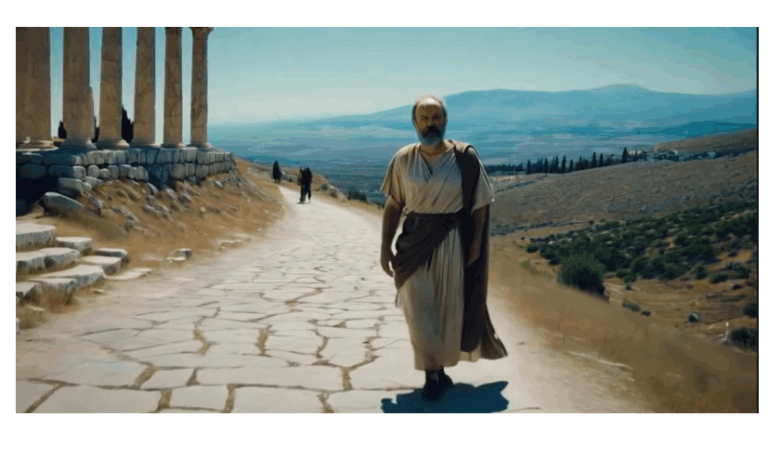
Using artificial intelligence, Apostolos Pavlos is brought to life within an educational project that, based on the texts of his letters, aims to transmit his messages to a broader audience. The project seeks to explore not only the historical period in which he lived but also address contemporary issues that resonate with timeless human questions.
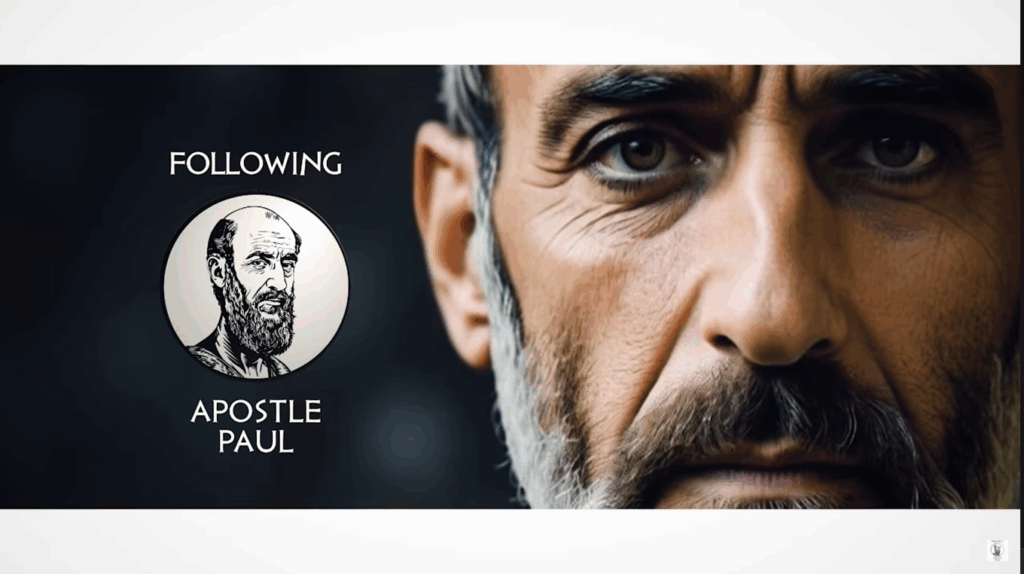
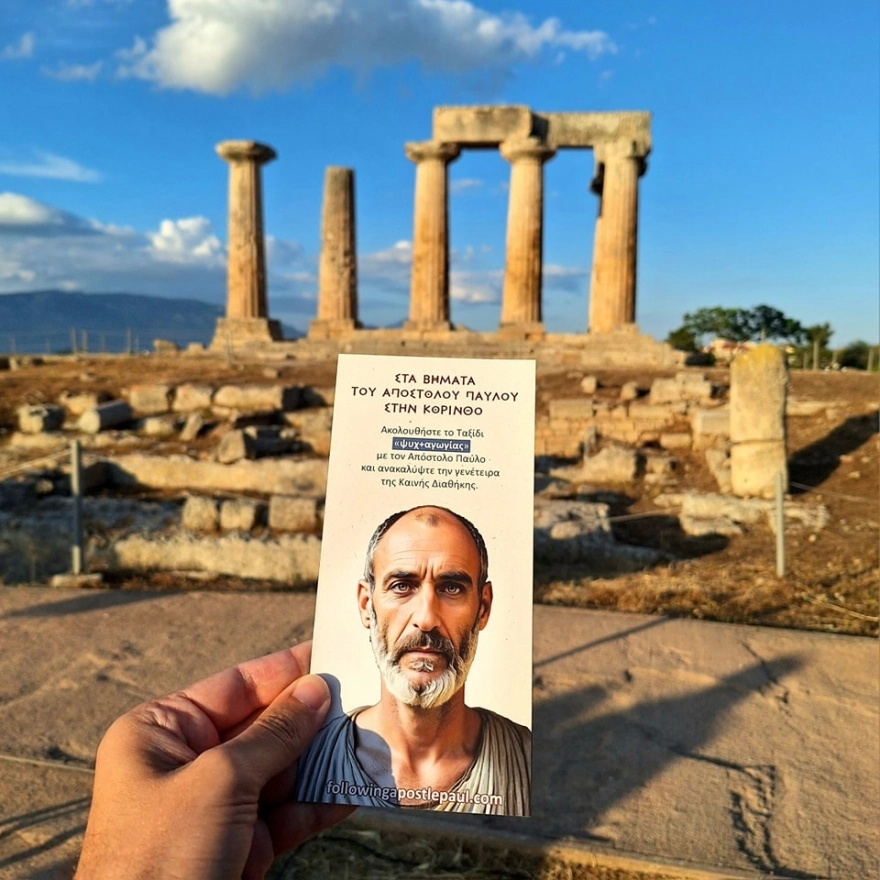
In the first publicly released video by the project called Following Apostolos Pavlos, he appears with a gray beard, brown eyes, and a wrinkled face. Dressed in a long white garment, a brown belt, and a cloak, he is initially depicted sitting on a wooden ship with fabric sails heading from Athens to ancient Corinth. There, he disembarks at the port of Kechries, interacts with passersby, converses on the stone streets, and delivers the foundational messages of Christianity.
His appearance was generated using artificial intelligence, drawing upon iconographies of Apostolos Pavlos and descriptions from ancient texts.
“The goal is to connect with the audience”
“Our aim is to enable Apostolos Pavlos to converse with people today—taking each individual by the hand and traveling together through the historical sites of Corinth, Philippi, and other key moments of his journey as they appeared in the past. At the same time, he will be able to respond to very modern, critical questions about human freedom, our bodies, mental health, and the path to genuine happiness,” explained Sotiris Despotis, professor at the Department of Social Theology and Religious Studies at the National and Kapodistrian University of Athens (NKUA), in an interview with ANA-MPA. He clarified that the project operates under his auspices and involves experts from fields such as technology, art, and social media.
Regarding the origins of the idea, Professor Despotis mentioned it stemmed about a decade ago when his previous residence in Athens was rented by Koreans. “I asked them why they came to Greece, and they told me they wanted to discuss the Bible. I wondered how it was possible for Koreans to travel to Athens to introduce Apostolos Pavlos and the New Testament, whose original texts are written in Greek… I don’t know under which organization they arrived from Seoul, but that fact truly struck me,” he recalled.
Growing Interest from Americans and Koreans
He further explained that while expensive scientific conferences are organized—and often lack a broad public impact—there has been increasing interest in recent years from Americans and Koreans, particularly regarding Apostolos Pavlos’s persona. “From my position as President of the Patriarchal Missionary Foundation of the Far East, under the Patriarchate of Constantinople, and through my work with the Korean Mission and engagement with Koreans and New Zealanders, I have observed a strong curiosity among these communities to learn about Apostolos Pavlos. We should remember that, whether we realize it or not, the foundations of Western culture and the importance of individual rights owe much to him. Apostolos Pavlos gave immense value to the human person and famously stated—still relevant today—that there is no male or female, slave or free, but that all are one,” he emphasized.
Mr. Despotis highlighted that Western culture places a high value on the individual—on every human being—especially in the postmodern era, regardless of their particularities. He expressed the view that “if Apostolos Pavlos were to visit today’s Athens, he would probably teach at Panteion University of Social and Political Sciences or at the Medical School, rather than at the Theological School.”
He specifically noted, “Christianity, as preached by Apostolos Pavlos, is not only about metaphysical ideas concerning the soul’s journey to heaven but also about shaping a political attitude towards life and understanding how one can achieve true happiness.”
“Apostolos Pavlos’s fundamental model is that our societal organization makes sense only when we invert the pyramid—when we cease to rely on domination of one over another, emulating Christ who sacrificed himself. Despite his impressive academic background, Apostolos Pavlos’s greatest pride is in his wounded, vulnerable body, bearing the scars of his sacrifices. His core message is that all political structures based on power, strength, and dominance have an expiration date. Instead, he advocates for organizing society into small communities rooted in love—not as corrupted today, but a sacrificial love of offering and service rather than consumption,” he explained.
The project aims to speak the language of young people—hence its promotion on social media—to showcase Apostolos Pavlos’s journey through modern technology, connect his teachings with contemporary needs, and develop content in Greek and English. The team’s scientific supervisor is Mr. Despotis, supported by Iphigenia Kapsomeneaki—Research and Development Engineer and Project Manager; Eleftherios Betsis—Visual Artist, Graphics, and AI Lead; and Konstantinos Dimos—Web Designer and Social Media Coordinator.
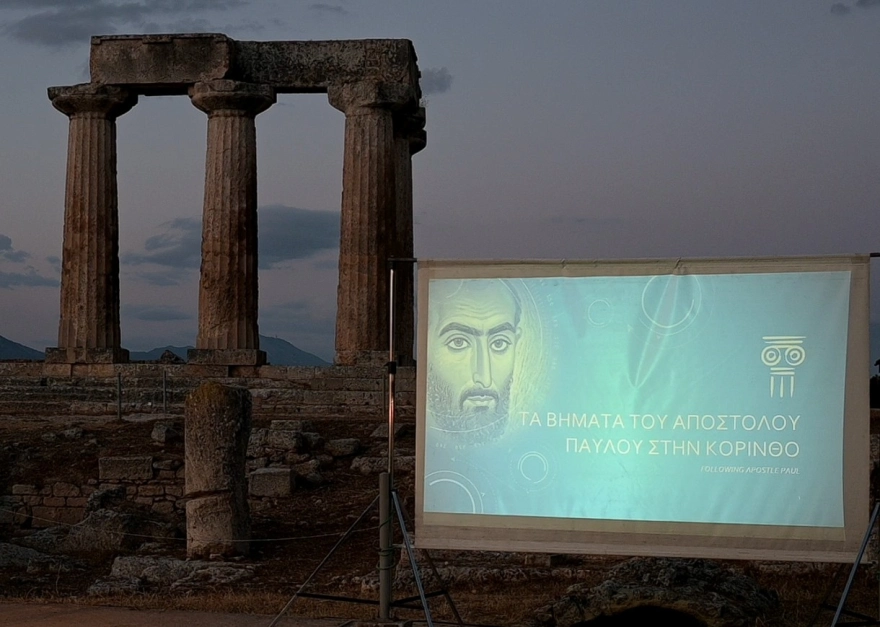
Recently, the project was presented in Corinth during the signing of a memorandum of understanding among ten Greek municipalities to foster inter-municipal cooperation for the “Path of Apostolos Pavlos.” The presentation highlighted his arrival in Corinth, after initially leaving Athens disappointed. Historically, in the Peloponnese, he was viewed as a wandering figure sharing life advice across the Mediterranean. Apostolos Pavlos began his work there by sewing tents from goat skins in the workshop of Aquila and Priscilla, providing shelter to the local community. Simultaneously, he spread Christianity from the East to the West, meeting Phoebe, who played a significant role in the early Christian community and later carried and interpreted his Letter to the Romans in Rome.
Today, the creators of the project, according to the NKUA professor, aspire to transform it from merely an open museum that spreads his message into a living museum—one that actively interacts with everyone and keeps his teachings alive.
Ask me anything
Explore related questions