





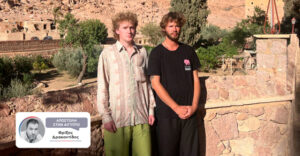
They asked me for help as I stood outside the gate of the Monastery of Sinai, observing the silence and stillness that had spread everywhere. They were two young Americans, visibly shaken by the news that the Monastery had closed its doors to the public.
Initially, the monks had announced that the Monastery would remain closed until Sunday afternoon (June 1), but eventually, after consultations, intense behind-the-scenes pressure, and internal discussions that lasted for hours, the monks decided to lift the isolation decision and reopen the monastery gates to the faithful and visitors.
“We want to speak with one of the monks. We want to stay here, to join the community,” they told me honestly, almost in awe. The first is named Christodoulos Horch, he is 22 years old, a filmmaker from Colorado, an Orthodox Christian, and is involved in an American film production documenting monastic life on Mount Athos, with the participation of several Greek-Americans. He spent three months on Mount Athos and immediately afterward traveled to Sinai, seeking spiritual continuity. When he arrived at the Monastery, he knew nothing about the recent events. “I found out today. I came here to pray, I didn’t expect such unrest,” he said calmly, with visible disappointment.
Christodoulos Horch speaks about his need to pray
His journey toward faith, as he explains, did not begin from a theological search but from a need to understand the world and himself. “In seeking knowledge and traveling, I found God. And I found Him in Greece, on a trip to Rhodes and Patmos. Greek hospitality brought me closer to God than any book ever could,” he tells us. “When I visited Patmos, I felt an incredible energy that I cannot describe in words. It’s something that pierces through you.”
George Smith, economics student, explains why he visited the Monastery of Sinai
At his side is George Smith, 21 years old, also from Colorado, an economics student. His personal journey began in Chile, continued in Kyoto, Japan, and Sydney, Australia. He met Christodoulos in Cairo – and as he says, it was Christodoulos who convinced him to visit the Monastery of Sinai. “I came because I felt something calling me here. I’m not sure what I want, but I’m certain I can discover it here,” he notes.
The two of them now walk outside the closed gate of the Monastery, observing the walls of silence the monks have erected in recent hours. The Monastery remains closed to the faithful, as the monks have chosen to withdraw internally in protest of an Egyptian court’s decision to confiscate the Monastery’s real estate, causing uncertainty and sorrow within the monastic community.
“We don’t want to disturb,” Christodoulos tells me. “We just want to speak with someone. To understand. To pray with them.” Their desire to join the Monastery – even if not immediately feasible – reflects a deeper need that many young people feel today: to retreat from the noise of the world and find truth where there are no lights, no sounds, no images – only faith, silence, and prayer.
Both Christodoulos and George openly condemn the Egyptian court’s decision, calling it unjust and offensive to the historical significance and spiritual mission of the Monastery. As they mention in statements in the accompanying video, such actions not only create insecurity but also strike at the core of Orthodox life that has flourished for centuries in Sinai.
Ask me anything
Explore related questions




