





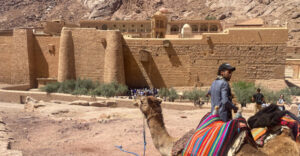
In an attempt to prevent a fait accompli that would alter both the character and legal status of the Holy Monastery of Saint Catherine in Sinai — a monument of world cultural heritage and a unique, living site of Christian religious expression and operation — Athens is calling Cairo for new consultations. The goal is to implement the spirit of understanding that was achieved between the leaders of the two countries, as well as the working groups that had negotiated an out-of-court settlement.
Following communication between Prime Minister Mitsotakis and President Sisi, it was agreed that talks would be held between the two sides. Initially, an expert team was to visit Cairo today, but it was announced yesterday that Foreign Minister George Gerapetritis himself will lead the mission, and the meeting will take place on Wednesday in the Egyptian capital, headed by Egyptian Foreign Minister Sameh Shoukry.
It is evident that the Egyptian side favors political negotiation over technocratic discussion, which would by default also focus on the previously reached settlement. In any case, any approach would require high-level political confirmation.
Firm Messages
Greece’s priority is the “preservation of the pilgrimage and Greek Orthodox character of the Monastery and resolving the issue institutionally,” while the two leaders agreed that the solution lies in the already documented common understanding of the two sides, as well as in the publicly announced and privately agreed-upon terms during the Egyptian President’s visit to Athens on May 7.
The revelation (by protothema.gr yesterday) that Egypt itself has long accepted, within the framework of UNESCO, the Monastery as the legal owner of its buildings and grounds, puts Cairo in a difficult position vis-à-vis the Monastery and the international community — and offers Greece a key argument.
After Athens was alerted to the surprise ruling by the Ismailia Court of Appeal concerning legal challenges aiming to dispute and strip the Monastery of its property rights (both within and outside the Monastery walls), Cairo sent messages of reassurance — though not clarity — regarding the substance of the issue.
The Egyptian presidency insists that the court decisions “reinforce” its commitments to maintain the religious character of the Monastery.
However, the unresolved question is whether Cairo is truly open to meaningful discussions, given it allowed a legal precedent to unfold, breaching the previous top-level political understanding that was supposed to seal the out-of-court settlement between the Monastery and the Governor of Sinai. That agreement had explicitly stipulated the halt of legal proceedings and recognition of the Monastery’s legal status as owner of the buildings and lands it has held for centuries — alongside recognition of the authority of Egypt’s Antiquities Department. This would have permanently resolved the property ownership dispute, both legally and institutionally. For Athens, it will be extremely difficult to accept any process that simply ratifies the court’s decision — especially with Athens’ own signature.
An “Arab Bazaar”
According to the court decision, summarized by Egyptian media and in the Monastery’s legal team’s possession, a kind of “Arab bazaar” logic is applied: stakeholders are meant to consider it a favorable outcome that only remote properties (buildings, plots, fields) are being confiscated, while ownership of the Monastery itself and the structures inside and around it remains in a legal “grey zone.”
There, the court’s provision is essentially to grant the monks permission to continue their religious duties — but without clearly recognizing ownership. This effectively strips the Monastery of its property rights, as it’s granted merely the right of use for religious purposes.
While the court did reject the claim for immediate eviction of the monks and financial compensation for their “illegal” occupation, it also dismissed the Monastery’s appeal for legal recognition of its ownership of the buildings within the walls.
Statements by the Egyptian Presidency and Foreign Ministry that the “religious character” of the Monastery will not be affected are far from reassuring. No one ever proposed turning the church or the sacred grounds into a resort or club — the issue has always been about the Egyptian state recognizing the Monastery’s ownership rights.
A Hostile Act
Athens wishes to exhaust all avenues for understanding with Cairo, but must make it clear that such actions are not only hostile toward Greece but also to the global community. This undermines Egypt’s image in Europe, and linking the persecution — essentially — of a millennia-old Christian presence with a tourism redevelopment plan damages the project’s credibility.
Cairo’s handling of the matter raises serious concerns in Athens, as it represents a major blow to Egypt’s reliability as a close partner and interlocutor, with whom Greece shares interests and challenges in the Eastern Mediterranean. Athens seeks balance — to avoid accepting the Sinai fait accompli while preserving the political relationship. But such a relationship would cease to be one between equals.
The Egyptian government, which in recent years has invested heavily in tourism redevelopment as a path to economic recovery and survival, has long had its sights set on the Sinai region.
With grandiose, “pharaonic” projects, Egypt aims to “cement” its control over Sinai — historically a point of contention with Israel, and more recently a hotspot for Islamic terrorism and ISIS. These projects are also fueled by endemic corruption in public works, as large financial interests push for rapid development. The Saint Catherine Monastery, with its strict operational rules, spirituality, and significant land ownership, stands as a major obstacle.
“The Great Transformation”
The Egyptian government aims to transform the Sinai into a kind of “Disneyland” of entertainment, religious, therapeutic, mountaineering, and luxury tourism — through a massive project called “The Great Transformation.”
Prime Minister Mostafa Madbouly recently visited the area to inspect early construction and accelerate progress, so that President Sisi — who has taken a personal interest in the project — can inaugurate it soon.
The plan includes major infrastructure works: reusing groundwater, flood protection, road networks connecting tourist destinations in South Sinai (like Dahab and Sharm El Sheikh), and upgrading Saint Catherine Airport.
Projects under development include a new visitor center at Wadi El-Quds Square, a Peace Plaza and Building (12,000 sq.m.) with an open celebration space, museum, theater, conference room, café, and meeting halls.
The existing eco-lodge is being expanded with 74 chalets and a new restaurant, while a new eco-lodge in Wadi El-Raha will include 192 environmentally friendly rooms and 56 suites. A mountain hotel (12,900 sq.m.) will overlook the Monastery, the Mount of Transfiguration, and Wadi El-Raha — integrating a large cave for a unique panoramic setting. A desert garden will connect the lodge to the hotel, with a pedestrian trail — the “Moses Path” — mimicking Moses’ historic journey through the valley.
The project also includes a new residential area in Zeitouna, with housing units, services, and 21 hotel complexes (546 units total). The “Great Transformation” includes upgrading the existing lodge, building a new one, creating a Peace Park, constructing a mountain hotel, opening a new visitor/admin center, and developing a heritage and tourism hub in the city.
It also focuses on upgrading local Bedouin housing and constructing a new complex, developing the Monastery Valley, and building a new road and utilities network with flood safety measures. A spiritual retreat in the surrounding mountains will target holistic and healing tourism — and serve as a Mecca for climbers.
Tourist services will include golf carts transporting visitors from parking to the Monastery — one of the world’s oldest Christian monasteries. Prime Minister Madbouly recently emphasized the government’s commitment to overcoming any obstacles in executing the project.
Ask me anything
Explore related questions




