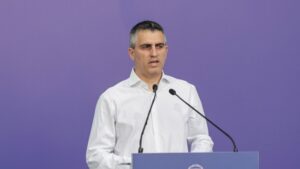
The Minister of National Economy and Finance, Kyriakos Pierrakakis, spoke at the auditorium of the internationally renowned French University Sciences Po, on the sidelines of the OECD Ministerial Conference starting today.
Pierrakakis was asked by students of the School of Political Sciences about all issues concerning our country, with a focus on the positive course of the Greek economy.
The Minister of Economy and Finance highlighted Greece’s significant progress in fiscal stability, noting that the country achieved a primary surplus that exceeded targets. At the same time, he noted that Greece is recording steady economic growth and attracting investment, proving that reforms and the green and digital transition are strong drivers of growth.
“Greece in 2029 will not be the country with the highest public debt in the eurozone,” the minister said, highlighting the role of digital tools in significantly reducing tax evasion. Referring to the informal economy, he pointed out that it had fallen from 35-40% of GDP before the crisis to 15% today, which he said was mainly due to digital transformation.
On tariffs, Kyriakos Pierrakakis referred to the need to overcome the EU-US trade dispute, while stressing the importance of implementing the Letta and Draghi proposals to remove internal barriers to the completion of the single European market.
Allowing digitalisation
Referring to the progress of the digitisation of the Greek economy, Pierrakakis stressed that the upgrading of state digital services not only deconstructs distrust towards the state but also unleashes growth potential. “Digitisation should be the North in our compass to restore citizens’ trust in the state,” he said.
Kyriakos Pierrakakis elaborated on his vision for shaping the future through bold reform policies, stressing that Greece has left the period of crises behind and has entered an era of radical change and growth. He underlined the importance of the digital transition, pointing to the creation of gov.gr, the introduction of electronic prescription, and the digitalisation of more than 1,500 services, a development that has significantly reduced bureaucracy, as models of modernisation. “We need quick wins like the digitisation of the civil service to build a modern state,” he said.
Brain Regain
The finance minister made special mention of the reform that paved the way for the creation of branches of international universities in Greece, stressing that “linking education and the economy strengthens the knowledge economy.” Speaking about the brain drain and the return of young people who left Greece during the crisis, the Minister referred to an article by Thomas Friedman in the New York Times published 15 years ago amid the economic crisis. As the Minister recalled, Friedman stressed that he was not looking at the daily fluctuation of Greek bonds but at whether young people were returning to the country. “If you see them leaving, sell. If you see them returning or staying, buy,” Friedman wrote, and on the occasion of this reference, Kyriakos Pierrakakis called on young Greeks living abroad to return to a different Greece today.
Ask me anything
Explore related questions