





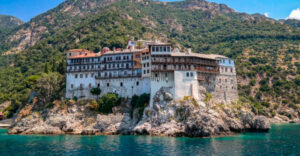
Experts are in a wait-and-see mode regarding the development of the phenomenon after the earthquake of 5.3 on the Richter scale on Agios Oros at noon on Saturday, with the president of the OASP, Ethymio Lekka, saying today that “we don’t know the mood of the fault. We are dealing with a strange phenomenon that has been going on for 14 months.”
Explaining why he used the term, Lekkas said it “peaked last summer, came back in February, and is now returning more with 5.3 Richter, which is the strongest tremor. It’s a sequence that we can’t predict because it has a lot of ups and downs.”
He added, “We can’t locate the fault because it’s underwater.”
The positive thing, according to Lekka, is that “we see the epicenters are concentrated in a small area, which means we don’t see transmission to other neighboring faults,” adding that this particular fault “can give up to 5.6-5.7 Richter.”
Specifically about Agios Oros, he noted that “it is an area with old monasteries, most of which have been adequately maintained and have not been damaged in the centuries that have passed. We therefore recommend avoiding old buildings and old sketes and areas with steep morphological slopes for the risk of landslides.”
“Here, the rule is confirmed that there are no rules in seismic sequences, no two are alike, no two are alike; it is a chaotic phenomenon for which we are struggling to find some edges. We have dozens of earthquakes of 1 or 2, or 3 Richter, but from this we cannot prescribe whether it is a normal sequence.”
Euthymios Lekkas concluded.
The mobilization of the authorities
A rescue vehicle of the 2nd EMAK and a team of the 2nd EMODE are in Mount Athos, in Karyes, since the evening hours of Saturday, to assist if necessary.
At the same time, the Inspector of Northern Greece will also be in Mount Athos this morning, in order to carry out an autopsy in the affected areas and coordinate the civil protection actions.
Ask me anything
Explore related questions




