





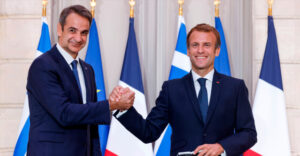
French President strongly reaffirmed French support for defending the rights of Greece and Cyprus in their maritime zones from the threats they face, French President Emanuel Macron gave on the floor of the World Ocean Conference in Nice.
The French president’s statement is extremely significant as it comes at a time when challenges to Greek sovereign rights in the Aegean and Eastern Mediterranean have been exacerbated by Turkey, on the occasion of the Marine Spatial Planning, the Marine Parks and the Cyprus-Crete electricity interconnection.
Greece, by the end of the month, as Kyriakos Mitsotakis himself said from the podium of the conference, will institute the Ionian and Southern Cyclades Marine Parks, announcing more Marine Parks at a later stage. It is a pending matter of several months, the announcement of which a year ago had provoked strong reactions from Turkey. Despite the fact that the Marine Parks will be confined only within Greek territorial waters of 6 nautical miles, the Turkish reaction is focused on the reintroduction of the “Grey Zones” theory, as Turkey claims that many of the islets and rocky islets to be included in the Marine Parks are of “disputed sovereignty.”
The fact, however, that the announcement concerns a Marine Park in the Southern Cyclades, leaves a large number of islands disputed by Turkey, which, on unofficial maps that had seen the light of day, were included in the Marine Park, out of the planning for the next phase.
Similarly strong opposition exists on the issue of Maritime Spatial Planning, as Greece presented the base map on 16 April and the drafting of the set of maps accompanying the MSP, detailing the permitted activities in maritime zones and outside territorial waters, is still pending, so that it can be submitted to the Commission and thus enable the European Court of Justice to suspend the procedure for payment of the fine. The Greek map includes the potential maritime zones under the Law of the Sea, while it depicts the territorial waters in the Aegean Sea at 6 nautical miles, noting that it is our country’s right to extend them under the provisions of the Law of the Sea.
Of course, as far as the Marine Parks are concerned, the reaction of Turkey is to be expected, but the question is whether it will move from rhetoric to action on the ground when scientific, environmental and other projects begin to be implemented on the rocky islets included in the Marine Parks.
Turkey has designed its own MPA, which overlaps much of Greece’s potential maritime zones and the areas included in the Greek MPA map, and will soon, Turkish sources say, submit it to the relevant international organizations.
In the immediate future, however, decisions will have to be taken on the expansion of the marine parks, the completion of the FSM and the continuation of work on the Cyprus-Crete electricity interconnection, so as not to give the impression that Greece is backing down from exercising its sovereign rights because of Turkey’s threats.
Athens, in a very difficult climate, is trying to maintain the process of Greek-Turkish rapprochement and, after months of delay, two meetings will be held this week: The Thetical Agenda with Deputy Foreign Minister Tassos Hadjivassiliou in Athens and the Political Dialogue on Thursday in Ankara led by Deputy Foreign Minister Alexandra Papadopoulou.
The aim is to shape the conditions for the High Cooperation Council and the Mitsotakis-Erdoğan meeting in Ankara in early July. The two leaders will also meet at the NATO summit in The Hague (24-25 June), but the pressure of the weight of the summit’s agenda and Donald Trump’s first NATO appearance, following his threats to abandon the transatlantic strategic relationship, will not allow for long bilateral meetings.
In recent months, the climate has been aggravated both by Turkey’s aggressive rhetoric on the CFE and Marine Parks, and by the obstacles it has raised to the continuation of the Cyprus-Crete electricity interconnection project. Another point of confrontation is Greece’s effort to set terms and conditions at the European level for the participation of the Turkish defence industry in Europe’s major rearmament programme, which is of great economic importance for Ankara, but also political, as it considers it an important step for its de facto participation in one of the most important pillars of European integration, the European Defence.
Ask me anything
Explore related questions




