





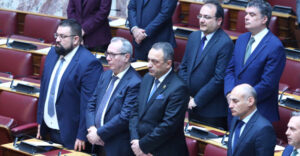
An unprecedented shift in Greece’s post-junta and parliamentary framework is marked by the decision of the Special Electoral Court, which removes three elected members of the national legislature from their parliamentary seats. The final ruling of the Supreme Special Court results in the definitive “expulsion” from Parliament of Vasilis Stigas, Petros Dimitriadis, and Alexandros Zerveas. At the same time, it calls for the Parliament to operate with 297 MPs until the next national elections, as the court does not authorize a procedure to fill the vacated seats.
According to the reasoning behind the decision, the participation of the Spartans party in the June 2023 national elections is deemed entirely illegal, since it was determined that actual leadership was exercised by Ilias Kasidiaris, who has been convicted at first instance for leading a criminal organization. However, the consequences of the relevant law are only triggered for the three MPs against whom legal challenges were filed. The remaining nine elected Spartans MPs (I. Kontis, Ch. Katsivardas, G. Manousos, I. Dimitrokallis, D. Valtogiannis, Th. Chalkias, K. Floros, G. Aspiotis, M. Gavygiotakis) retain their parliamentary seats.
It’s worth noting that the decision by the Electoral Court aligns entirely with a prior ruling by the Plenary Session of the Supreme Court’s A1 Division, which barred the Spartans from running in the recent European elections. However, it does not align with a more recent decision by the Single-Member Court of Appeals, which acquitted the Spartans in a criminal case concerning voter deception.
Chaos and Legal Debate
For now, the Parliamentary Presidium is awaiting the official text of the Supreme Special Court’s ruling to enforce the decisions and formally remove Stigas, Dimitriadis, and Zerveas from Parliament.
Meanwhile, behind the scenes, conflicting opinions are circulating among seasoned legal experts and constitutional scholars regarding whether the reduction in the total number of MPs to 297 should also lower the thresholds for majority requirements in proposal submissions, bill approvals, and constitutional revisions.
Supporters of one view argue that all relevant thresholds should be adjusted accordingly, meaning that the 151-vote majority should become 149.
This legal interpretation was expressed in a radio interview by Pavlos Marinakis, who also noted that the government commands a majority well above 151 votes, and thus is unaffected if the threshold drops slightly.
On the other hand, critics cite Article 74 of Parliament’s Rules of Procedure, insisting that the majority should remain at 151, since it is determined by the total number of parliamentary seats—not the number of currently active MPs.
PASOK’s MP-at-large Panagiotis Doudounis even commented on X, saying:
“The Government Spokesman’s claim that ‘the majority of the total number of MPs, as the law states, drops from 151 to 149’ is completely unconstitutional, unscientific, and raises questions about its intent—particularly in relation to pending issues. The Constitutionally defined ‘absolute majority of the total number of MPs’, as set by law, is not altered by today’s ruling of the Supreme Special Court, since it is not affected by unfilled or vacated seats. See also Article 74(2) of Parliament’s Rules of Procedure.”
In any case, associates of the Speaker of Parliament, Nikitas Kaklamanis, told protothema.gr that once they receive the relevant court ruling, they will request an opinion from the Parliament’s Scientific Service on this issue.
Two Legal Interpretations in Play
If the first interpretation prevails, then all thresholds would be recalculated based on 297 MPs. For example:
– The simple majority would drop from 151 to 149.
– The supermajority for constitutional revision would drop from 180 to 178.
– The number of signatures required for a no-confidence motion would drop from 50 to 49.
If the second interpretation is upheld, then Article 74 of Parliament’s Rules of Procedure will apply as-is.
Specifically, Paragraph 1 states:
“Where the Constitution or the Rules of Procedure set a percentage of MPs for submitting a motion or taking a decision or for any other purpose, this percentage is calculated based on the total number of MPs in the Plenary or in the Standing Committee during recess periods, and any fractional results are rounded down—unless the Constitution or the Rules explicitly state otherwise.”
This category includes:
– No-confidence motions (threshold drops from 50 to 49 MPs).
– Motions to form investigative committees (1/5 of 297 = 59 instead of 60).
(Note: Proposals to form pre-investigation committees require 30 signatures, as specified by the Constitution and Rules.)
However, Paragraph 2 of Article 74 specifies certain votes where the required majority is “non-negotiable” and strictly tied to the total number of parliamentary seats, even if all are not currently filled:
“Where the Constitution or Rules require an absolute majority of the total number of MPs to make a decision, this majority is calculated based on the total number of parliamentary seats.”
In this case, the 151-vote threshold remains, even with only 297 MPs, for cases such as:
– Approval of proposals to form pre-investigative committees or refer ministers to the Judicial Council
– Legislation altering the boundaries of national territory
Dissolution of the Spartans Parliamentary Group and an Eight-Party Parliament
Finally, the removal of V. Stigas, P. Dimitriadis, and Al. Zerveas from Parliament leads to the dissolution of the Spartans parliamentary group, as it no longer meets the minimum MP requirement. As a result, Parliament will now operate with eight parties.
Ask me anything
Explore related questions




