





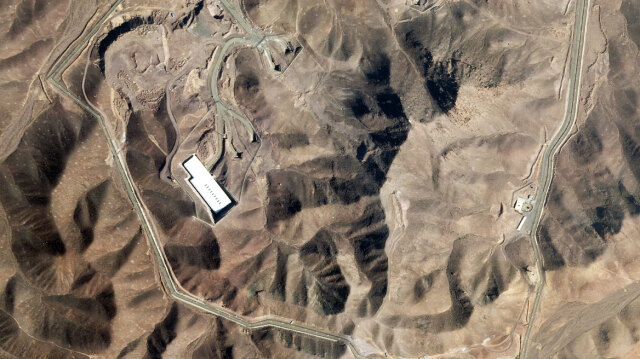
The possibility of a strike on Iran’s Fordow nuclear facility has occupied the international community in recent days, as Donald Trump is reportedly considering such an action, potentially using the so-called U.S. “super-weapon,” the GBU-57 bunker-buster bomb.
While the former U.S. president “weighs” his options, top nuclear safety experts consulted by CNN believe that a potential U.S. attack on the underground Fordow nuclear site would not result in the catastrophic consequences many fear.
According to their assessment, a radiation leak would be limited and contained within the facility, without causing major environmental or public health impacts in the wider area.
Kelsey Davenport, Director for Nonproliferation Policy at the Arms Control Association, noted that even if the bombs penetrated Fordow’s underground structures, “there would be some limited radiation from the enriched uranium stored there.” However, she clarified that “no significant or widespread environmental contamination is expected.”
Unlike a nuclear reactor—where an attack can lead to meltdown and the dispersal of large amounts of radiation—Fordow operates with enriched uranium in the form of uranium hexafluoride gas. While still hazardous, it does not carry the same level of risk.
Davenport explained that the main concern relates to the chemical toxicity of the uranium hexafluoride and the possible release of low-level alpha radiation, which would likely be confined within the installation itself. “It would be manageable, provided the appropriate protective equipment is used,” she noted.
A similar assessment was offered by Behnam Ben Taleblu, a senior analyst at the Foundation for Defense of Democracies, who described the potential damage as primarily a chemical hazard.
Scott Roecker, Vice President for Nuclear Materials Security at the Nuclear Threat Initiative (NTI), stressed that the risk of radiation spread is not significant:
“The enriched uranium at Fordow is fresh. If there’s a leak, it will be contained on-site, and since the facility is underground, we don’t even know how much of it would be released.”
Why Fordow is not Chernobyl
Despite the concerns surrounding any military strike on nuclear facilities, experts underscore that Fordow cannot be compared to Chernobyl-type disasters. The 1986 nuclear catastrophe in Ukraine was caused by an explosion in an active reactor, leading to a massive radiation release into the atmosphere, which caused incalculable environmental and health damage across Europe.
In contrast, Fordow is not a nuclear reactor, but rather a uranium enrichment plant. The uranium stored there is fresh, in the form of hexafluoride gas, and is not involved in fission—the process responsible for chain reactions and meltdown in a reactor.
As Kelsey Davenport explains, even if the facility were hit, any radioactive leak would be localized and limited:
“There would be some low-level alpha radiation and chemical toxicity, but there is no serious risk to the broader population.”
She adds that:
“Bombing a reactor is an entirely different scenario,” emphasizing that only such an event would result in massive radiation dispersal and truly devastating consequences.
Ask me anything
Explore related questions




