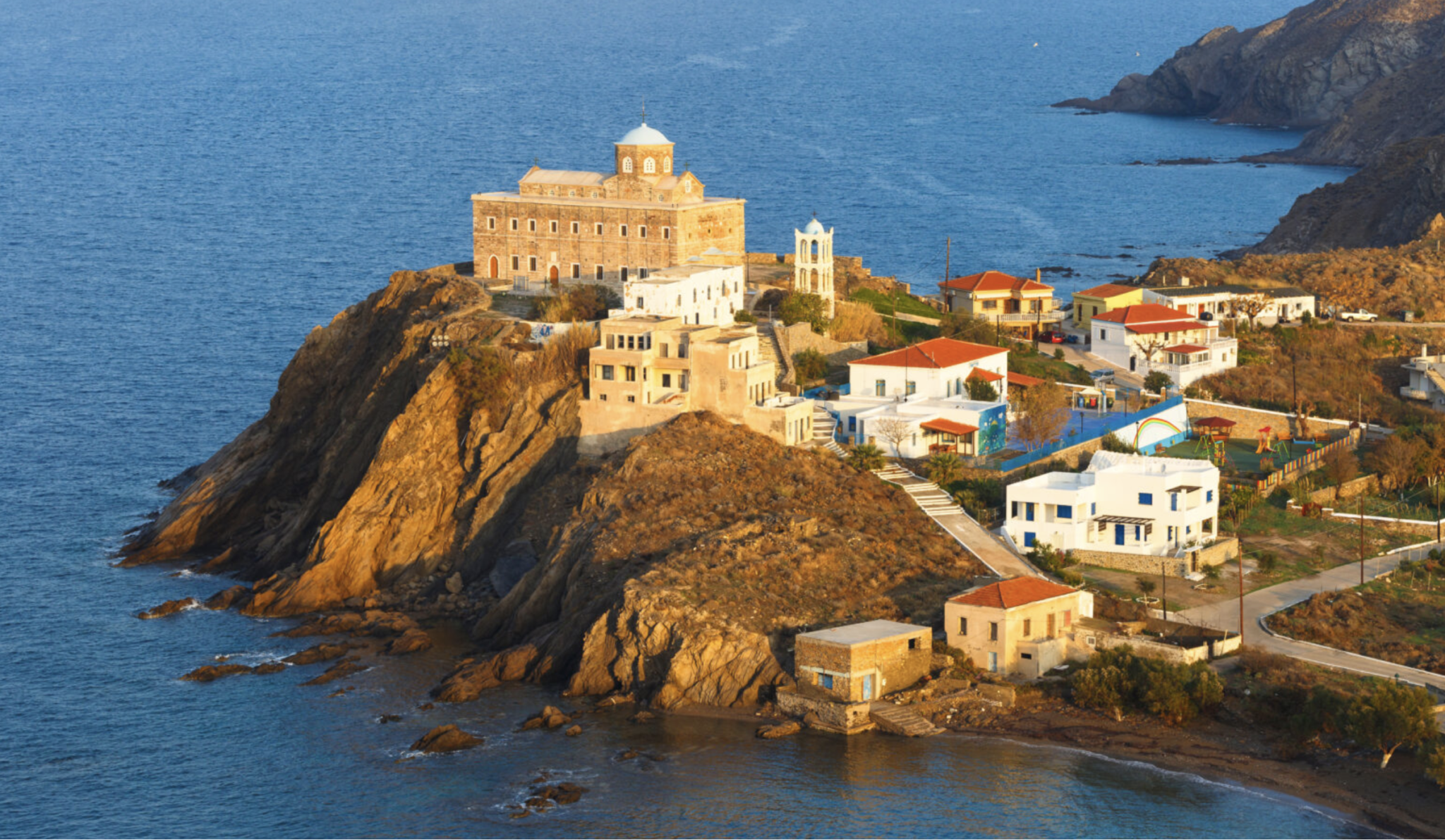
The small island of Psara lies west of Chios, spans just 40 square kilometers, and belongs to the category of islands with only one settlement. What does that mean? That it’s perfect for relaxing holidays, disconnecting, and enjoying absolute tranquility.
There are references suggesting that in antiquity, the island may have been identified as “Psyra” or “Psyrii.” It is best known from the Greek War of Independence against the Ottomans, as it ranked among the most significant naval forces of the Revolution, alongside Hydra and Spetses.
One event that left a lasting mark on both the island and the struggle for independence was the massacre of Psara, which played a pivotal role in shifting the stance of the European Powers. The island has a deep-rooted history, with signs of life dating back to the Mycenaean era. Here, you won’t find large hotel complexes. The atmosphere is laid-back, with a few carefully selected accommodation options. The road network is limited, mostly cement-paved, connecting the main village (Chora) with chapels and beaches. Distances are short and manageable even on foot—and if you need to go farther, a local will surely offer to help.
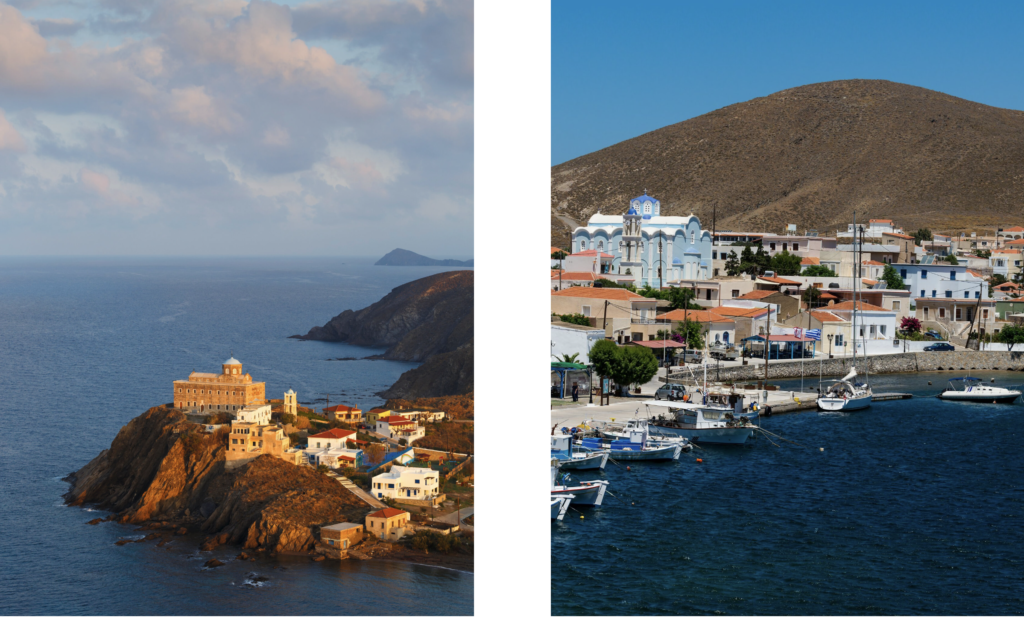
For swimming, you can choose between the beaches near Chora or others along the coastline. Most are only accessible by sea, but those reachable on foot are more than enough. The closest to the village are Katsounis Beach to the east and Kato Gialos to the west of the harbor. The bay of Agia Kyriaki, just past Katsounis, is a youth favorite, while Megali Ammos and Lazareta stand out for their natural beauty. Further away, Limnos Beach combines sand and pebbles, with tamarisk trees and impressive waters. However, sea access is easier at a particular point due to flat rocks on the seabed.
Fanari Beach impresses with its deep waters, though access is somewhat more challenging. To the west, Lakka stands out for its crystal-clear waters, and nearby Archontiki—next to an archaeological site—adds historical interest. Among the most beautiful beaches is Ftelio, with a wide sandy shore and ideal seabed for snorkeling. As for the more remote shores that are not accessible by land, getting to know locals might just open doors to otherwise unreachable seas.
If you’re looking for a break from the beach, you can visit the island’s few but intriguing sights. Chief among them is the Mycenaean settlement at Archontiki, where archaeologists have found both a settlement and a cemetery, part of which is submerged in the sea. In terms of religious tradition, the island is filled with small chapels. In Chora, the Church of Agios Nikolaos stands out: it began construction in 1785, was completed in 1793, destroyed in 1824, and rebuilt in 1863 by returning residents. It was here that Konstantinos Kanaris prayed before setting fire to a Turkish ship.
South of the port, at Mavri Rachi (also known as Palaiokastro), near the chapels of Agios Ioannis Prodromos and Agia Anna, stands a monument dedicated to the island’s holocaust. It was the site of a gun emplacement used by Psara’s defenders. The viewpoint is spectacular and easily accessed via a trail. Palaiokastro is an excellent spot to watch the sunrise or sunset.
East of the port and above Katsounis Beach stands the old stone quarantine station from the 18th century, now operating as a restaurant. Known as “Spitalia”—a corruption of the word “hospital”—it hosted returning sailors until they were cleared of contagious diseases.

Outside Chora, it’s worth visiting the Monastery of the Dormition of the Virgin Mary, which was destroyed in 1824 and began reconstruction in the mid-19th century. According to tradition, the icon of the Virgin Mary once housed there was painted by Domenikos Theotokopoulos (El Greco). It was relocated to Syros and now resides in the Church of the Dormition in Ermoupolis, known as the “Virgin of the Psarians.” The monastery also hosts a notable library with rare books and manuscripts.
If you wish to explore the island further, you can follow trails and roads leading to its many chapels—over 50 in number, quite a lot for such a small island. To the north, you’ll find the Holy Hermitage of Panagia Vatousena, Agia Triada of Xirokampos, and the Church of Agios Isidoros of Chiopolis. East of the village and closer by are chapels such as Agios Eleftherios of Achladokambos, Agios Theodoros in Limnos of Psara, Agios Ioannis in Livadi, and the Archangels in Belaitis. A beautiful route also leads to the Kokkino-poulos Lighthouse, built in 1909, where early risers can enjoy perhaps the island’s most stunning sunrise.
Ask me anything
Explore related questions