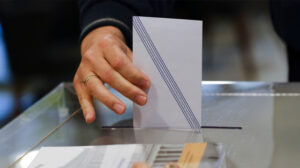
The new poll conducted by Real Polls for Protagon shows New Democracy stabilizing above 30%, with Plevisi Eleftherias retreating significantly and losing second place to PASOK, which however fails to show significant gains.
The poll, which was conducted between June 13 and 16 among a sample of 1,702 citizens, puts New Democracy above 31% in the outcome prediction, above that of last June’s European elections (28.31%), but consistently and significantly lower than its performance in both the 2019 (39.85%) and 2023 (40.79% and 40.56%) national elections.
In detail, the poll shows the ruling party receiving 27% in voting intention and 31.5% in outcome prediction, marginally lower than the corresponding figures in the May survey (27.7% and 31.9%). Even with these data, ND is by far the first party, with three times the second party in the vote intention.
Of significant interest is the significant drop of the Eleftherias Party, as it was measured at 8.8% (from 14.1% in the May survey), with PASOK returning to second place. However, this fact does not give Charilaou Trikoupis the right to celebrate: PASOK receives 9% in the vote intention (marginally down from 9.2% in May), and it seems that the problems that were identified in the previous period and which reduced the party’s appeal remain.
The 13% as a forecast is marginally higher than the May reading (12.9%), the party’s performance in the European elections last year (12.79%).
What can also be concluded is that three parties are strengthened by the big drop of Plevsi Eleftherias: the Hellenic Solution, which climbed back to fourth place with 7.2% in the vote intention (from 5.3% in May), SYRIZA, which reached 4.9% (from 3.7%), and MPA25, which now reaches the threshold of parliamentary representation (from 1.9% in May). The KKE is in fifth place, almost stable, with 6.2% (6.4%).
The picture is the same in the result prediction, as ND is at 31.5%, with PASOK at 13% and Eleftherias Eleftherias at 12.3% (from 18.9% in May).
Hellenic Solution is in fourth place with 8.4%, followed by KKE with 7% and SYRIZA with 6.9%. The peculiarity of the result prediction is that three other parties, MP25 of Yanis Varoufakis with 3.7%, the Voice of Logic of Afroditis Latinoopoulou with 3.6%, and the Movement for Democracy of Stefanos Kasselakis with 3.2%, enter the Parliament.
The concern about the deadlocked fluidity in the broader centre-left is still identified by citizens on the issue of leadership.
To the question “Which of the following persons could lead the progressive party and lead it into government?”, the answers are overwhelming: 54.3% answer “none”, 13.5% choose Alexis Tsipras, 11.6% choose Zoe Konstantopoulou, and only 5.6% choose Nikos Androulakis.
The index of citizens’ discomfort with the protagonists in the field of the Centre Left is also found in the question about their views on the increased mobility that has recently been observed in the field of the Centre Left.
73% believe that this is an attempt to keep certain politicians and politicians in the limelight.
Of particular interest are also the citizens’ positions on the critical period of 2015, during Alexis Tsipras’ premiership, with the referendum and capital controls.
Almost three out of four respondents, 73%, answered “yes” and “definitely yes” to the question of whether these events continue to influence their view of the protagonists of that period.
Only 25% believe that these events contributed to the country’s exit from the memorandum. However, 56% believe that the SYRIZA-ANEL coalition government was not solely responsible for these events.
If there is one relatively positive point about Mr Tsipras’ image, it comes from the question “Which Prime Minister has, in your opinion, pursued the most effective foreign policy?” On this question, Mr Tsipras comes third with 14.6%, with Kostas Al. Karamanlis (19.2%) and the first Kyriakos Mitsotakis (28.5%).
For the government, the biggest problem remains accuracy and is the first issue of concern for citizens, with the NHS in second place and low wages in third, with 67% of citizens believing that the government is mainly responsible for high accuracy, while only 9.7% adopt the explanation of “imported accuracy”.
Ask me anything
Explore related questions