While the government’s attention was focused yesterday on the NATO summit in The Hague, the Tripoli government in Libya took another step that could be interpreted as a “message” to Athens. This is because the agreement to exploit four blocks of the “Libyan EEZ” — based on the illegal Turkey-Libya memorandum — with the Turkish state oil company (TPAO) has put the Greek government on alert to determine whether this map constitutes a violation of Greece’s sovereign rights.
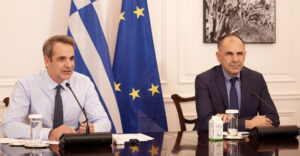
As Prime Minister Kyriakos Mitsotakis departed for Brussels for today’s EU summit, and Foreign Minister George Gerapetritis headed to Paris, Environment and Energy Minister Stavros Papastavrou was tasked with investigating Libya’s exact actions.
Based on analysis of the map displayed during the signing between the Tripoli government and TPAO, the Greek government believes that the median line principle has been followed. Sources highlight that Egypt is expected to face greater issues with this map. Nevertheless, senior diplomatic sources suggest that Greece’s recent agreement with Chevron regarding blocks south of Crete likely triggered reactions from both Turkey and Libya.
In today’s EU summit conclusions — which also cover a range of other topics (Middle East, Ukraine, defense, migration, etc.) — Mitsotakis is expected to request the reaffirmation of the 2019 EU position that the Turkey-Libya memorandum is not recognized by the EU and produces no legal effects. “I consider it important that this position is clearly reiterated to Libya at this time,” Mitsotakis said at yesterday’s press conference in The Hague.
Additionally, the Prime Minister will raise the issue of intensified migration flows from Libya and has already discussed this with European Commission President Ursula von der Leyen. The government has decided to deploy two frigates off the Libyan coast as a deterrent, while Gerapetritis is working to arrange a visit to Libya in early July. However, as Libya (including the Haftar faction) intensifies its engagement with Turkey, conditions for a visit by the Foreign Minister are becoming more challenging.
Slow progress for Greek-Turkish summit
The situation in Libya is also weighing on dialogue with Turkey. Mitsotakis had a brief conversation with Erdoğan on the sidelines of the NATO summit, noting meaningfully, “We raised the issues we needed to raise.”
A date for the High-Level Cooperation Council is still pending, with the meeting being postponed month by month. Diplomatic sources had considered early July as a possibility, but that scenario now seems unlikely, and attention is shifting toward autumn. There is no momentum in the talks for the two leaders to engage in core Greek-Turkish disputes, making a summit meeting unlikely to have a substantive agenda. Under these conditions, Mitsotakis and Erdoğan appear to prefer maintaining a “normality” of brief, regular contacts, avoiding tensions on the ground, but the Greek government has no illusions about the broader geopolitical context.
It is worth noting that the next NATO summit will be held next year in Turkey, with Ankara seeking by all means to re-enter Western defense planning.
Ask me anything
Explore related questions