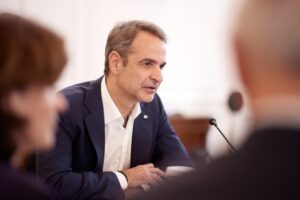
Developments with OPEKEPE dominate Kyriakos Mitsotakis’ Sunday post.
The prime minister makes it clear that “the time has come, then, for the abscess to be broken”, while also talking about the illegal Turkey-Libya Memorandum included in the conclusions of the recent European Council.
He also talks about the government’s activity in the Health and Justice sectors, while standing on Greece’s presence in space with the DUTHSAT-2 cubesatellite.
Read in detail what the Prime Minister wrote:
“Good morning! We are here not only to talk about the good things that happen, but also to talk about the more difficult things. To take responsibility and most importantly, to show what we are doing to provide solutions. That is why I am starting today’s review with the issue of the OPET. Let me make it clear from the outset that you will not hear from me any offsetting of the past – in the sense of “others have done the same” – that justifies inaction for the present and for the future.
I know that you trusted us to change the wrongs, not to perpetuate them. As difficult as the battle with the deep state may be. As it turns out, the long-standing weaknesses of the OPEKEPE have allowed for clientelism of a bribery nature. Unfortunately, this was also the case with our own party. Significant efforts have been made to consolidate. But let us be honest. We failed. The dialogues that are coming to light are causing outrage and anger.
The time has come, then, for the abscess to be broken. Our decision to abolish the OPEKEPE by integrating its functions into the AADE demonstrates this. We have, after all, made many successful reforms in critical areas. We will do so now, with the same determination and effectiveness.
Those who have been proven to have received European funds to which they are not entitled will be asked to pay them back. Our many farmers and ranchers who toil and produce quality products, and all law-abiding citizens, will not tolerate fraudsters who declare non-existent pastures and herds, nor those who facilitate them to do so.
As for political attitudes, I will say only one thing: if we want to be a truly European democracy, we cannot tolerate practices that suggest, or give the impression of suggesting, trading for a few crosses. And this applies to the entire political world, which must finally say no to old-fashioned partisanship.
A modern and digital state, as expressed by gov.gr does not ask the citizen what he votes for and expects no quid pro quo to serve him quickly and always according to the law. This fair, equitable and transparent concept must therefore permeate the functioning of every state agency and the culture of every state official. And you can be sure that it will. The struggle for a better state and a political system that accords respect and dignity to every citizen without partisan glasses is an ongoing struggle and is a non-negotiable condition for me personally and anyone who wants to stand with me.
Continue. This has been a week of critical foreign policy and defense decisions. In The Hague, it was decided to drastically increase Alliance defense spending over a ten-year horizon. Greece continues to spend more than 3% of its GDP on defence, remaining in the hard core of NATO countries that exceeded the 2% target, even in the difficult years of the economic crisis. In Brussels, at the European Council, we achieved important diplomatic victories. The “27” clearly reiterated in our conclusions that the EU-Turkey Memorandum is illegal and unsustainable. We also stressed the need for Libya to cooperate with the EU, as the increase in migratory flows from Libya and their instrumentalisation constitute a security challenge that Europe cannot ignore. We cannot let the traffickers decide who enters the European Union. Finally, the European Council included Greece’s proposal concerning defence cooperation with third, “like-minded” countries. These should be aligned with the Union’s foreign and security policy. We cannot go ahead with partnerships that run counter to Europe’s strategic interests.
In this week’s government activity, I begin with three pieces of news from the public health sector. I had the opportunity to visit the brand new wing of the Emergency Department at KAT, the largest orthopedic hospital and trauma center in Greece. A renovation was necessary since the hospital’s Emergency Department alone receives over 87,000 citizens/patients per year and 110,000 in the Outpatient Department. This is an impressive transformation of the ICU into a state-of-the-art facility, both in terms of space and medical equipment. This means upgrading its capacity to handle, with speed and greater efficiency, emergencies of all severity, in line with the latest international standards. Let me remind you that in the last five years, the budget of the CAB has increased by almost 70%, reaching EUR 66.3 million last year. Within the next few months, the renovation and upgrading works in 16 other ICUs in Attica are expected to be completed. In total, €142 million has been allocated from the Recovery Fund for the construction, extension, renovation and modernisation of 63 ICUs across the country.
A little further north, in Larissa, a project that has been waiting more than 15 years is finally getting underway. So work begins on the creation of the new 8,600-square-meter wing at the 84-bed capacity Larissa General Hospital. The budget of the project is 14 million euros, with funding from the Thessaly Region, and is expected to be completed in 2028.
Meanwhile, waiting lists in “cold” surgeries with a wait of more than 4 months – for example, cataract, power and knee replacement surgeries – have been halved: from 80,000 in 2023, they have now been reduced to under 40,000. You may say, is 40,000 too few? Not. But with the full operation of evening surgeries, we will reduce waiting times even further. We are working for a better NHS, a more modern and stronger public health system that delivers quality services to all citizens. And what I have just said is proof of that.
Let’s move on to the labour sector now and the really impressive results from the implementation of the Digital Job Card in major sectors of the economy. According to data from the ERGANI system, this April, recorded overtime in all sectors implementing the Digital Card appears to have increased by 78% compared to April 2024. The most spectacular increase is found in the tourism sector: 1.105%! Yes, you read that right: one thousand one hundred and five percent, and in full. We are therefore moving on to extend the Digital Job Card to other sectors: wholesale trade, energy companies, the financial sector, as well as administrative and support activities in tourism. In the first phase, it will be piloted, and from next November, fully. This brings the total number of workers protected by the measure to 1.85 million.
And since we say something about the DHS every week, let’s do a roundup. Over the last 6 years, more than 645,000 of our fellow citizens have benefited from its programs: 240,736 have found jobs, while 402,967 have attended training programs. There are also actions of the organisation designed for specific categories, such as the programme for LARCO. A total of 429 of the 658 former workers have already been hired by regions, municipalities, hospitals and health centres or university departments. The duration of the subsidised employment is up to 24 months for beneficiaries up to 54 years old and up to 7 years for beneficiaries 55 years old and over, with a gross monthly salary of EUR 1,210. The budget of this programme amounts to EUR 60 million.
I continue with the area of Justice. As has been rightly said, “justice that is delayed tends to be non-justice”. We are moving forward with changes to the Code of Civil Procedure that are intended to help significantly reduce the time it takes to deliver judgments in all civil cases. To become Europe, that is, in terms of decision times. So, under the new CCP, a court decision will necessarily be issued within 8 months at the latest, even for complex legal issues, and a final judgment within 2 years at the latest. Judgments on injunctions will have to be delivered within 1 month and 4 months in cases of voluntary jurisdiction, such as recognition of paternity, validation of a will, or court representation. It is foreseen for the first time that the hearing date in all proceedings will be set directly on a specific date by filing the pleading within a period not exceeding 6 months from the filing of the action. All deadlines are binding and if they are not met, then it is provided that the President of the SC and the Judicial Inspector will be informed of judges who delay the issuance of decisions so that the natural leadership of the judiciary can decide whether disciplinary proceedings should be initiated.
An innovation of the new Code is the introduction of an obligation for the head of the court to inform the parties of any delay in issuing a decision concerning them. This regulation, which is a pioneer at the European level, shows practical respect for the citizen. At the same time, the electronic case file for each case is an innovation for Greek, and I dare say for European, standards. The electronic file will free up valuable time for judges and lawyers and will reduce court costs for citizens. To further reduce the workload of the courts, additional workload will be transferred to lawyers (payment orders and orders for the performance of leasehold property), while the publication of wills will be done by notaries, which will relieve the courts and drastically reduce the publication time from the 300 days currently required in Athens to just 7 days. The new Code also provides a definitive solution to appeals against enforcement and auctions, which are scheduled to be heard until 2036! These cases, through an electronic platform created on the model of the law on over-indebtedness, will be reassigned, and judgments will be issued no later than 3 years after the implementation of the law. The new Code will come into force from the new judicial year, i.e., from 16 September.
I attach great importance to the Ministry of Health’s bill that has started to be debated in Parliament, as it concerns minors and, in particular, their protection from alcohol and various tobacco products. The new bill explicitly prohibits the sale and distribution of these products to minors, either in places of entertainment or from supermarkets and kiosks. An electronic register of points of sale and shop managers is also created, so that we know exactly who is selling what and where it is being sold. Sellers will be required to ask for identification and the check will be done through the new digital tool “Kids Wallet”. Penalties are being significantly tightened, from heavy fines to the removal of a business licence. Even for private events involving minors, there will be an obligation to notify the competent authorities via a platform.
The next issue has to do with safety in the daily life of citizens travelling by public transport. In 2021, we had implemented the Ariadne Plan to enhance passenger safety on the Metro and the HSTAP, with foot patrols by police officers in trains and buses, police presence at stations and seasonal patrols alongside the routes. We focused on areas where crime rates remain high. The plan has been tested in practice and has been positively evaluated. Thus, from February 2025 we are implementing the second phase of Ariadne, extending the daily police presence on Tram, Suburban Railway and urban buses. In the last 4 months alone, almost 55,000 checks were carried out and 900 arrests were made for various offences. And just because the plan is paying off, to the 220 police officers patrolling the five public transport systems so far, the Ministry of Civil Protection is adding 50 more.
But to move on to the next topic, the security enhancement is not just limited to transportation. In the centre of Athens, we face a multidimensional problem that combines congestion, addiction, delinquency and, most importantly, the activity of organised circuits that exploit human vulnerability. They are not all the same. We do not deal with them in the same way. We separate the person in need from the person who uses them. And we act with a plan: with shelters, with direct medical care, with supervised use, with the aim of access to treatment and social reintegration. At the same time, we are clear: there is no tolerance towards trafficking and exploitation networks. The message is clear: there are no avatars.
For another, larger plan, the new Action Plan 2025-2030 for the Reform and Modernization of the Penitentiary System, we informed the relevant Committee of the Council of Europe during its recent visit to Athens. We even received positive comments on the ambition and strong commitment of our plan for detention and correctional facilities that will be modern, safe and with humane conditions for prisoners, especially the most vulnerable groups, such as juveniles. It is a matrix of interventions, both short- and long-term, that address the overall functioning of prisons: from the living conditions and health care of prisoners to the working conditions of staff. The plan also includes the maintenance of existing infrastructure and the construction of eight new prisons across the country, which will increase the total capacity of the system by around 4,000 places by 2030. The Committee was also briefed on alternative forms of sentencing we are implementing, such as “bracelet”, acknowledging the progress made towards implementing the recommendations for reforming the prison system.
I’ve left for last a news story that, quite literally, takes us higher than ever! For the first time, our country is making its presence in space with the DUTHSAT-2 cube satellite, designed and built by researchers from the Democritus University of Thrace with the support of the Athena Research Center and the Greek companies Space Asics and Prisma Electronics SA. It was successfully launched from the Vandenberg base in the USA and is the first of the relatively smaller and more exploratory space missions of the National Microsatellite Program. The satellite will collect images and measurements, which will be used to provide information on soil moisture, as well as marine pollution. We hope this success is just the beginning and that more will follow!
That’s all for today, and for this month. Before we close, an important reminder: today, the fire danger is extremely high (category 5) in many areas: Attica, Attica, Kythira, Evia, Euboea, Laconia, Crete, Lesvos, Chios, Samos and Ikaria. Let us all be particularly careful. With a little care, we can protect human lives, the environment and our land. Have a nice day!”
Ask me anything
Explore related questions