The government is adopting a hardline stance on illegal immigration using the “Evros formula,” in an effort to prevent the consolidation of a new route controlled by smuggling networks that targets Crete and Gavdos. This decision comes in light of the sheer number of several million civil war refugees from Sudan, migrants from the Sahel, and Egyptians fleeing economic turmoil—numbers that pose a nightmare scenario.
Prime Minister Kyriakos Mitsotakis raised the issue at the EU Summit alongside his Italian counterpart Giorgia Meloni, finding full understanding and support from fellow EU leaders who recognize the risk of a new migration crisis facing Europe.
Greece’s strategy includes deploying warships—since Coast Guard vessels cannot be easily mobilized for multi-day missions due to the distance—to international waters beyond Libya’s territorial waters. These ships will primarily serve a deterrent role, as their size makes them unsuitable for direct interception operations against small fishing boats typically used by smugglers.
However, the Greek warships will have a secondary mission: to notify the corresponding Libyan authorities in both eastern and western Libya of any detected movements using their radar systems. This is intended to enable Libyan forces to intervene and prevent the traffickers from setting sail—thus also demonstrating that Libya is not weaponizing migration flows in the manner Turkey did at the Evros border in February 2020.
Mitsotakis also implied that the EU will intervene with Egypt, given that a significant number of migrants originate from there, in order to facilitate and expedite their return.
He also spoke of a “carrot and stick” approach—referring to the EU’s offer of not just financial aid, but also technical expertise and tools for managing migrant and refugee flows. These flows are being driven by the unstable political situation in Libya, from which people seek to reach Greece and Italy.
As part of this initiative, an EU delegation—led by the European Commissioner for Migration and including ministers from Italy, Greece, and Malta—is scheduled to visit Tripoli and Libya next week to coordinate on this critical issue.
Naval Presence and Regional Tensions
The presence of Greek warships also comes amid renewed interest from Libya in the Turkey-Libya memorandum and disputes over Greece’s sovereign rights—especially following the publication, on June 12 in the EU’s official journal, of a tender for licenses related to two blocks south of Crete, which Chevron has expressed interest in.
Boatloads to Crete
At the same time, the new migration corridor chosen by smugglers—from eastern Libya to Crete—is creating unbearable pressure on local communities, prompting the government to take urgent action.
The volume of these flows is causing headaches for relevant ministries (Shipping, Citizen Protection, Migration) as well as the Prime Minister’s Office. The ministers must handle these arrivals through a delicate mix of law enforcement and logistics, while the PM’s staff realizes that a coordinated response is necessary to prevent public perception that migration is again becoming a central issue.
Speaking to Protothema, Minister of Shipping Vasilis Kikilias suggested one possible solution: an intergovernmental agreement allowing the Coast Guard to patrol international waters near the Libyan coast and alert local authorities more quickly about departing vessels.
Though there had been no arrivals in Crete in the four days before this article was written, this is but a drop in the ocean given the numbers of recent months.
From the beginning of the year to June 24, 7,044 migrants had arrived in Crete. This figure far exceeds the island’s proportional share compared to the rest of Greece. By comparison, during the same period last year, the Coast Guard had rescued 1,968 people, while in all of 2024, the total number did not exceed 5,000, representing less than 10% of total sea arrivals to Greece (53,440).
Demographics and Smuggler Tactics
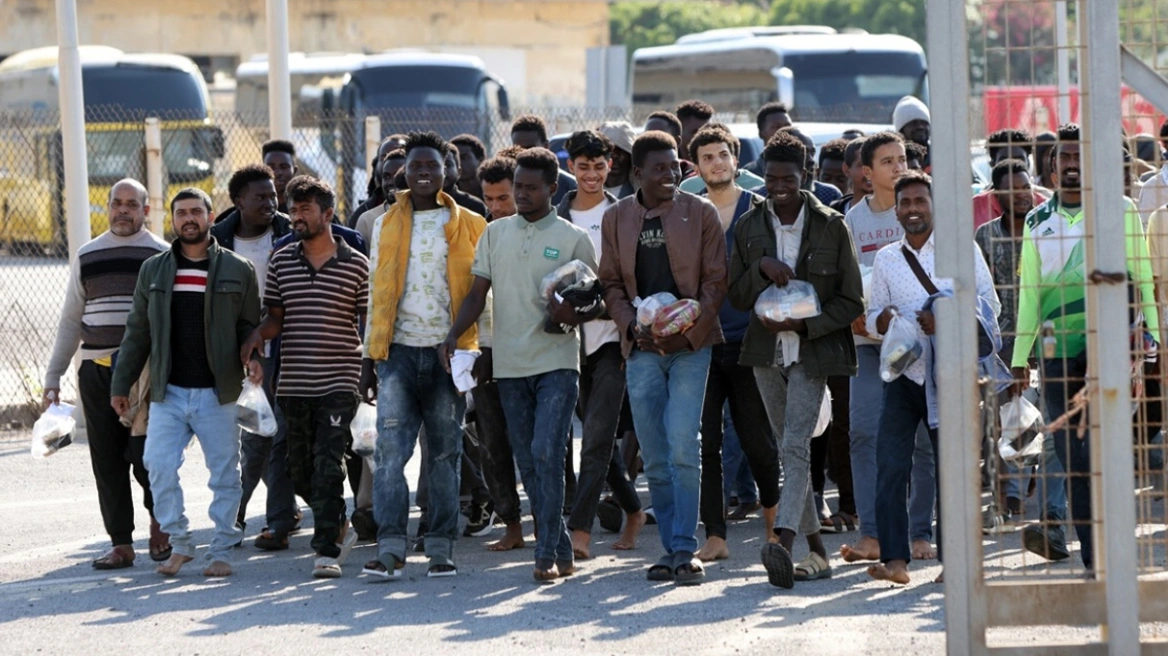
Notably, 95% of the 7,044 arrivals were single fighting-age men between 18–35, with women and children barely exceeding 5%.
This dramatic surge is largely due to the situation in North Africa. 70% of those arriving are Egyptian, with the remaining 30% mainly from Pakistan and Bangladesh, and only a few from war-torn Sudan.
Excluding those from Sudan, 98% do not meet the definition of a refugee, as Egypt, Pakistan, and Bangladesh are considered “safe countries” by Greece.
Although asylum applications are reviewed individually, data so far shows that 98% of these applications are rejected, leading to deportation procedures.
At present, Greece is using every available facility to cope. Those arriving in Crete are transferred to the Malakasa facility, where they submit their initial asylum application. Depending on their profile, they are then distributed to other facilities across the country.
Smuggling Networks
According to protothema.gr, many migrants arriving in Crete tell authorities they had no idea Greece was their destination. Smuggling networks—well-entrenched in territories controlled by Khalifa Haftar and his sons—promise a life with benefits and jobs in Italy.
Chasing a better life, migrants contact these networks via social media, mistaking them for legitimate travel agencies. Once interest is confirmed, the smugglers demand huge sums—between €5,000 and €10,000—forcing families to sell assets.
If full payment isn’t possible, they take whatever they can and demand the rest later through monthly remittances—often under threats to harm their families. The nightmare begins when they set out for Libya: crammed into vans, they cross from Egypt and end up in Tobruk, held like prisoners in warehouses at unknown locations until departure.
The startling scale of arrivals isn’t due to more trips, but to smugglers cutting costs by using old, overcrowded ships—choosing them solely for their capacity.
Thus, migrants arrive in hundreds per boat, risking their lives on every journey. Each voyage carries the threat of a tragedy like the one off Pylos, which bore similar hallmarks in how the smuggling rings operated.
Reactions
These numbers have thrown the local society of Crete into disarray. On one hand, solidarity is evident, with ordinary citizens donating clothes and providing food. On the other hand, the large influx of migrants is sparking reactions, and there are also opportunists attempting to stir unrest.
Speaking to THEMA, the mayor of Rethymno, Giorgos Marinakis, made it clear that the municipality has already done far more than its responsibilities dictate and is now waiting for coordinated actions from the government to solve the problem.
“We found a warehouse, a former pigeon coop, cleaned it, disinfected it, and installed electricity to offer shelter to some people,” he says, adding: “These places don’t meet the standards for hosting people, but we are doing what we can.”
Speaking about the profile of the migrants, Mr. Marinakis pointed out that they are mostly young men, who often argue among themselves—even over chocolate:
“Crete is geopolitically targeted. The people coming here are not from war zones—they’re fleeing poverty. If the issue is not resolved, we won’t be able to cope much longer. We had to provide food and shelter without receiving any money from the ministries. We hope to receive funding at some point.”
Asylum
In this context, the government is exploring every possible means at its disposal to address the situation. According to THEMA sources, the decision to suspend the examination of asylum applications for one month should be considered finalized. This move will be implemented via an Act of Legislative Content, citing reasons of public interest.
It’s worth noting that a similar measure was enacted during the hybrid attack on Greece in March 2020 at the Evros border. Back then, any legal challenges were dismissed by the Council of State, which rejected appeals against the legislative act.
The Prime Minister appears to have reviewed the data and, in the latest emergency meeting of the Government Council for Foreign Affairs and Defense (KYSEA), instructed the Ministry of Migration and Asylum to prepare all necessary steps to activate the suspension if the phenomenon does not subside.
Reportedly, this will apply to those arriving in Crete via Libya, and practically speaking, it means they will be denied access to the asylum process and be processed for return instead.
Wave of Diplomatic Visits
The government is also attempting to resolve the issue through political and diplomatic channels. This is evident in the Prime Minister’s statements following the EU Summit, where he said the European Union recognized the issue and organized a mission of the Migration Commissioner to both Eastern and Western Libya.
The mission will include the Greek Minister of Migration, along with his Italian and Maltese counterparts.
This trip will occur a few days after the Greek Foreign Minister’s visit to Libya. Bilateral relations with Libya have recently become strained, as shown by the ongoing disputes over maritime zones and the illegal Turkey-Libya memorandum.
Vassilis Kikilias: “Agreement with Libya is the only solution”
“In the Northeastern Aegean, the Coast Guard operates just 2-8 nautical miles from the Turkish coast. It detects boats in time and notifies the Turkish Coast Guard, which intervenes. But in the Libyan Sea, at 100 or 200 nautical miles, we can only carry out rescues. The solution is an agreement with the Libyan authorities—similar to those Italy and Malta have—so that we can patrol in international waters, near their shores, and notify them to intervene. I know that Mr. Gerapetritis will visit Libya to reach a similar agreement. The men and women of the Coast Guard perform their duties with selflessness and patriotism.”
Ask me anything
Explore related questions