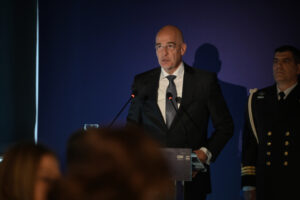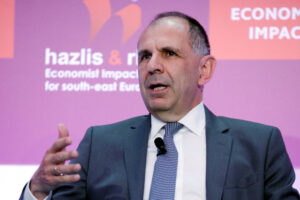
“Times are full of challenges and the situation is getting worse and worse because there is not a single challenge that is limited to one country or one region,” the foreign Giorgos Gerapetritis in a discussion held today at the Economist conference with former German Foreign Minister and new President of the United Nations General Assembly Analena Baerbock.
“Aggression is not a regional issue. It affects the whole world what is happening in Syria and Ukraine. It’s the same with food security, with climate, with artificial intelligence. They all cause a domino effect of developments,” he noted.
He pointed out that this “is the moment for the EU to stand up and say we are here to talk,” and stressed that it is important for the international security architecture to have Euro-Atlantic relations.
He said that all NATO members, except Spain, voted for 3.5% for defence spending and that “this is the problem with democracies, we have to calibrate our needs. I think sometimes we are very narcissistic. We feel we are very good and we have unlimited resources to do everything.”
Gerapetritis noted that while we need a strong welfare state in the EU, as this is the basic narrative of the European culture, we need to calibrate, but it does not mean that we will be far from this principle.
He said that politicians need to be open and honest with society and that what we need to fight here in Greece and elsewhere is the battle against misinformation.
“The West must stay united, because this is the essence of our culture. But this must be done on equal terms and in a way that we are open to society.”
“We are in the 3rd phase in geopolitical Europe, which has completely changed the scene. After World War II, we were in economic Europe, then in political and then in geopolitical Europe,” he pointed out. “To be a geopolitical power is to have a view on phenomena. Our key card is that we are a geopolitical power that can be mobilized.”
He said that in Europe, “We agree on the principles, the problem is that we disagree on the tools we need to use to achieve the result.”
He noted that he is concerned about the new violent phase, but there are some positive results: “We have a stronger Europe, stronger facilities, and above all, we now have the mindset of not complete dependency. When this war started, Europe relied on 50% of Russian gas; now it relies on 10%. These developments can help us become stronger and make a difference globally.”
“I believe in the European vision, that in Europe we have a huge capital of culture, of history, of adherence to principles,” he said. “I believe in the West. If we stay together, we will be very strong, and I believe that the European vision is always very attractive, and we should not be afraid of the future. We must have a vision, we must invest in the future.”
A. Baerbock: If all of Europe works together within NATO and with the Western Balkans, there is a lot of potential
“What has happened in Syria and the Middle East hurts Europe. We can’t wait for what someone else will do,” Annalena Baerbock noted for her part.
Asked about China and relations with the EU, she noted that Germany was late in terms of its China strategy. Reducing the risk was the most important thing. “With China, we have to be smart to understand what is happening, and right now, there is the background for a new geopolitical configuration. Now is a good opportunity for those who believe in the strategy of de-risking to join forces.”
“To be fully optimistic is to be naive. We know where Europe works and where it doesn’t,” he said, adding that the EU is capable of achieving the changes needed and has proved it over the weekend after the invasion of Ukraine.
“We had the biggest package of sanctions that was very clear, and we said we have to do a 180-degree policy change,” he said. “At some point, as a politician, you have to ask yourself what you have to stand up for. If all of Europe works together within NATO and with the Western Balkans, there are many possibilities,” he concluded.
Ask me anything
Explore related questions