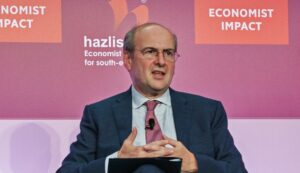
Five government initiatives for the coming period were presented by Deputy Prime Minister Kostis Hatzidakis, referring to “key moves” aimed at a stronger Greece.
Speaking at the 29th annual conference of the Economist, Hatzidakis specifically mentioned:
1. On the Prime Minister’s announcements next September at the TIF. “They will move on many levels, but mainly on further tax cuts, primarily for the middle class. Which is made possible thanks to the fight against tax evasion, the introduction of the digital job card, and the high growth rates compared to other European Union countries,” he said.
2. On the battle with the deep state.“After the successes we have had with digital modernisation, tax evasion, the PPC, the EFKA, and the introduction of digital procedures in health care, the battle will be fought in two main areas. The OPEKEPE and the OSE. As we have succeeded in the other sectors, we will succeed in these two. Before the elections, there will be tangible evidence of this.”
3. On the separate battle that has to do with running the public sector. “Despite progress, we still have ‘stories of daily madness’. We will make the civil service more citizen-friendly, and interaction with public services simpler. And we will step up efforts on evaluation by broadening the scope in education and introducing patient-led evaluation in health care. We will also move forward with the digital work card in the civil service,” the deputy prime minister noted.
4. On the national water strategy. “The Mediterranean is at the heart of the climate crisis, and Greece is 19th in the world in terms of risk of water scarcity. A number of steps have been taken, but a coherent national strategy is needed that will address the fragmentation of water planning and management. This will be one of the government’s key priorities,” Hatzidakis stressed.
5. The social field, an area in which the activation of the three new European funds adds new weapons for improving everyday life and quality of life. As the deputy prime minister said, the budget of the three funds is equal to half the recovery fund, and these funds will be used to finance, among other things.
“We will move forward”, he stressed, “knowing that citizens do not just stand by what has been done but also rightly demand further interventions that will lead to a better quality of life, boosting income and a stronger Greece.”
The deputy prime minister referred to the main successes of the government’s policies, noting among others the fiscal surplus in 2024, the record foreign investment, the recovery of the investment grade by all rating agencies, the reduction of unemployment below 8% for the first time since 2008 and the proposal for the takeover of the Greek stock exchange by Euronext.
He added that the government is continuing without any hesitation the reforms in its second four-year term, stating: The introduction of private universities, the fight against tax evasion, interventions to speed up the judiciary, spatial planning, the completion of the Land Registry by the end of the year, the new strategy to boost exports and the target to reduce the bureaucracy faced by businesses by 25%. “All this, he said, underlines the political will to promote the necessary reforms to achieve convergence with the European Union average.”
Hatzidakis described artificial intelligence as an important opportunity for Greece because of its high-quality scientific potential. He said that the focus will be on 4 areas: improving productivity, ensuring that everyone has the skills needed to use AI, shaping the right regulatory environment that promotes innovation while protecting human rights and freedoms, and finally using AI to make the state more efficient.
Finally, referring to Greece’s position in the world, Mr. Hatzidakis pointed out two advantages that our country has, which are its participation in NATO and the European Union on the one hand and the fact that it is located at the crossroads between South-Eastern Europe, the Middle East, and Africa on the other.
“We know,” Mr Hatzidakis concluded, “that to have a positive future, we need to combine two parameters. A strong economy and a strong defence. These are two areas in which the government is investing very much. After the dramatic experience of the last decade, we know that the secret is the private sector. How to give all the necessary opportunities to the private sector to grow. If you have a strong private sector, you have a strong economy and a strong country.”
Ask me anything
Explore related questions