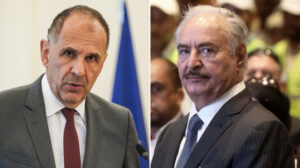
With the visits of Foreign Minister Giorgos Gerapetritis today to Benghazi and likely on July 15 to Tripoli, Athens is picking up again the thread of Greek-Libyan relations, in an effort to prevent new faits accomplis in the context of the Turkey-Libya Memorandum and to control illegal immigration flows, while the internal situation in the country remains extremely fluid and dangerous. The issue of maritime zones as well as the involvement in Sudan threatens to disrupt relations with the powerful neighbor, Egypt.
Athens is ready to propose the resumption of dialogue for the delimitation of maritime zones, a dialogue that will practically take place in parallel with Tripoli and Benghazi, until there is a unified representation of the country. A difficult endeavor, as many obstacles must be overcome, the most significant perhaps being Benghazi’s intention to negotiate by exercising sovereignty over maritime zones it theoretically controls.
According to our sources from the environment of the Speaker of the Libyan House of Representatives, Aguila Saleh, Egypt and Cyprus must be involved in this discussion, which means that, at least from this side, Turkey is excluded from the negotiations. Of course, within the two camps in Libya, there are different groups with conflicting interests, with Benghazi’s “prime minister” Osama Hammad operating in a different context than that of the Speaker of the House. In Eastern Libya, however, the word of General Khalifa Haftar carries the most weight, whom Mr. Gerapetritis is expected to meet today, Sunday.
The original plan of the Greek minister foresaw successive visits to both Benghazi and Tripoli. However, due to internal developments in Libya, the Tripoli government at the last minute requested the visit be rescheduled. This might actually be a positive thing, as the messages conveyed through the meetings with General Haftar will affect the talks that the Foreign Minister will have in Tripoli the Tuesday after next. According to information, Tripoli proposed a date for Mr. Gerapetritis’ visit only after it became known that the meeting with General Haftar had been arranged.
The Foreign Minister will meet with General Haftar in Benghazi, as the Speaker of the House will be absent. The commander of the Libyan National Army (LNA), who holds dual nationality (Libyan and American), is the strongman of Eastern Libya and has transformed from a red flag for the international community into a counterpart for the Americans, Europeans, Russians, and of course the Turks, successfully balancing in a marketplace of securing quid pro quos.
Athens’ goal is to dispel the impression created over the past two years, during which relations with Benghazi were almost nonexistent, to offer incentives within the capabilities of Greece, and at the same time to highlight the importance of avoiding provocative actions that could rupture relations with the EU.
A positive development
In this context, it is recorded as a positive development for Athens that, so far, despite contrary information, the ratification of the Turkey-Libya Memorandum has not been submitted to Parliament. General Haftar was among the first to oppose the memorandum, attributing it to Ankara’s blackmail of the then Tripoli government of Fayez al-Sarraj in order to provide Turkish military assistance, which halted his advance toward Tripoli in early 2019.
Since then, however, much has changed, and Turkey has now fully restored its relations with Eastern Libya and Haftar himself, as it seeks during the country’s political transition to consolidate its influence and validate the signed memoranda so that they remain in place even after a unified government is formed—whenever that may occur.
The agreement signed by the state oil companies of Turkey and Libya, TPAO and NOC respectively, to start exploration in four blocks in the potential Libyan EEZ was the first alarm bell. Although at first glance these do not seem to overlap with areas of the Greek EEZ, as unilaterally defined by Law 4001/2011, this is only the beginning. It represents Turkey’s effort to bind Libya on the ground in a cooperation that may later expand to areas claimed by Libya from Greece under the Turkey-Libya Memorandum.
Libya, however, is not relying solely on Turkey in the energy sector. As announced by NOC last week, it will proceed in November with the first tender since 2007 for licenses for exploration and drilling in 22 onshore and offshore areas, for which 37 foreign companies have already expressed interest, including American Chevron, French Total, and Italian Eni. The presence of such large companies will obviously provoke strong competition for Turkish TPAO.
For 14 years now, after the chaos following the overthrow of Gaddafi, Libya has been a field of confrontation between Turkey and Egypt. Cairo reacts not only to the neo-Ottoman notion of expanding Turkish influence to the borders of the Ottoman Empire but also because the strengthening of Turkey’s presence in Libya could turn it into a lever of strategic pressure on Egypt, which shares more than 1,000 kilometers of land border with Libya.
Despite the steps toward restoring Ankara-Cairo relations, there remains intense suspicion toward such moves, as Egypt sees itself losing the monopoly of support and influence over General Haftar, in whom it has invested for nearly a decade.
Athens, lacking both the capability and the intention to get involved in a bidding war of offers to Libya’s rival factions, is examining a cooperation package that will include, among other things, the resumption of the program for Libyans to study and train in the Armed Forces’ productive Schools, where there is a long tradition from the Gaddafi era, the provision of scholarships, the enhancement of health and education programs, the continued support for the restoration of Benghazi’s port, and cooperation in other sectors. At the same time, direct air connectivity between Benghazi and Athens will also be reexamined.
Strong card
Greece’s strong card is, of course, its alignment so far with Egypt, but primarily the important role the EU plays in Libya.
This coming Tuesday, European Commissioner for Migration Magnus Brunner is expected to visit Tripoli and Benghazi, accompanied by the Ministers of Migration of Greece, Italy, and Malta. There they will convey to both sides the clear message that Europe does not intend to allow the opening of a new major route of illegal migration from Africa through Libya.
At the same time, cooperation measures will be examined, which will clearly include the provision of expertise and funding to address the migration problem.
The European mission will arrive in Tripoli shortly after Gerapetritis’ visit to Benghazi and just before his visit to Tripoli. All this at a time when the EU, at the highest level during the European Council summit, reaffirmed its position on the invalidity of the Turkey-Libya Memorandum—a position that will be conveyed to both sides in Libya to make clear that moves to impose the illegal memorandum will not go without consequences.
Turkey has fully restored its relations with General Haftar, with the opening of a consulate in Benghazi and with expressions of interest from many Turkish companies for projects in Eastern Libya, while there is also military cooperation. Following the official visit to Turkey by General Haftar’s son, Lieutenant General Saddam Haftar, commander of the Libyan National Army’s Ground Forces, on April 4, three military technical delegations from Eastern Libya traveled to Turkey between June 15–28, visiting military headquarters and units.
Cairo, according to sources cited without being specified by Middle East Eye, has approached one of the special envoys appointed by U.S. President Donald Trump, Massad Boulos, asking him to intervene with General Haftar and exert influence so that the Turkey-Libya Memorandum is not ratified. The website reports that there was a phone call between Egyptian Foreign Minister Badr Abdelatty and the American official, during which the former warned of the risk of tensions in the Eastern Mediterranean at a time when Egypt is dealing with the consequences of the conflicts in Gaza and Sudan.
Egypt, which was among the first countries to condemn the Turkey-Libya Memorandum in 2019—not only due to the irregularity in its signing process but also for substantive reasons—reacted strongly when Tripoli attempted a year ago to impose a maritime delimitation between the two countries based on the memorandum’s line, which overlaps part of Egypt’s EEZ. And now, the initial picture of the blocks offered by Tripoli to the Turkish company TPAO concerns precisely this area.
Due to developments regarding the maritime zones issue and the probable involvement of Haftar’s forces in the civil war in Sudan—supporting the RSF (Rapid Support Forces) against the government-backed forces supported by both Egypt and Turkey—President Abdel Fattah Al-Sisi invited the strongman of Eastern Libya to Cairo, where they held talks, although it has not been disclosed what exactly was decided during their meeting.
The moves of the Haftar family
Eastern Libya, possessing funds from oil sales and enjoying the support of regional and international powers, but primarily due to the “order” imposed by General Haftar, is in a better state than Western Libya and is now moving toward attracting foreign investment.
A leading role in this effort is played by Belkacem Haftar, son of the general and president of the Reconstruction Fund of Eastern Libya. Haftar’s son has visited many European capitals, while in April he was in the United States, seeking to attract interest from American oil companies to participate in energy programs and research in areas controlled by his father in Eastern Libya.
General Haftar has six sons and one daughter. Saddam Haftar is the Chief of Staff of the Special Forces, Khaled Haftar is commander of the Security Units, and Belkacem is in charge of finance and reconstruction. Another son, Al-Sadiq, who recently visited Greece as his family was vacationing there, is involved in the agricultural sector in Eastern Libya. The other two sons, as well as his daughter, live in Virginia, USA.
Ask me anything
Explore related questions