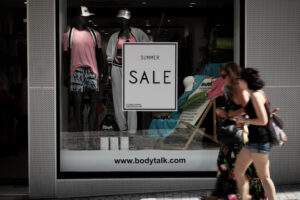
Summer sales begin today and will run until the end of August, while stores may optionally remain open on Sunday, July 20, 2025.
This discount period is ideal for “smart shopping” by consumers, and the commercial sector hopes for increased purchasing activity that will drive overall turnover upward.
As stated to the Athens-Macedonian News Agency (AMNA) by Vassilis Korkidis, President of the Piraeus Chamber of Commerce and Industry, the business community remains optimistic and places its hopes for a higher turnover than last year on increased tourist flows during the summer sales. Foreign visitors are expected to contribute to total turnover through imported consumption. Attractive prices on selected and branded items often act as a magnet for shoppers, who nevertheless compare in-store discounted prices with those available on e-shops.
“We hope again this year,” Korkidis adds, “that the discounted prices will attract consumers, contributing both to their purchasing power and to overall turnover.” The aspiration of the retail sector this summer is for Q3 turnover (excluding vehicles, food, and fuel sectors) to trend upward, surpassing the reference benchmark of €7 billion, as it did last year.
Caution Advised for Online Shopping
Nikos Kogioumtzis, Vice President of the Athens Chamber of Tradesmen and Vice President of the Athens Trade Association, speaking with journalists, advised consumers to exercise caution when shopping online and to conduct market research to ensure the best value for money and to avoid deceptive discounts.
How Discounts Must Be Displayed
The Piraeus Trade Association reminds store owners of their obligation to follow the Code of Conduct (Ministerial Decision 66877/30-8-2024) regarding how discounts should be presented:
Every price reduction announcement must clearly state the previous price (reference price) on which the discount is based. The previous price is defined as the lowest price applied by the retailer on the specific product during the 30 days prior to the first discount (i.e., before July 14).
The price reduction during regular sales can be displayed in the following ways, always with the previous price clearly stated:
As a percentage, e.g., “20% discount.” As a specific amount, e.g., “10 euros off.” As a new (lower) price together with the old (higher) price, e.g., “now €50, previously €100.” The former price may also appear crossed out.
What Consumers Should Watch Out For
The Union of Working Consumers of Greece advises consumers to:
Prioritize their needs and shop within their budget. Conduct market research before deciding on a product. Avoid being misled by excessively large discount percentages. Check – as far as possible – the quality and authenticity of products, and consider the value-for-money ratio. Be aware of each store’s policy regarding defective products, warranties, etc.
Identifying Unfair and Illegal Commercial Practices
During the sales period, consumers should be mindful of the following to detect unfair or illegal commercial practices:
Every price reduction announcement must indicate the previous price applied by the seller during a specified time before the discount. This is defined as the lowest price used during the 30-day period prior to the discount.
If the product has been on the market for less than 30 days, the previous price is the lowest price since it was introduced.
If the price is progressively reduced over 60 days, the previous price is the one before the first of the successive reductions.
Example:
Original price on June 10 (without markdowns/offers): €150
Actual offered price: €120
On July 11, new price: €115
Thus, the valid discount is €5 (120 – 115).
(According to Law 5111/2024)
Indicating a percentage discount is allowed as a supplementary method.
The method of calculating and displaying the reduced price must be accurate and truthful.
If more than 60% of all items sold are discounted, this percentage must be displayed in the shop window and communicated in all promotional material. If different product categories have different discount rates, the range should be stated (e.g., “from …% to …%”). Otherwise, it must be stated that discounts apply to selected items, with the relevant percentage indicated.
Authorities responsible for monitoring and enforcing the legislation on price reduction announcements and penalties include:
The Head of the Interagency Market Control Unit (DIMEA) of the Ministry of Development, for checks conducted by DIMEA.
The Consumer Protection Directorate of the Ministry of Development, for relevant inspections.
Ask me anything
Explore related questions