Today marks 29 years since the murder of Tasos Isaac in the buffer zone of Derynia, a few steps from the city of Famagusta. It was a crime that left an indelible mark on modern Cypriot history.
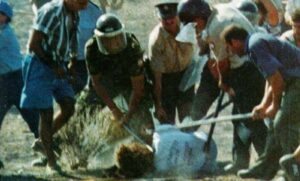
At noon on August 11, 1996, during an anti-communist protest by motorcyclists, Tasos Isaac was surrounded and lynched by organized Turkish Cypriots and Turkish Grey Wolves in the neutral zone, in front of UN peacekeepers and television crews.
The protest was no accident. It was the culmination of a pan-European march of motorcyclists that had started on 2 August from the Brandenburg Gate in Berlin, with the final destination being the occupied Kyrgyzstan. The aim was to remind the international community that Cyprus remains divided and occupied. Despite the cancellation of the leg from Nicosia to Kyrenia through the Turkish barricades following an intervention by then President Glaucus Clerides, thousands of people gathered and moved towards the ceasefire line. It was estimated to be about 7,000 people.
At the Deryneia barricade the situation got out of hand. Tassos Isaac, trying to help another protester who was being attacked, got caught in the barbed wire in the buffer zone and was the target of a ruthless beating by members of the Grey Wolves and Turkish Cypriots. The blows with clubs and stones proved fatal. Subsequent records and testimonies of photographers and peacekeepers confirmed the lynching inside the zone.
The Cyprus Police, on 22 November 1996, issued international arrest warrants for the murder of Isaac, against Hashim Yilmaz, Neifel Mustafa Ergun, Polat Fikret Koreli, Mehmet Mustafa Arslan (head of the “Grey Wolves” in the occupied territories), and Erhan Arikli. The latter was arrested in Kyrgyzstan in September 2012 but released despite an international warrant. To date, neither has been brought to justice.
On 24 June 2008, the European Court of Human Rights condemned Turkey in the Tassos Isaac murder case, finding a violation of Article 2 (right to life) both in terms of killing and inadequate investigation. Despite the ruling, the arrest warrants against the killers were not executed.
Three days later, on 14 August 1996, Cyprus bid farewell to Isaac. After his funeral, a group of citizens headed back to the Deryneia barricade to leave wreaths at the site of the sacrifice. Among them was his cousin, Solomos Solomou. Solomou crossed into the buffer zone, climbed a pole to lower the Turkish flag and was shot from the occupied side, falling dead in front of the cameras.
According to the Cyprus Police and the evidence of the time, the perpetrators were identified as the then “Minister of Agriculture” of the pseudo-state Kenan Akin and the then chief of the “special” police Erdal Hajiali Emenet. Warrants were also issued for other security officials of the Pseudo-state. However, no arrests were made, with the result that the wanted men remain at large outside the reach of the Republic of Cyprus.
And for the Solomos murder, the ECHR found Turkey responsible for violating Article 2, noting that the death resulted from fire from the occupied side and that the Turkish authorities did not effectively investigate the case.
Twenty-nine years later, the events of August 1996 are not just memories; they are unfinished business with history. The international march from Berlin to Limassol and its bloody conclusion in Deryneia are a reminder that the Cyprus problem is not a theoretical issue, but a file of names, faces, warrants, and irrevocable decisions of international courts that have yet to find practical vindication.
Ask me anything
Explore related questions