





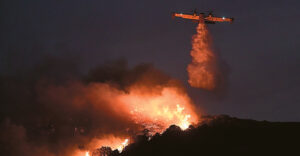
As darkness falls over fire-stricken Keratea, terror spreads along with the flames. Without the aircraft, which can only fly during daylight, firefighting is difficult. “No,” say the pilots of two Canadairs that are carrying out crucial drops.
This moment will go down in history as the first nighttime firefighting drop in our country, and it is also a glimpse of our future, as in distant Canada the first of the seven new Canadair 515s that Greece has ordered is already under construction—aircraft capable of operating at night as well.
According to the Canadian company De Havilland (which purchased Viking, the firm that acquired the Canadair production rights from Bombardier after the production line shut down in 2015 due to zero international interest), deliveries of the new firefighting aircraft will begin at the end of 2027 or early 2028.
Most likely the very first one—or, if not, one of the very first—will be Greek. Company executives promise that in any case, the DHC-515 will be stationed and operational for the 2028 firefighting season in the northern hemisphere. Beyond that, it will be usable not only for transportation but also for firefighting drops, 24 hours a day.
When they are coming
About 1,900 kilometers from where the legendary Canadair CL-415s and earlier CL-215s were once built, in Calgary, Canada, the first Greek DHC-515—the new generation Canadair—is under construction.
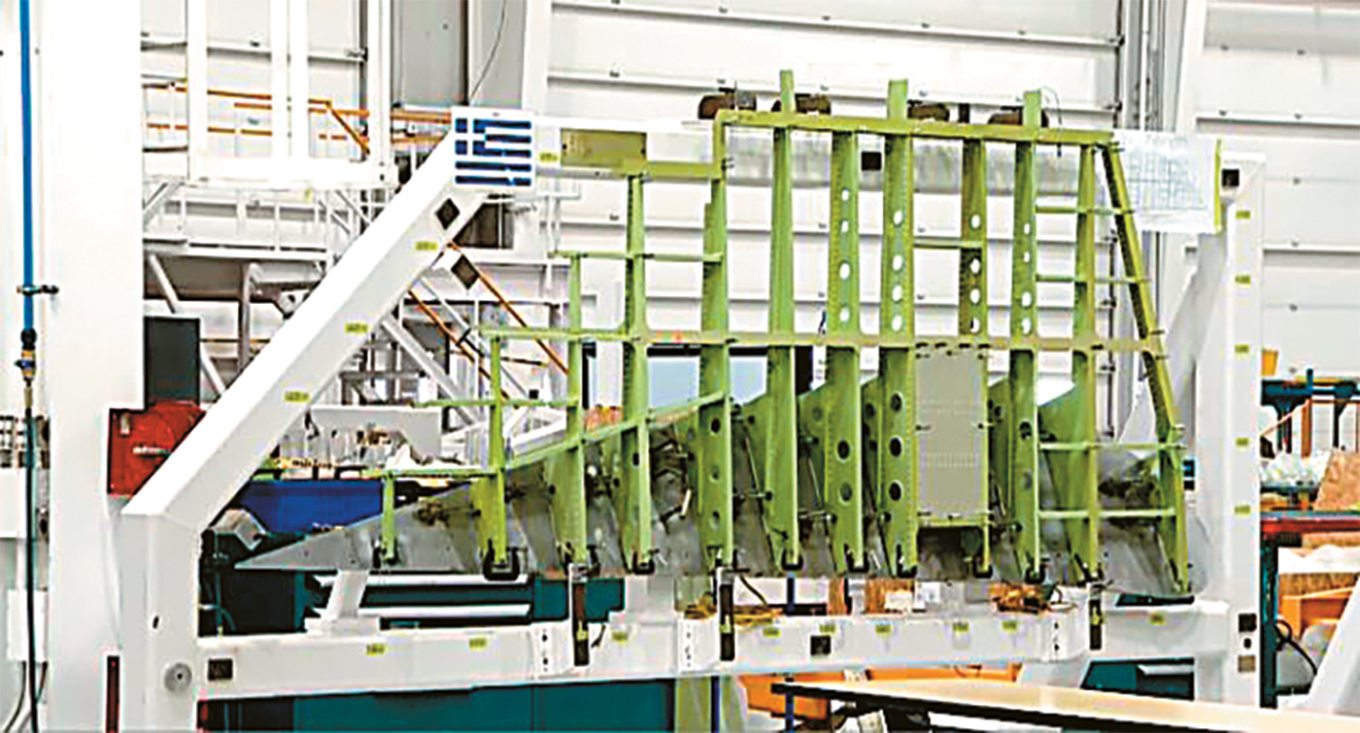
A fuselage section of the first Greek Canadair 515 is already being assembled in Canada.
The company has painted it blue and white to remind workers where the aircraft they are building will “land.” It will be the first of the new generation for the Hellenic Air Force, set to enter service in 2028. De Havilland hopes to deliver the rest at a rapid pace soon after.
Clients, after all, are “burning” to get them. The EU has ordered 24 Canadair 515s, while member states (Greece, Spain, Portugal, France, Italy, Croatia) have placed additional individual orders.
For De Havilland—who required “a sufficient number of orders” before restarting production, having learned from Bombardier’s fate when it “died” waiting for orders that never came because the EU and others were focused on fiscal austerity—the hardest part was finding suppliers and reorganizing them to restart production.
Any delays came from this. Now, executives say, things are on track—or, more accurately, the fuselage and wings are already on the production line.
De Havilland plans, to avoid falling behind schedule, to open another production line in Alberta, Canada, employing 1,500 people. But since demand for other aircraft is also increasing, the company is considering “exporting” production lines.
One country considered for such a line is Greece. Canadians have held exploratory talks with Greek companies, but so far without tangible results.
For now, the company’s main obligation is to deliver Greece’s order of 5+2 Canadair 515s (five funded through the Ministry of Civil Protection’s “Aegis” program, and two through the EU’s rescEU program). Deliveries: one in early 2028, another at the end of the same year, two in 2029, and the final three in 2030.
After that, De Havilland must handle the upgrade of the Hellenic Air Force’s CL-415 fleet to 515 standards. For the record, each new Canadair costs €50 million, while upgrading the CL-415s (essentially transforming them into 515s through a De Havilland branch in Greece in cooperation with local companies) costs €43 million per aircraft.
Night flights and other capabilities
“Forget what you knew about aerial firefighting,” promise the DHC-515’s manufacturers. They stress that beyond carrying the latest technology, the aircraft will feature outstanding operational capabilities, reduced maintenance requirements, and a lifespan comparable to the CL-215s—many of which have surpassed half a century of service.
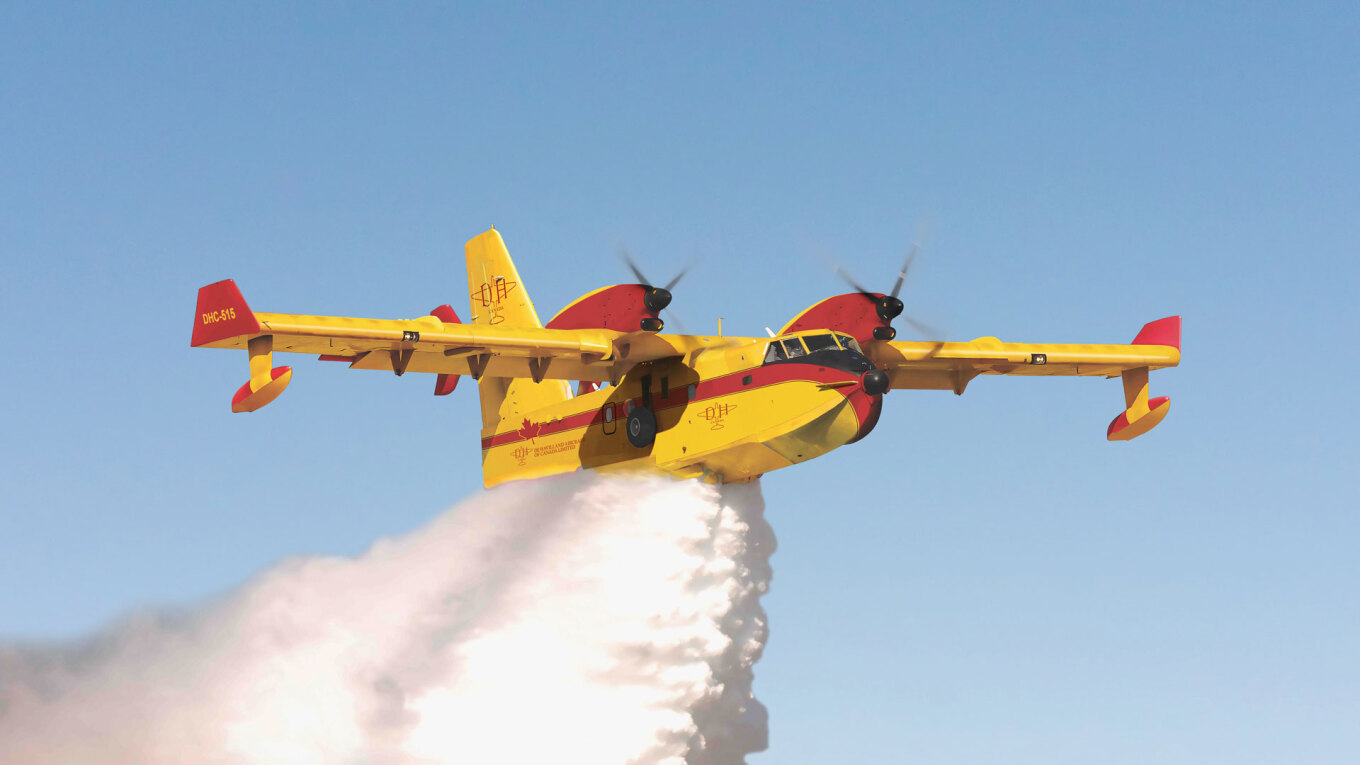
What makes them so desirable?
First of all, the avionics. With wildfires becoming more frequent and intense worldwide, the company decided to equip the 515 cockpit with the “glass cockpit” Universal Avionics InSight system, with touchscreens. It includes synthetic vision with advanced mapping, weather, terrain, and traffic data, enhancing safety and situational awareness.
The cockpit is “HUD ready,” meaning it can support night-vision helmets for pilots. This will make night operations easier, especially with improved VFR (visual flight rules).
The differences between the 515 and earlier generations of Canadairs are literally “night and day.” Pilots will not only operate more powerful, faster, and more capable aircraft but also in an entirely different cockpit environment.
There’s also an advanced climate control system (important given the extreme cockpit heat above wildfires) and other avionics tools making night operations easier.
The new Canadairs will feature 3D topographic maps powered by AI, connected directly to the operations center. Pilots will receive real-time updates on fire fronts and terrain, enabling in-flight analysis and optimized drop planning.
This means fewer “useless” data on their displays (critical for night flights) and improved efficiency.
In addition, the 515 has a revolutionary new drop system for water or retardant. Its capacity is 15% more than the CL-415’s—about 7,000 liters.
The larger tanks can fill in just 12 seconds (!) even in tight spaces (requiring 1,398 meters for approach, scooping, and takeoff at 15 meters altitude), including seas with waves up to 2 meters. Drops can be carried out every 5–7 minutes for three consecutive hours.
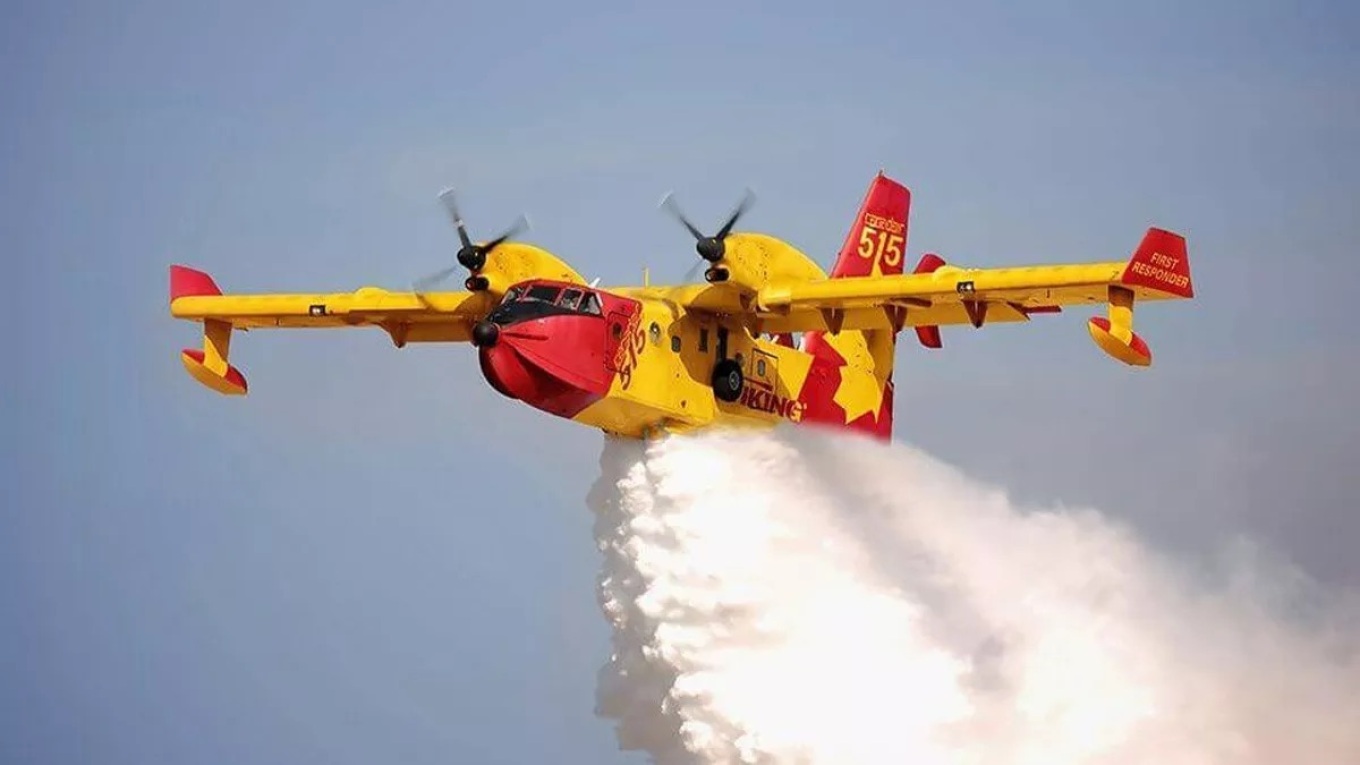
De Havilland estimates a Canadair can deliver over 690,000 liters of water during a typical “shift.” Under pressure, it could drop up to 115,000 liters per burning area per hour.
The aircraft comes with new, stronger engines (top speed 346 km/h), legendary structural durability, reliability, maneuverability, and operational capability—factors that make Canadairs famous and in high demand worldwide.
What about the rest of the fleet?
Today, 150 Canadairs exist worldwide: 117 CL-415s and 33 CL-215s. Some of the latter—first flown in 1967, with Greece acquiring its first in 1974—are now over 50 years old.
They operate in 11 countries (outside the U.S.), all of which are also ordering the 515: Canada, Spain, Italy, Greece, France, Morocco, Croatia, and Malaysia.
Globally, 125 CL-215s, 86 CL-415s, 3 CL-415MPs (maritime patrol), and 6 CL-415GRs were built. The “GR” designates the ones built specifically for Greece.
Today, Greece has 10 CL-215s and 7 CL-415s, having lost two modern Canadairs in accidents (April 7, 2006; July 23, 2007; May 5, 2014). Earlier CL-215 losses occurred in 1977, 1978, 1984, 1993, 2000, and most recently 2023—tragic incidents that claimed heroic crews.
Through these sacrifices, and thanks to dedicated ground crews, the Hellenic Air Force has kept its 17 Canadairs operational. All are covered by FOS agreements (for spare parts and support). The seven CL-415s will be upgraded—through a small De Havilland line in Greece—into 515s, with structural reinforcements, engine upgrades, and most importantly, the glass cockpit.
De Havilland will also provide night-vision helmets for CL-415 pilots, ensuring that Greece’s 7+7 Canadair fleet becomes homogeneous, reducing costs and simplifying training for pilots and mechanics.
The harder case is the CL-215s. Though outdated, they have proven extremely resilient—hence why they’re still used worldwide.
A support contract exists, but engine maintenance (Pratt & Whitney) is difficult. As long as they remain operational, they will continue to fly. De Havilland will support them until 2028 and then propose solutions for extending their service life and availability.
The competitors
Since Greece is one of the privileged countries to have Canadairs—the world’s best firefighting aircraft—and will be the first to receive the new generation, many nations are trying to find alternatives.
The main rival was the massive Russian Beriev Be-200, the world’s only jet-powered firefighting aircraft, capable of dropping 12 tons of water in 14 seconds. It was leased by Greece in 2002, 2007, and 2021.
Costing around $70 million, it ran into problems in 2018 when its Ukrainian engine parts supplier cut ties due to Crimea. Russia replaced them with SaM146 engines from the Sukhoi Superjet, which required NATO parts. France and Greece expressed interest, but in 2021 the program shifted to purely Russian engines. After the 2022 invasion of Ukraine, sanctions followed.
The EU revoked certification for Berievs, banning them from flying in Europe. Production also halted after Ukrainian drone strikes on the factory. Chile, which had ordered them for 2021, has yet to receive any.
Other alternatives: Israel successfully tested firefighting C-130s in Cyprus. Airbus has teamed with French company Hynaero on the Fregate-F100. Rumors swirl that Airbus may adapt an existing platform, but it is cautious, not wanting another failure like the Supertanker (a modified Boeing 747 capable of dropping 74,000 liters but retired in 2021 after Evergreen’s bankruptcy).
Elsewhere, startups in France, Belgium, and Italy are working on concepts to capture part of the estimated $16–20 billion market. In the U.S., the FF72 is being developed on the ATR72 platform.
Which of these will actually make it to market remains to be seen.
Ask me anything
Explore related questions




