





Once upon a time, centenarians in Greece were rare cases that many heard about but few actually knew. Today, Greeks live longer and with better quality of life than ever before. And while in the past Ikaria and Crete were mentioned as the prime examples, today Lesvos, Chios, the whole of the North Aegean islands, and Epirus also take the spotlight. Is longevity the result of a lifestyle code and personal choices, or simply a matter of genetic evolution?
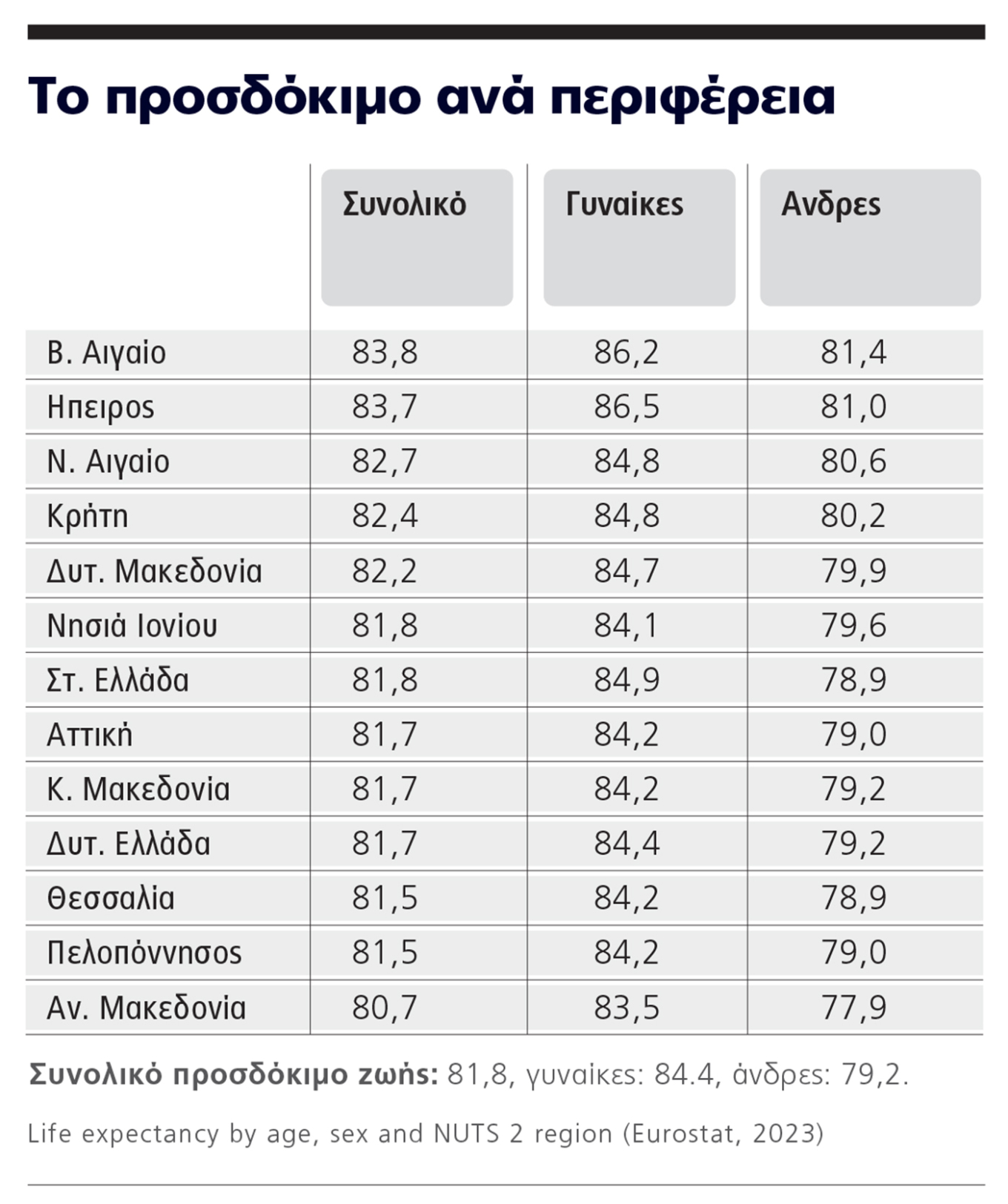
According to Eurostat data (2023), the women of Epirus lead longevity in Greece. However, in combined averages of men and women, the longest-lived Greeks are in the North Aegean islands, where life expectancy reaches 83.8 years.
Women in the region reach on average 86.2 years, while men live to 81.4. This picture comes as no surprise, as Lesvos, Chios, and Samos rank high, while Ikaria has been internationally studied for its longevity rates.
Epirus ranks second, showing that long life is not limited to the islands. There, overall life expectancy reaches 83.7 years, with women averaging 86.5 years and men 81.
In third place comes the South Aegean, with life expectancy at 82.7 years. Although women there live up to 84.8 years, men lag behind at 80.6, the smallest gender gap in Greece (4.2 years). By contrast, Eastern Macedonia records the lowest overall life expectancy in the country, only 80.7 years, and one of the largest gender gaps at 5.6 years.
The widest gender gap, however, is found in Central Greece, where women live on average 6 years longer than men. This finding shows that differences between men and women in life expectancy are not necessarily linked to a region’s overall longevity.
At the national level, the average life expectancy in Greece is 81.8 years. Women consistently lead, reaching 84.4 years, while men average 79.2. This gap, observed across all regions, reflects both biological factors and lifestyle differences.
Stories of the Long-Lived
Mrs. Evdokia, 94, attributes her long life to a mix of genes and personal choices. “I have good genes, but that’s not enough. For about 50 years I’ve avoided foods that didn’t agree with me.” She eats balanced meals, doesn’t drink, doesn’t smoke.
Mrs. Frideriki, 87, living in a village near Aliveri in Evia, describes her daily life: “Every morning I wake up and take care of my chickens and garden, where I have herbs, cucumbers, and zucchini.” Her routine is closely tied to nature.
Mr. Giorgos, 84, who splits his time between Athens and Gytheio, believes his good life is due to leaving his administrative job after 25 years to dedicate himself to his olive trees.
Mr. Spyros, 85, from Corfu, says he has never eaten processed foods. “I eat only fresh fish, fruit, and vegetables from my garden. As for meat? Rarely, and only from a butcher friend I trust.”
Diet, Emotional Bonds, Activity, and Sleep
Studies show that the so-called Mediterranean diet increases life expectancy. It is rich in vegetables, legumes, whole grains, eggs, fish, with limited red meat and no processed foods.

Clinical dietitian Panagiotis Zisis explains: “Fish and seafood rich in omega-3 fatty acids support longevity. Antioxidants protect against cellular aging, while vitamin C (from fresh fruits and vegetables), vitamin E (olive oil, nuts), and polyphenols (berries, red wine) play a key role in maintaining health.”
Fermented foods like yogurt and pickles also support gut health and longevity. The Cretan diet, rich in wild greens, olive oil, honey, and grape molasses, embodies these principles.
Community and Belonging
In Ikaria, wine symbolizes community ties, says pharmacist and winemaker Nikos Afianes. Families make their own wine, shared at gatherings, festivals, and Sunday meals. Strong social bonds, physical work, walking, and daily exposure to the sun contribute to well-being.
Sleep is also crucial: humans need 8 hours per night, yet we are the only species that routinely suppresses this need. Good sleep is a key factor in anti-aging.
The Profile of Centenarians
According to pathologist Vasilis Tsakraklidis:
- Centenarians usually enjoy high quality of life until death, mainly from cardiovascular disease (40%).
- They are mostly women, often firstborn children, living in rural areas.
- Common traits include:
• Love of life
• Optimism and realism
• Physical activity
• Strong mental engagement
• Enjoying small pleasures
• Wide interests
• Active social life
• Sense of humor
• Religious faith and spirituality
• Low blood pressure
• No smoking, minimal drinking
Genes and Longevity
Some inherit “bad” genes (e.g., BRCA1, APC), while others inherit “good” ones favoring longevity. Children and grandchildren of centenarians are more likely to live past 100. Advances in treating cardiovascular disease, strokes, and cancer are expected to extend life expectancy by at least 15 years.
Men vs. Women: EKPA Study of 400 Centenarians
Research by Xanthi Ch. Tigani (National and Kapodistrian University of Athens, Medical School) with 400 Greek centenarians showed:
- Women centenarians: higher rates of widowhood, lower education levels (reflecting past social norms), greater adaptability, higher socialization and kindness, optimism linked to external health control.
- Men centenarians: more likely to have a centenarian first-degree relative (strong genetic factor), greater optimism, strong self-direction, spirituality, and belief in self-responsibility for health.
Self-assessment of health was higher than expected: centenarians felt relatively healthy despite their age. Living with family or caregivers, strong family ties, optimism, and adaptability supported positive health perception, while obesity harmed it.

Peter Diamandis: The Greek Mentor of Longevity
Greek-American entrepreneur Peter Diamandis, born in 1961 in New York to immigrant parents, studied Molecular Genetics and Aerospace Engineering at MIT and Medicine at Harvard before turning to innovation.
Inspired by the question: If the bowhead whale lives over 200 years and the Greenland shark up to 500, why can’t humans? he now focuses on AI, genomics, CRISPR, and regenerative medicine, aiming for decades of healthy life extension within the coming decade.
Ask me anything
Explore related questions




