





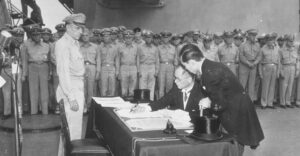
When an American-led armada sailed into Tokyo Bay 80 years ago to accept the Japanese surrender in World War II, it had been just 27 days since the first – also American – atomic bomb killed some 70.000 people with a single strike in Hiroshima. It had been 125 days since Adolf Hitler committed suicide, ending the life of the man responsible for the slaughter of 60 million souls, and 218 days since the liberation of Auschwitz by the Red Army, where the disembodied survivors martyred in the depths of human brutality.
The lessons, for many Americans, seemed self-evident: Isolationism, nationalism, and authoritarianism lead to disaster. Alliances, free trade and democracy are the only way forward. And the US must take the lead.
The US must take the lead.
Despite the turbulence, this consensus has generally held – at least among policymakers – for nearly 80 years. But the presidency of Donald Trump, with its unrelenting commitment to American primacy, may mark its end, but it also changes the world has never before encountered or confronted.
“How do you navigate a complex and dangerous world? You don’t do it by tearing down what has worked,” said former Senator and Secretary of Defense Chuck Hagel, a Republican from Nebraska, in an interview with the Washington Post. “You don’t tear up a postwar world order based on institutions, the rule of law, and common interests. That’s very dangerous. It is the greatest threat to the future of humanity.” Hagel’s father served in the South Pacific during World War II, and he, who was awarded two Purple Hearts in Vietnam and served as Secretary of Defense under President Barack Obama, also stressed that the memory of World War II was everywhere when he was growing up in his small town in Nebraska.
“In the 1950s, everyone in town was a World War II veteran. Every kid at that time was aware of what happened, why it happened, how it ended and what the future held.”
But the generation that remembers Nazi Germany, Imperial Japan, the death camps and atrocities has all but died out. Of the 16.4 million American World War II veterans, just 45,418 – far less than 1 percent – are still alive, according to the National World War II Museum. Of the five U.S. presidents who have served this century, four – Bill Clinton, George W. Bush, Trump, and Joe Biden – were born during or immediately after the war. The next president is assumed to have grown up in a much later era. All this at a time when fewer and fewer Americans today believe that active engagement in the world is important to the United States. In 2024, just 56% said the country should be actively involved in international affairs – a historically low percentage, according to a poll by the Chicago Council on Global Affairs.
This change also reflects the growing feeling among many Americans that the U.S. has tried to do too much: expanding too much, wasting money, sacrificing lives, getting involved where it didn’t want to be, and letting others take advantage of the situation.
White House officials argue that this is not a dilemma and that Trump has succeeded in promoting international stability while ensuring that American interests come first. They cite the Armenia-Azerbaijan peace deal, the Abraham Accords, and a peace agreement between Rwanda and the Democratic Republic of Congo as evidence that Trump is willing to act on the international stage, just not in a way that wastes American lives and dollars.
“America First has never meant America Only, and President Trump has effectively restored America’s place on the international stage while strengthening international stability,” said White House deputy spokeswoman Anna Kelly. “His foreign policy accomplishments speak for themselves – by leveraging diplomatic relations, fair trade is being restored, more than 70 Americans detained abroad have returned, borders are secure, Europe is taking responsibility for its own defense, and longstanding conflicts around the world have ended.”
Curt Volcker, US ambassador to NATO under Bush, also argues that Trump’s approach reflects a timeless element of American public opinion. “There is an undercurrent in American life that says we don’t want to burden the world, that we are divided by oceans, we are peaceful and free, and we just want to get on with our lives,” he said. “That trend has always existed.”
However, Volcker argued that most Americans still believe in the promotion of democratic values by the United States. “President Trump and Vice President Vance are expressing a frustration with how they feel America has done too much and that others should do more,” he said. “They can win supporters, but I don’t think that’s where the hearts of Americans are today.”
Moreover, defenders of the postwar consensus argue that even if many Americans would prefer to withdraw from the world, that is not sustainable.
“The world will come to you if you’re not there – that’s what happened in World War II. We thought we could stay out, and then we were attacked by Japan,” said Ivo Dalder, Volcker’s successor as ambassador to NATO under Obama. “The danger is that in a world that remains deeply interconnected – deeply interdependent – the possibility of withdrawal is almost nil,” he added.
Eighty years ago, desperate to avert a new global catastrophe, leaders built bastions that defined the modern world. They met in New Hampshire in 1944 to create an interconnected financial system and in San Francisco in 1945 to establish the United Nations. NATO was born in 1949 and a few years later an early version of the European Union. The philosophy was clear: anything that could bind nations together so that they would never fight again.
Trump has attacked many of these institutions, questioning the value of NATO and criticizing the United Nations. Of the European Union, he said in February that it was “created to exploit the United States.” With heavy tariffs, it upended the international trading system that began with the 1947 General Agreement on Tariffs and Trade.
Trump has exploited widespread frustration with the results of US international engagement. Few would dispute that America has often been subjugated to its ambitions to be a beacon of freedom. Particularly in the Cold War, the United States regularly supported authoritarian regimes simply because they opposed the Soviet Union, and targeted democratic movements if they did not align with the West.
For decades, the Soviet Union, armed with nuclear weapons, posed a threat that underscored the need for engagement. Its collapse in 1991 caused many to question whether that engagement was still necessary. The war in Iraq, which began twelve years later, seemed to highlight the futility of US overextension, with the US losing more than 4,500 troops.
But Trump is not alone. And in Europe, where many of the tragedies of World War II unfolded, the once-unassailable lessons of war are rapidly losing their power. Britain left the European Union in 2020, disapproving of the post-war system of alliances. Nationalist and anti-immigrant parties are gaining strength and shedding their stigma – even in Germany and France, two key countries of World War II.
When ships of Allied nations assembled in Tokyo Bay on the morning of September 2, 1945, some observers saw not only the end of the war but also the anticipated end of an era of carnage that included World War I and the Great Depression.
The Japanese delegates boarded the USS Missouri and signed the Practice of Surrender shortly after 9 a.m., followed by General Douglas MacArthur, who expressed the hope that “a better world will emerge from the blood and carnage of the past.”
In a radio address later that day, MacArthur proclaimed: “A great victory has been won. The sky no longer rains death.” But he added a more sombre warning: ‘We have had our last chance. If we do not now create a more just and balanced system, the apocalypse will stand at our doorstep.”
American leaders and their counterparts then rushed to build that more equitable system. But with memories of the war fading, the sense of impending Armageddon has also faded.
“The living memory of World War II has all but died out – and that’s the important thing,” Eliot Cohen, a former top adviser to Secretary of State Condoleezza Rice, also recently said. “There was never a full consensus on the details of foreign policy, but there was a realization that really horrible things could happen and that isolation was not a realistic option.”
If we forget this lesson, Cohen stressed, “we are playing with our fate. We increase the risk of disaster. For Britain in 1940, there was at least the United States standing behind it. Today, no America is standing behind America.”
Ask me anything
Explore related questions




