Libya has opened fronts not only with Greece but also with other neighboring countries, after the Tripoli government decided to unilaterally submit to the UN the external limits of its Exclusive Economic Zone (EEZ), which it delineates based on the Turkey–Libya Memorandum, as well as the agreement granting offshore blocks to the Turkish company TPAO — blocks which of course violate the sovereign rights of neighboring countries.
Following Greece’s reactions — including its second note verbale to the UN on September 3 (see the letter) — and Egypt’s, Malta has now also strongly reacted. Malta, which has a history of litigation with Libya at The Hague and a 1985 ruling on maritime boundaries, has issued two formal diplomatic protests, calling Tripoli to dialogue. Interestingly, Tripoli’s interim foreign minister, Taher Salem Al Baour, rushed to Malta, and after talks with the government, it was agreed to begin negotiations on pending maritime zone issues. They even left open the possibility of third-party participation in the talks, pointing to Italy in the east and Tunisia in the west.

On Monday, Greek Foreign Minister Giorgos Gerapetritis met with Belgacem Haftar, son of the powerful man of Eastern Libya, Khalifa Haftar. On Wednesday, a meeting is also expected with Tripoli’s interim foreign minister, Taher Salem Al Baour.
Al Baour will be in Athens this Wednesday, returning the visit Gerapetritis had earlier made to Tripoli. This creates an important opportunity for Athens to push for the launch of the first round of negotiations between the two countries on maritime boundary delimitation.
Greece’s leverage is greater, since the licensing of two offshore blocks south of Crete, in which the American energy giant Chevron is entering, creates a serious fait accompli against Libya’s claims under the Turkey–Libya Memorandum.
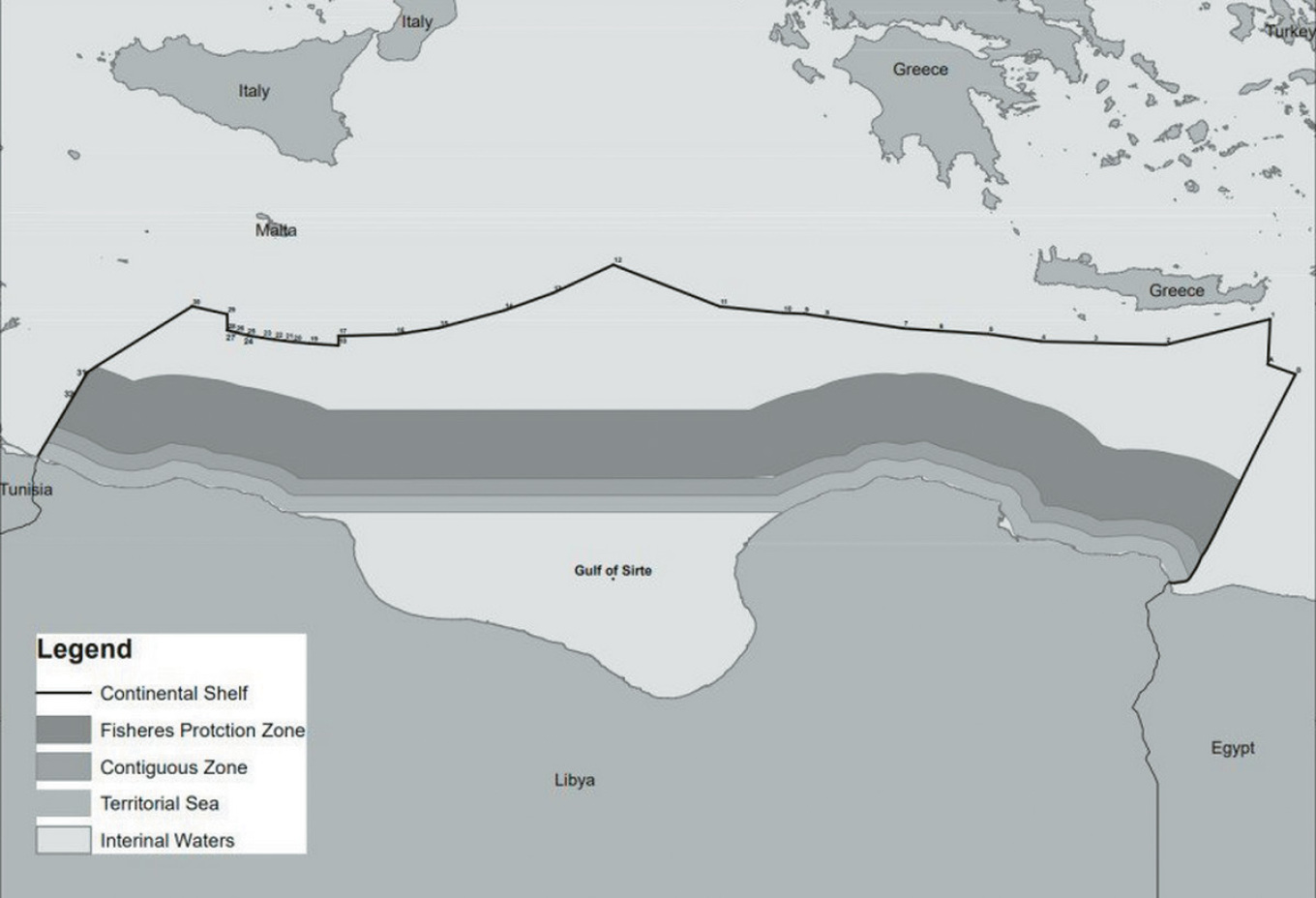
By provoking tensions not only with two EU member states — Greece and Malta — but also with its strongest neighbor, Egypt, Tripoli is opening fronts it clearly cannot manage. Especially now, as political settlement efforts are peaking, the Libyan government cannot afford isolation from the EU or an open clash with a permanent UN Security Council member.
Despite the limited trust toward both Libyan sides, the current moment may be favorable for the start of negotiations, possibly even for recourse to The Hague, where pressure would inevitably include examining the legality of the Turkey–Libya Memorandum.
Malta’s reaction
In its first note verbale, Malta completely rejects the map and coordinates submitted by Tripoli to the UN on May 27, as they encroach upon Malta’s continental shelf and EEZ.
Libya, acting unilaterally on both sides of the delimitation line established by the International Court of Justice in 1985, shifted the median line northward at Malta’s expense. Malta’s diplomatic note stresses that Libya applied the median line method between continental coasts, thereby distorting the delimitation — ignoring islands, as in the Turkey–Libya Memorandum. Notably, by doing so, Libya avoided creating friction with its close ally Italy, since it treats Sicily as part of continental Italy.
Malta also strongly objects to Tripoli’s practice of closing the Gulf of Sirte and calls on Libya to return to the baseline established back in 1973.
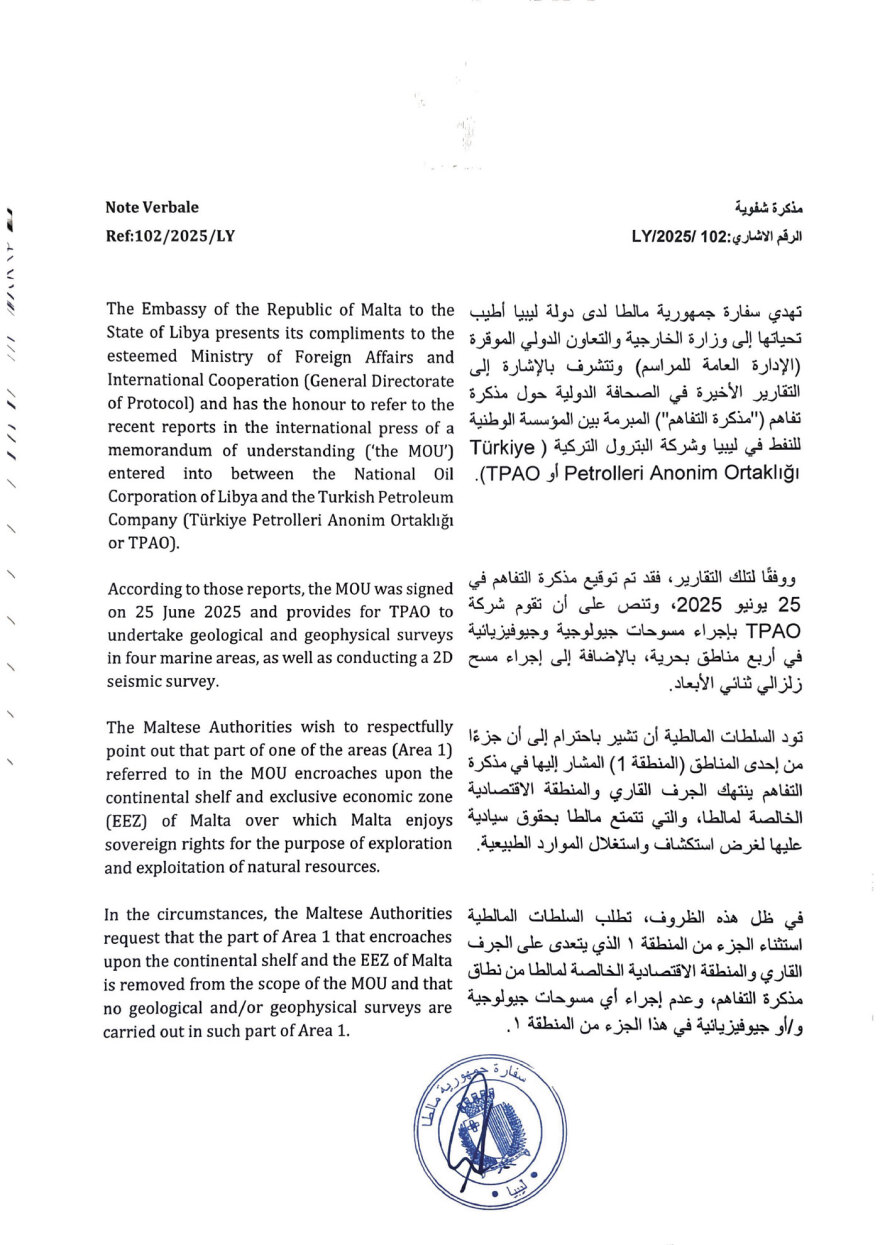
Malta’s second note verbale came after the July agreement between Libya’s NOC and Turkey’s TPAO, which granted four blocks to the Turkish company for exploration. Malta demands that the portion of Block 1 overlapping its continental shelf and EEZ be excluded from the deal, and that no geological or geophysical surveys take place in that section. It also declares that no marine scientific research can be conducted in its EEZ or continental shelf without Malta’s consent.
Of particular interest: in both Malta’s and Egypt’s case, the blocks delineated by Libya — and reportedly granted to Turkey’s TPAO — violate maritime delimitations with those countries (though no agreements exist). By contrast, in relation to Greece, Libya drew all its blocks along the median line defined by Law 4001/2011.
Texts of Malta’s Notes Verbales
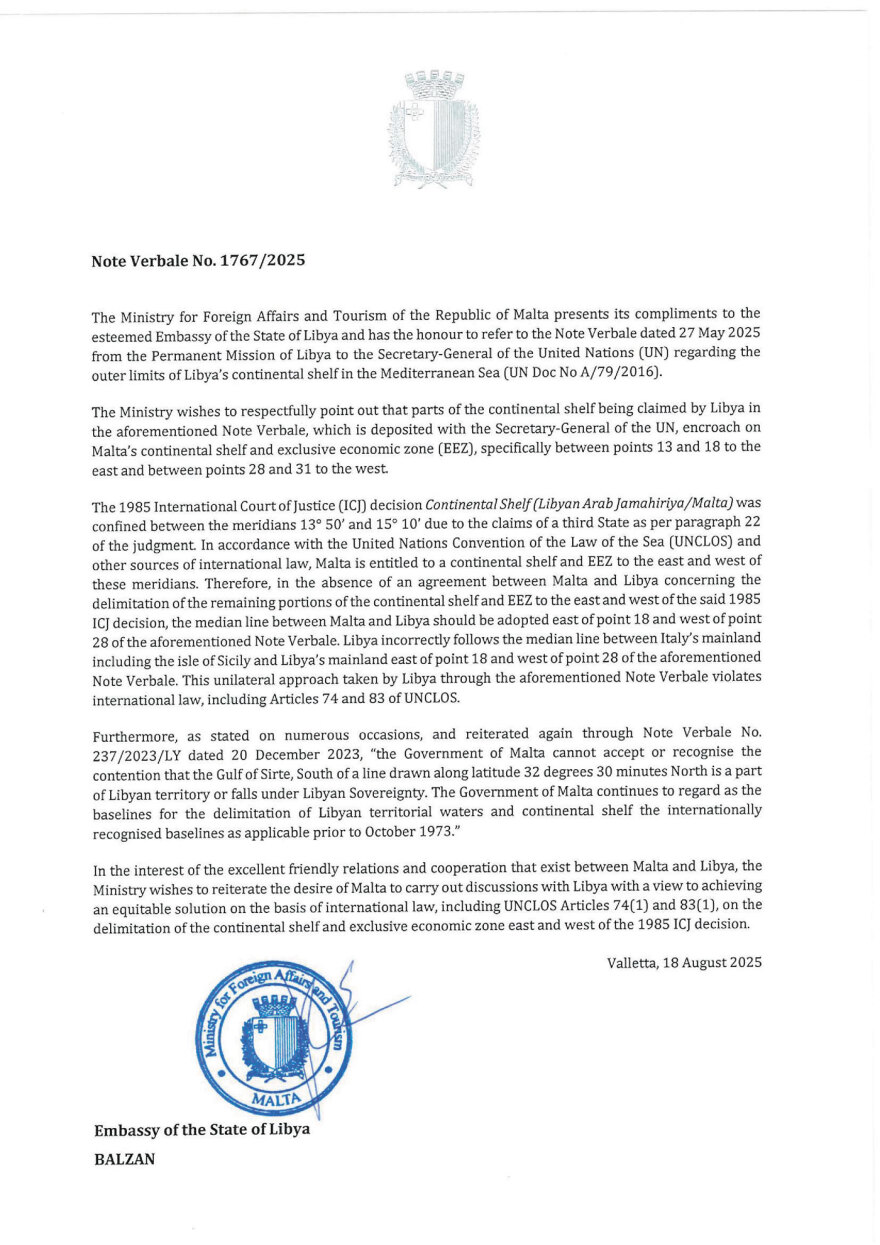
Note Verbale No. 1767/2025 (Valletta, 18 August 2025):
“… The Ministry wishes to respectfully note that parts of the continental shelf claimed by Libya in the aforementioned note verbale encroach upon Malta’s continental shelf and EEZ … The 1985 ICJ judgment limited delimitation between 13° 50’ and 15° 10’ meridians. Under UNCLOS, Malta is entitled to continental shelf and EEZ east and west of that area … Libya’s unilateral approach violates international law, including UNCLOS Articles 74 and 83 … The Government of Malta cannot accept Tripoli’s claim that the Gulf of Sirte constitutes Libyan internal waters … Malta reiterates its willingness to negotiate with Libya to reach a fair settlement under international law.”
Note Verbale Ref:102/2025/LY (Tripoli, 9 July 2025):
“… The MoU between Libya’s NOC and Turkey’s TPAO signed on 25 June 2025 grants the Turkish company rights to conduct surveys in four offshore areas … One of these (Area 1) overlaps Malta’s continental shelf and EEZ … Malta requests that this portion be excluded from the MoU and that no surveys take place there … Malta further insists that no marine scientific research can be carried out in its EEZ or continental shelf without its consent … Malta invites Libya to open discussions to resolve overlapping claims under international law.”
Ask me anything
Explore related questions