





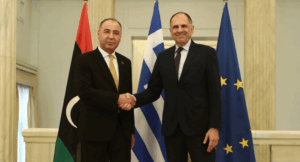
The first step in a process that is expected to be arduous and of uncertain outcome was taken yesterday, with the launch of discussions on the delimitation of the Exclusive Economic Zone (EEZ) between Greece and Libya. The meeting took place in Athens between the foreign ministers of the two countries, Giorgos Gerapetritis and Taher Salem Al Baour.
According to the statement of Foreign Ministry spokesperson Lana Zochiou, “the two ministers declared the start of the process for the delimitation of the Exclusive Economic Zone between Greece and Libya. In this context, the first session of the technical committees was held. It was agreed that the next meeting will take place in Tripoli.”
Notably absent from this first session was Deputy Foreign Minister Alexandra Papadopoulou, head of the Greek negotiating team, who arrived yesterday in Washington. Still, it was decided there was no reason to delay the launch of the process. Representing Greece were the political director of the Foreign Ministry, Ambassador A. Fryganas; the head of the A6 Directorate, F. Georgakakis; and two members of the Special Legal Service, Alexandros Kolliopoulos and Aliki Gkana.
After the initial meeting of the two delegations, the two ministers held a private discussion, while the first meeting of the negotiating teams took place in parallel, lasting over an hour. This was followed by talks between the expanded delegations.
According to the Foreign Ministry, Giorgos Gerapetritis emphasized the need to respect international law, including the Law of the Sea, and reiterated the Greek and European position that the Turkey–Libya memorandum is null and void.
Sources indicated that the meeting of the technical teams was exploratory, aiming to assess each side’s positions and whether any changes had occurred since the last round of talks in 2010–2011. Since then, of course, the landscape has changed significantly — most notably with Tripoli’s signing of the Turkey–Libya memorandum.
The Benghazi question
Another serious issue is how Benghazi will be involved in this dialogue, since the Haftar camp does not recognize the Dbeibah government nor considers itself bound by the agreements it has signed. Up to now, Eastern Libya’s rejection of the Turkey–Libya memorandum has rested on two arguments: that it was never ratified by parliament, and that the interim government lacked the legitimacy to sign such agreements.
This may change, however, due to pressure from Turkey on Benghazi as well as Haftar’s intent not to appear “conceding” to Greece at this critical juncture.
Positions of Athens and Tripoli
At the start of the process, Greece regards as non-negotiable the principle that discussions must cover the entirety of the EEZ between the two countries, including the area encompassed by the Turkey–Libya memorandum. Moreover, if no agreement is reached, Greece’s aim is for the dispute — including the memorandum — to be referred in its entirety to the jurisdiction of the International Court of Justice in The Hague, so that the Court may also rule on the memorandum’s legality.
Libya, on the other hand, believes that this process should undo the fait accompli created by Greece with the delineation of the median line under Law 4001/2011.
Both Athens and Tripoli have already made their diametrically opposed positions on the issue public, through letters submitted to the United Nations since 2019. Over the last three months in particular, Libya has been accused of arbitrarily interpreting the Law of the Sea, aligning with Turkish arguments, despite the fact that Libya — unlike Turkey — has signed the UN Convention on the Law of the Sea.
According to reports, the Libyan foreign minister showed particular eagerness to begin talks. This is seen as a result both of Greece’s moves to delineate and license offshore blocks west, southwest, and south of Crete, and of Tripoli’s desire to appear conciliatory toward the EU and Greece, which carries significant weight in Libyan affairs due to its seat on the UN Security Council.
Broader bilateral relations
During the talks at the Greek Foreign Ministry, bilateral issues were also addressed, following up on Gerapetritis’s recent visit to Tripoli. Cooperation was discussed on migration — with Greece expressing readiness to continue training members of the Libyan coast guard — as well as in the areas of economy, energy, transport, and construction.
The two ministers also expressed readiness to launch a direct air connection between Athens and Tripoli and agreed on the organization of a Greek business mission to Tripoli in the autumn.
Ask me anything
Explore related questions




