





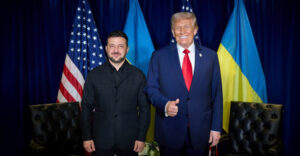
Donald Trump has never been a politician known for grand speeches. His heavy business profile and his preference for handling matters personally—face to face whenever possible—have reshaped the landscape, especially on the war that has been raging in Ukraine for almost four years.
The American president has been called many things and accused of many more, but even his fiercest enemies cannot credibly dismiss him as a fool. Still, the White House’s 180-degree turn since February 28 is striking. From openly humiliating Volodymyr Zelensky to now declaring that “Ukraine can win back all its territories,” the shift feels like a change of eras, as if different historical figures were at play.
On Sunday, Trump declared:
“Putin and Russia are in BIG economic trouble, and this is the time for Ukraine to act. In any event, I wish both countries well. We will continue to supply weapons to NATO for NATO to do what they want with them. Good luck to all!”
What Trump Said, and When
- February 28, 2025 – Oval Office, Washington, DC
In his first meeting with Zelensky, Trump warned that Ukraine was “gambling with the lives of millions” and risking “World War III.” He argued that without U.S. equipment, the war would have ended in two weeks and urged an immediate ceasefire. - March 4, 2025 – Washington
Claimed to have received a letter from Zelensky, expressing willingness to negotiate “as soon as possible” for lasting peace. - March 17, 2025 – Air Force One
Told reporters he planned to contact Vladimir Putin, saying “a lot of work was done over the weekend” on a peace initiative. - August 16, 2025 – Interview after Alaska meeting
Suggested that “land swaps” and “security guarantees” were discussed with Putin, hinting at possible concessions. - September 3, 2025 – Meeting with the President of Poland
Warned Putin that “if his decisions on Ukraine are not satisfactory, you will see things happen.” - September 7, 2025 – Statement on sanctions
Argued that the war would end if NATO states stopped buying Russian oil and imposed high tariffs on large buyers like China. - September 18, 2025 – Comments after Alaska meeting
Said Putin had “disappointed” him, accusing him of “killing a lot of people” and admitting that talks had stalled. - September 21, 2025 – Dinner at Mount Vernon
Criticized European states for importing Russian energy, saying they were “funding the war against themselves.” - September 23, 2025 – UN General Assembly, New York
After meeting with Zelensky, reversed course, declaring Ukraine—with NATO and EU support—could win back “all its territories,” including Crimea. Called Russia’s campaign “long-winded and ineffective,” urging Europe to immediately cut energy imports from Moscow.
A Turning Point
For the first time since taking office, Trump has taken an explicitly pro-Ukraine stance. The change stunned even close allies such as Senator Marco Rubio. If matched with concrete action—such as renewed U.S. military aid before winter—it could alter the trajectory of the war.
Trump, a long-time acquaintance of Putin, has now chosen to openly challenge him. Moscow is expected to escalate both attacks and contingency plans in response. For the first time, Trump’s statements exert direct pressure on Russia, which until now has benefited from time, space, and exposure.
For Kyiv and its pro-Democrat allies, Trump’s shift provides a clear, public U.S. commitment that could help push through long-stalled issues. Zelensky himself, after meeting Trump, pointed to new military data showing tangible evidence of change.
The Clear Danger
The risk, however, cannot be ignored. The same man who is “all in” today may walk away tomorrow. Trump is unpredictable, though unlikely to reverse himself without allowing time for results. The impact of his words will depend heavily on whether they are backed by swift deliveries of weapons and systems that could enable Ukraine to recover occupied territory.
Toward the Harshest Winter
Developments in Ukraine are set to accelerate. Winter in the region is traditionally severe, and this year is expected to be one of the coldest in a decade. Historically, the most intense fighting has taken place between February and April. With Russia rearmed and reorganized, the coming months could be the most difficult phase of the war so far.
But the “heavy winter” will not fall only on Ukraine. If Trump follows through and Europe severs energy ties with Moscow while imposing strict sanctions on third parties, the Kremlin will face severe challenges sustaining the current pace and intensity of the war.
Ask me anything
Explore related questions




