





How dangerous can meteoroids — the objects that cause meteors, commonly known as shooting stars — become? Although these tiny bodies usually burn up as soon as they enter Earth’s atmosphere, this is not the case outside of it. When they collide at high speeds with other objects in space, the consequences can often be catastrophic. A research program run by the European Space Agency (ESA) and the National Observatory of Athens (NOA) is studying these impacts to strengthen planetary defense.
The NELIOTA project (Near-Earth object Lunar Impacts and Optical TrAnsients) has been underway since 2015 and has just entered its third phase. Its goal throughout all phases is to study meteoroids — objects ranging in size from a few millimeters to several centimeters — which travel at extremely high speeds, from 15 to 60 kilometers per second. Their kinetic energy is so great that they can pierce metal and therefore pose serious risks to artificial satellites and future lunar bases.
The Moon serves as a natural laboratory for this program. Because meteoroid speeds cannot be reproduced in terrestrial laboratories, the Moon — which has no atmosphere to shield it, meaning all meteoroids strike its surface — is the ideal testing ground.
“We may be studying the flashes created by impacts on the Moon, but ultimately we want to understand what happens when objects of this size strike artificial satellites. There are now several thousand satellites orbiting Earth. Also, since humanity plans to build lunar bases, it is important for us to know the consequences of such impacts,” explains Dr. Alexios Liakos, research associate at the Institute for Astronomy, Astrophysics, Space Applications and Remote Sensing (IAASARS) of the National Observatory of Athens, and the scientific lead of the program.
Since the program began, 193 fully confirmed flashes from impacts on the Moon’s surface have been recorded, along with an additional 103 candidate events. By analyzing these flashes, scientists can estimate the mass and radius of the impacting bodies, the size of the craters they create on the Moon, and — for the first time — the temperatures produced by the impacts. For the 193 confirmed flashes, it was found that in most cases the impacting objects had a mass of less than 200 grams and a radius of about 1–3 centimeters.
“Mass together with speed gives us kinetic energy, which allows us to understand the potential damage such an object could cause if it struck something human-made — such as a spacecraft, an artificial satellite, or infrastructure on the Moon. Also, the temperatures that develop within tenths or hundredths of a second, reaching 3,000–4,000°C, help us select materials for space missions that can withstand these sudden temperature spikes,” Dr. Liakos notes.
The program’s third phase, funded by Horizon Europe, began in the summer and will last three years. A month ago, the team resumed observations, and during the first four nights they detected five possible lunar flashes, though only one was fully confirmed — the 193rd since the program’s inception.
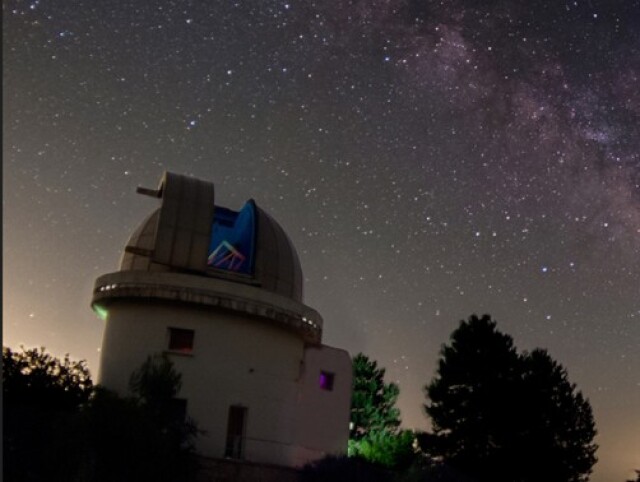
The project is based at the Kryoneri Observatory in Corinthia, Greece, where a 1.2-meter telescope — the largest in the world dedicated to observing the Moon — uses two advanced digital cameras to capture images of the Moon at 30 frames per second in two different wavelengths. This allows researchers to estimate the temperature of the flashes. An automated software system then analyzes the images to detect potential impact flashes.
The program will result in the development of an open-access lunar impact flash database, inviting the broader scientific community to contribute.
In addition to the ground-based NELIOTA observations, ESA is funding the LUMIO space mission, in which a small CubeSat satellite will be launched in late 2026 and sent to the Moon’s far side to record lunar flashes. Dr. Alexios Liakos and Dr. Alkistis Bonanos — research director at IAASARS/NOA and former scientific lead of NELIOTA — are participating in the mission as scientific advisors.
Ask me anything
Explore related questions




