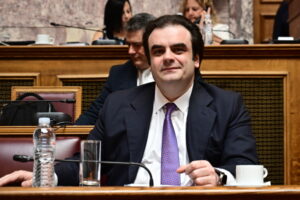
Minister of National Economy and Finance Kyriakos Pierrakakis Testifies on the Draft State Budget
Today, Minister of National Economy and Finance Kyriakos Pierrakakis presented the draft state budget before the House Standing Committee on Economic Affairs. “The potential for supporting society will increase as long as we continue our policy of stability and growth,” Pierrakakis noted, projecting that the Greek economy is expected to record a significantly higher growth rate than the eurozone average for the sixth consecutive year.
The Minister emphasized that the growth rate is expected to reach 2.2% in 2025 and 2.4% in 2026.
Below is the full text of his speech:
“Ladies and Gentlemen of Parliament,
Dear Colleagues,
I would like to begin by expressing my personal joy and, on a political level, welcoming the positive outcome of the peace efforts in Gaza, achieved through intensive consultations over the past period.
This is a bright light in the darkness of a two-year conflict, a very important development for the region, the world, and for Greece. It removes a significant source of geopolitical instability and uncertainty that has influenced economic calculations in Europe and in our country.
Nevertheless, international uncertainty remains. Despite the positive developments in Gaza, the Middle East continues to experience heightened geopolitical volatility. In our era, peace is no longer a given.
Tensions persist at the eastern edge of Europe, centered on the war in Ukraine. The rise of international protectionism and higher tariffs than in the past are causing a global supply chain realignment, affecting growth prospects and international relations. Political instability in parts of Europe, particularly France, is also impacting the European Union’s functioning. Europe must simultaneously safeguard its defense and economic stability in a climate of political volatility.
The Government’s Approach
Our government has safely and prudently guided the country through successive international crises. Unlike many European nations, we have not merely maintained our position—we have advanced it. Despite challenges ranging from the pandemic to the energy crisis triggered by the Ukraine war and ongoing geopolitical and economic instability, we have strengthened Greece’s position.
Stability and growth are the cornerstones of an economic policy that delivers genuine progress and security. Growth must be balanced with fiscal stability to create conditions for a strong society, not a temporary illusion of prosperity. Fiscal stability ensures confidence in economic management, while income and investment policies must remain within safe limits.
The Draft Budget
This draft budget differs from previous ones in two key ways:
- It highlights the economy’s increased capacity to support society.
- It reflects a promise for the future—this potential will continue to expand as long as we maintain stability and growth.
For 2025, the Greek economy is projected to grow at 2.2%, and in 2026, at 2.4%. In comparison, the European Commission forecasts eurozone growth at 0.9% in 2025 and 1.4% in 2026, while the ECB forecasts 1.2% in 2025 and 1% in 2026.
Nominal GDP is expected to increase from €249.6 billion in 2025 to €260.9 billion in 2026, while domestic inflation is projected to decline from 2.6% to 2.2%.
Key Policy Initiatives Driving Growth
- Tax Reform and Direct Income Support – €1.76 billion in measures announced at the TIF, including:
- Structural income tax reform focused on youth, families, and the middle class.
- Families with two children and an income of €30,000 per parent will gain €2,400 per year; with three children, €4,400; with four children, €8,200.
- Tax reductions benefit over 4 million citizens, including workers, retirees, farmers, and the self-employed.
- Pension increases tied to GDP and inflation, support for low pensioners and people with disabilities, combined with reduced tax rates.
- Housing interventions benefit over 1 million citizens, and property tax reductions target landlords, alongside phased ENFIA elimination in rural areas.
- These measures are expected to add 0.6 percentage points to the growth rate through increased consumption and investment.
- Investment and Competitiveness – Investment growth is projected to rise from 4.5% in 2024 to 5.7% in 2025 and 10.2% in 2026, driven by private investment and public investment expansion. The Multiannual Financial Framework (MFF) rises to €16.7 billion in 2026, the highest growth in both the euro area and EU-27.
- Reducing Unemployment – Unemployment is projected to fall to 8.6% in 2026, the lowest since 2008, creating a virtuous cycle of increased employment, investment, and incomes.
- Fiscal Stability and Debt Reduction –
- Primary budget surplus: 3.6% of GDP in 2025, 2.8% in 2026.
- General government balance: 0.6% in 2025, -0.1% in 2026, essentially reaching equilibrium.
- Public debt is projected at 137.6% of GDP, the lowest since 2010, reducing spreads and attracting foreign investment.
- Reforms and Digitalization – Deepening digital state services boosts productivity, competitiveness, and efficiency, while reducing tax evasion. In 2024, revenues from combating tax evasion reached €1.7 billion, projected to rise to €2.2 billion in 2025.
Summary of Growth Drivers
- Tax cuts and income support
- Investment growth
- Unemployment reduction
- Fiscal stability and debt reduction
- Structural reforms
These five pillars form a virtuous cycle with continuous positive feedback on society, reflected in the draft budget. For this cycle to continue, political stability and consensus on core economic principles are essential.
Responses to Opposition Claims
- On ELSTAT and Eurostat – Statistical methods and results are accurate, with Mr. Thanopoulos, appointed by Eurostat, confirming compliance. Any claims to the contrary are misguided.
- On the Cost of SYRIZA Programs – SYRIZA’s program costs €45.8 billion over four years, with significant reliance on middle-class taxation. In contrast, current measures directly support society while maintaining fiscal balance.
- On PASOK Proposals – Proposed measures totaling €5.76 billion would require additional taxation. Current policy ensures direct support without overtaxing citizens.
- On Discretionary Revenue Measures (DRMs) – DRMs allow targeted spending within EU fiscal rules. Measures previously implemented, such as tax breaks, were delivered successfully to citizens and can be repeated when justified.
- On Cash Reserves and Fiscal Management – Early debt repayment demonstrates fiscal discipline. Greece’s growth rate currently exceeds the European average.
- On Investment and Exports – Greece has increased its investment-to-GDP ratio from 11% in 2019 to 15.3% today, with further improvements expected. Exports are rising, reaching 42% of GDP compared to the European average of 51%.
- On Policy Goals – While challenges remain, the draft budget is pro-society, aiming to support citizens where it matters most. History shows that quick fixes rarely succeed; sustainable, systematic policies drive real results.
“This draft budget takes us one step further. It is pro-society and designed to deliver stability, growth, and fairness. We are proud to submit it to the Greek Parliament.”
Ask me anything
Explore related questions