





10:15 a.m.
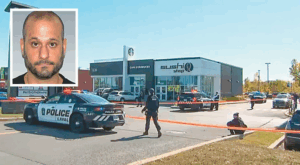
On a sunny morning in Laval, a densely populated area of Montreal, life went on as usual. But this particular Wednesday, October 1, would be a fatal one for a Greek-Canadian figure rising in the city’s underworld—40-year-old Charalambos Theologou, known to many as “Bobby the Greek.”
That morning, Bobby arrived in a bulletproof Cadillac Escalade at the parking lot of a Starbucks on 4630 Voie de Dessert South, near Highway 440—a busy area surrounded by restaurants and a McDonald’s.
He was accompanied by his 45-year-old right-hand man, Elias Hatzi. They entered the café and joined a third man at a table in the back. There were about 14–15 other customers, two of whom were sitting alone.
They knew exactly where he was sitting
At 10:35 a.m., two hooded men wearing blue and grey sweatshirts entered the café. Security footage shows them moving quickly toward the back right table, where Bobby and his associates sat. Without hesitation, they opened fire, hitting their targets before they collapsed to the floor.
Panic ensued. Customers and staff ducked under tables and counters. The attackers didn’t aim at anyone else—after 15 seconds, they fled.
Outside, a gray Honda Civic awaited them—the same vehicle that security cameras had recorded arriving ten minutes before Bobby.
Police and paramedics arrived within minutes. One man—believed to be an undercover officer—administered CPR to Theologou, but he was already dead. Hatzi and the third man were critically injured; after surgery, Hatzi survived and gave the first testimony. The third man’s identity remains undisclosed.
A pre-announced crime
The Sûreté du Québec (Quebec Police) launched a massive manhunt. Sixteen hours later, the getaway car was found burned in a junkyard on Joliot-Curie Avenue, in the Riviere-des-Prairies area. Investigators confirmed that modified Glock 18 pistols with high-capacity magazines had been used.
According to police sources, this was clearly a mob hit—a settling of scores among Montreal crime groups. Theologou had reportedly received death threats in recent months and took precautions, always accompanied by Hatzi.
Authorities also admitted that Theologou had been under close surveillance by a dedicated police team. Local Quebec media reported that an undercover officer was inside the Starbucks at the time of the shooting—one of the two “lone customers.” He was the one who tried to save Bobby’s life. The other lone customer, police believe, was an informant for the assassins, giving them real-time updates.
That day, five police cars with ten officers were following Theologou, plus a coordinating officer. One vehicle was parked at the café. Yet, the gunmen escaped completely unhindered—raising serious questions for investigators.
Warnings before the hit
Three days before the murder, on September 28, Bobby’s ex-wife—driving a car that once belonged to him—was blocked by an armed vehicle. Two gunmen approached but backed off upon realizing she was with their children. Hours later, a car was found torched outside a house in Kirkland. It turned out the arsonists had mistaken the target—they had meant to burn Bobby’s vehicle.
Former “brothers”
Who ordered Bobby’s death? Police suspect rival gangs, but also former allies.
Bobby controlled drug trafficking, extortion, bombings, arsons, threats, and murders across Laval, particularly targeting bars, restaurants, and nightclubs. He also brokered deals between gangs—sometimes working with everyone, sometimes stepping on toes.
He was allied with Arab Power, one of Montreal’s most violent gangs, and the Rolling 90s, who are linked to Markens Vilme, serving life for the 2019 murder of a top Ontario Hells Angels (O-HAMC) member, Michael Soulde. That killing had already strained relations between Bobby and the Hells Angels. Police initially suspected they were behind the hit.
Three days after Bobby’s assassination, Vilme was stabbed 20 times in prison—believed to be retaliation, suggesting an ongoing mob war.
Aiming for the top
“Bobby the Greek” had big ambitions—to reach the top of Montreal’s underworld.
His gang, the Chomedey Greeks, operated in Laval’s Greek-Canadian community. Starting his criminal career in 2005 at age 20, he had by 40 become one of Montreal’s most powerful figures.
His timing was significant: Leonardo Rizzuto, son of legendary mob boss Vito Rizzuto, had been arrested in June during Project Alliance, leaving a leadership vacuum. Multiple groups were now vying for dominance—including Bobby’s.
Experts like Valentin Pereda, criminology professor at the University of Montreal, told The Guardian that the arrests had destabilized the mafia’s structure, creating chaos among smaller, less-organized gangs. “The execution of Bobby is a sign of a volatile and fluid situation,” he said.
Life and crimes
Theologou’s first documented link to crime came in 2005, when Montreal police arrested him and six others for drug trafficking. He pleaded guilty and served two years in prison.
A year later, Theologou and four other men were arrested as suspects in connection with an earlier 2004 assault on a taxi driver who had been beaten into a coma over a debt to a loan shark.
Bobby pleaded guilty to obstruction of justice during the investigation and was sentenced to 15 months in prison.
In 2009, he was arrested again for drug trafficking at metro stations in downtown and southwest Montreal.
On February 24, 2010, he pleaded guilty to charges of drug trafficking, conspiracy, and possession of a firearm, and received a five-year sentence.
The sentences from his three cases were eventually merged, and on April 23, 2013, Bobby was released on parole after serving two-thirds of his total term.
“He told me he would change”
One of Bobby’s former high school teachers, James Watts, told Global News he was deeply saddened when he learned of his former student’s murder.
He remembered him as a lively, energetic, and promising young man—“full of life.”
“I think about what he could have achieved if he had made better choices,”
Watts said.
He last saw Theologou about ten years ago, when Bobby attended a relative’s graduation, after his first arrests.
“He told me he was going to turn his life around—and I really believed him,”
Watts recalled.
But, he added, Bobby never kept his word.
Ask me anything
Explore related questions




