






In the movie “Topkapi” Melina Mercouri and a group of imaginative bandits plan to steal a golden sword belonging to Sultan Mahmud, decorated with very large diamonds and smaller rubies, which is kept in a palace-museum. They succeed, but in the end, because of a mishap – a small bird that got in through the roof sets off the alarm – they are arrested and locked up in a Turkish prison.
This sort of thing might have happened in a movie, but it hasn’t happened to the majority of the people who planned some of the most spectacular heists, like the one at the Louvre a few days ago.
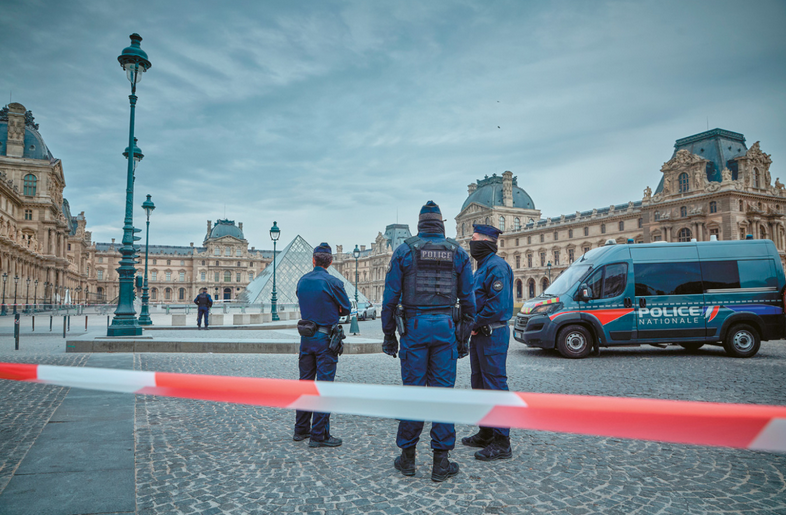
It was a strike at the heart of art, preying on Napoleon’s famous jewels, which shocked the world, even though such pieces are almost impossible to sell on the black market because of their uniqueness. The Louvre heist came as a reminder of some of the most spectacular hits on famous museums around the world, many of which are still searching for the stolen masterpieces that were forcibly removed from their display cases or the frames in which they were placed.
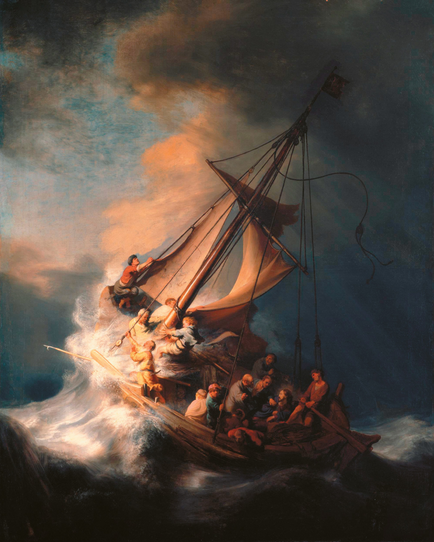
At the same time, the search for them has not ceased, although many of them may never be found, such as the Dresden Diamonds, Michelangelo Merizzi da Caravaggio’s “The Birth of Christ” and Rembrandt’s “Storm on the Sea of Galilee”. This particular painting was stolen from Boston’s Isabella Stewart Gardner Museum” along with other masterpieces by two brilliant thieves disguised as policemen.
Considered by many to be the “heist of the century,” the fate of the 13 works 35 years after the brazen hit remains unknown, as do dozens of others preyed upon by gangs who masterfully staged their hits.
Dresden: The 4,300 missing diamonds
2019, Green Vault Museum / The masterful heist with loot of precious stones worth 115 million euros, most of which were never recovered

Dresden is not called the “Florence of the North” for nothing, as the Saxon capital is a vast open-air museum where baroque architecture buildings and art spaces abound. The city’s royal palace with its 500 Renaissance halls also houses the Green Vault museum, which houses more than 3,000 historic artefacts and jewellery.
So in November 2019, a gang suspected to number more than six hit the Green Vault with pinpoint accuracy in a heist planned months in advance. The robbers, who, according to the investigations that followed, had inside information about the museum’s security, made sure to cut and loosely glue the bars of the only window not caught by security cameras before the hit. One of the gang had stolen a blue Audi S6 in Magdeburg – 300 kilometers from Dresden – months earlier, which they painted silver.
On 29 November 2019, shortly after 04.30, gang members destroyed a large electricity distribution cell. The streets around the museum are plunged into darkness, two people break in through a “blind window” and within five minutes remove 21 of the world’s most valuable jewels. In all, the items – from pins to a diamond-encrusted sword in its hilt – contained 4,300 diamonds, some small and some particularly large. Significantly, the sword with its scabbard and hilt alone contained over 800 diamonds of various sizes.
The whole operation lasts no more than ten minutes, while the robbers disappear in the darkness with jewelry worth a total of 115 million euros, according to prosecutors. Thirteen minutes after security cameras record the robbers breaking into the display cases, the Audi they used is found abandoned and burned in an underground garage 5 kilometers (3 miles) from the museum.
In the following months, police investigations put four museum guards who allegedly engaged in suspicious behavior in the frame. At the same time, authorities are processing hundreds of pieces of information from various sources about the brazen robbery that shocked the art world.
Almost a year after the incident, the German police are conducting a giant operation in Berlin, involving 1,638 men from all over the country, searching for five members of the Remmo criminal gang for whom there were reasonable suspicions of involvement in the robbery, three of whom will be arrested. Three more would later be arrested and, as it turns out, six are brothers and cousins, but the entire 21 jewels with 4,300 diamonds would never be found.
The arrested men were brought to trial, five of them were convicted, while the sixth presented an unimpeachable alibi and was acquitted. Some of the jewelry was returned, but most of the jewelry, especially the most valuable – among them the White Saxon diamond – remains missing and, according to experts, most likely broke up into smaller pieces to be sold.
Rotterdam: Perpetrator’s mother burned seven masterpieces in fireplace
2012 / Three Romanians in two minutes and 48 seconds stole seven paintings by Monet, Haan, Picasso, Matisse, Gauguin, and Lucian Freud
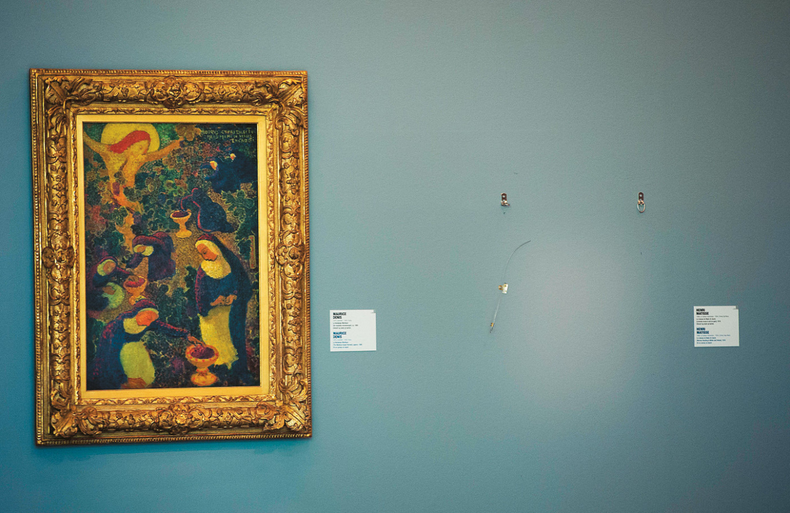
Even today many people wonder how three Romanians with a specialty in residential burglary managed to bypass security at the Rotterdam Museum and within 2 minutes and 48 seconds made off with seven paintings by Monets, Haan, Picasso, Matis, Gogin and Lussian Freud. The robbery was listed as one of the most brazen in history and took place on Monday, October 25, 2012, a rainy evening, while all the previous days Adrian, Radu and Eugene – the three robbers – had been going to the museum every day – not all together, but each individually, accompanied by their girlfriends to pick out the works they would rob, even though they didn’t know the first thing about art.
They also looked for a weak spot in the museum’s security systems, spotted it at the fire exit in case of a fire, and made the decision to enter through there. Eugene was waiting for them in the getaway car, while Adrian and Radu deactivated the electronic emergency exit key, entered the museum and were out in less than 3 minutes.
With them were Picasso’s “Head of the Harlequin”, two landscapes by Claude Monet, Lucian Freud’s “Woman with Closed Eyes”, Paul Gauguin’s “Woman in front of an Open Window, the Fiancée”, Matisse’s “Reader” and a self-portrait by Maier de Haan. The alarm went off, but police who arrived in just five minutes found nothing and alerted the museum’s management, who found that seven masterpieces were missing. At the same time the three Romanians have no contact to sell the stolen paintings and through an acquaintance they are trying to find a buyer, which was not easy since the works were stolen and the news had made the rounds while the authorities were trying to track down the thieves.
The closet in the hallway of Radu’s residence was not the best hiding place for the seven paintings, so he decided to take them to Romania. He removes them from their frames, packs his belongings and leaves for his village by road, travelling 2,500 kilometres in two days, with minimal stops for petrol and rest. A few days later the other two arrive, the trio begins to look for a buyer again, and at one point Radu calls an acquaintance, Mariana Dragu, a curator at the National Museum of Romanian Art, to see the paintings. At first Dragu thinks they are fakes, but when she sees a sticker from an international shipping company that specializes in transporting artwork and then examines the paintings with ultraviolet light, she realizes they are authentic.
She then urges them to turn them over to the police, but the three refuse, while she, seeing the news of the robbery, goes to the authorities and reports everything. After a few days, the police manage to tap the phones of Eugene and Radu, who has meanwhile moved the paintings to an aunt’s house, and also track down the prospective buyer.
They persuade him to show up with an “expert” who will examine the paintings, but at the last minute the thieves sense a trap – in the conversations they say they are probably being followed by the police – so a special unit arrests them after a raid on their homes. Radu’s mother, Olga, sees her house being torn apart by the police, who find no trace of the stolen masterpieces. Believing that if they don’t find the works her son will be spared, she goes to her sister’s house, takes them in a suitcase and buries them in the village cemetery!
With the noose tightening steadily over the next few days, and after a thorough search of her sister’s house, Radu’s mother goes to the cemetery at night, digs and retrieves the suitcase, takes it back to her house, lights the fireplace and throws the two Monet’s, Picasso, Freud, Gauguin, Matisse and De Haan into the fire in succession. Within minutes, then, these masterpieces had been reduced to ashes, and Olga long afterwards claimed that she had made a big mistake in wanting to protect her son.
Boston: 35 years later, Rembrandt and Vermeer have not been found
1990, Isabella Stewart Gardner Museum / It was described as the heist of the century. In one hour and twenty minutes, two thieves dressed as police officers stole 11 masterpieces
It was a sweet spring night just after 1 a.m. on March 18, 1990, when two police officers arrived at the side entrance of the Isabella Stewart Gardner Museum in Boston. They parked and before exiting checked the area for any presence. Then they rang the doorbell, waiting for the guard to open the door so they could check who they were and what they wanted. The latter had already seen the two officers with his colleague and when he spoke to them, they told him that they had received a call about an incident at the museum and had come to check.
Only they hadn’t come for that, nor were they real police officers.
Breaking security and protocol rules, the guard allowed the two officers to enter the museum through the employee entrance door. When they reached the entrance where the second guard was, they pulled out their guns and pointed them at the two stunned employees and asked them to put their hands up.
It was at that moment that the two guards realized that the uniformed men were not police officers, but robbers, but they were no longer in a position to prevent the “heist of the century” as far as the art was concerned. They were carried backwards, handcuffed and gagged, to the basement of the museum by the two unknown robbers who, undisturbed, immediately went to work.
They are being sought
It took them 1 hour and 20 minutes to remove 11 painting masterpieces including Rembrandt’s “Storm on the Sea of Galilee” along with two other works, Vermeer’s “Concerto”, five works by Degas, Manet’s “Chez Tortoni”, a landscape by Flynn and two objects of lesser value. To this day, investigators in the case have not understood why they left behind Titian’s legendary “Europe”, the painting that Rubens described as “the world’s leading painterly masterpiece.”
They escaped in the middle of the night, after first removing the security footage from the cameras that had recorded their actions when they removed the frames of these works. The robbery became known the next morning during the shift change, but it was too late to immediately search for the two unidentified men. The theft of the century had been committed.
This hit was described as the largest art theft in America and one of the largest in the world, as at least five paintings were priceless. Rembrandt’s “Storm on the Sea of Galilee,” for example, was the only painting by the Dutch painter to feature water, while Vermeer’s “Concert” is considered one of the most prominent examples of his paintings and is currently valued at $300,000,000.
In the city of Boston, residents stood up upon hearing everywhere about the heist that shocked the art world, and the investigation was immediately launched by the police and FBI, who didn’t have much on their hands. Descriptions of the two men were released in a sketch, but they had worked their disguises so well that they left no clues that could lead authorities anywhere.
The story began to fade in the media, days and weeks went by without any progress, and the $1 million reward for information leading to the recovery of the stolen artwork moved no one. In the years that followed, the amount increased first to $5 million and later to $10 million, and many stories about the incident saw the light of day. Stories featuring people like Michael Youngworth and his best friend Miles Connor who became involved in the case seven years after the theft.
The former on August 13, 1997 held a press conference outside the court where he was on trial for illegal possession of firearms. In front of reporters eager for the big news that Yangworth had fed them, he said he could mediate the return of paintings stolen from the Isabella Gardner Museum, leaving everyone with their mouths agape.
Only to do so he was asking to reap the $5 million reward, have the charges in his trial dropped and a friend of his released. That was Miles Connor, a known art thief who could not be charged with the Boston theft since he was incarcerated in jail that night.
Reporter Tom Musberg of the Boston Herald approached Youngworth a few hours later to check whether what he was saying was true with evidence. Some 24 hours later he arrived in the middle of the night in an undisclosed seedy area an hour outside the city, with a colleague of Youngworth’s in the driver’s seat. In those years, to get there you had to be either a police officer investigating or a drug addict looking for his fix, Musberg wrote a year later in the story he gave to Vanity Fair.
Empty frames
When they arrived at an up-and-coming construction site, with an old warehouse out front, a woman appeared and asked them what they wanted. The driver replied that Youngworth was sending them, and in a few minutes Musberg and the man wearing gloves and lighting a torch entered the darkened warehouse. They climbed some stairs and found themselves in a corridor with metal doors leading to small rooms, and after a few seconds they stopped in front of one. Youngworth’s partner took out a set of keys, unlocked it, and the two men entered the room, in which there were large bins, some on wheels. He stood over one, bent down and pulled out a plastic black cylinder, which he carefully opened in front of the stunned Masberg.
“He carefully pulled out a rolled-up canvas which he unwrapped in front of me,” the journalist wrote in Vanity Fair, filing a shocking description, “I was, I am sure, the ‘Storm on the Sea of Galilee,’ arguably the most famous stolen artwork in the world.”
The man showed him the faded corners of the painting from the frame on the night of the theft, and then the lens focused on Rebrand’s signature. A few minutes later, Masberg got into a taxi and left, having agreed not to write anything for a week, time enough for the Dutch painter’s masterpiece to be moved to another location. Since then no work has been found in this 35-year perpetual search, although others have emerged to say they know where the paintings ended up.
The latest is mobster Martin “the Viper” Foley, who worked with private investigator Charlie Hill, whom he allegedly put in touch with some members of the gang that pulled off the century-old theft. The public disclosure of the negotiations and manipulations didn’t sit well with the Viper, who disappeared, leaving Hill desperately searching for a clue.
Today, visitors to the Isabella Stewart Gardner Museum feel strange when they enter the room where Rembrandt and Vermeer’s masterpieces used to hang. There are only the empty frames there from which they were forcibly removed that March evening and are still awaiting their return.
Palermo: Caravaggio’s “The Nativity” was displayed as Cosa Nostra loot
1969, Chapel of Saint Lawrence / Urban legends about the fate of the stolen artwork and the dead mobster who never spoke about the stolen painting
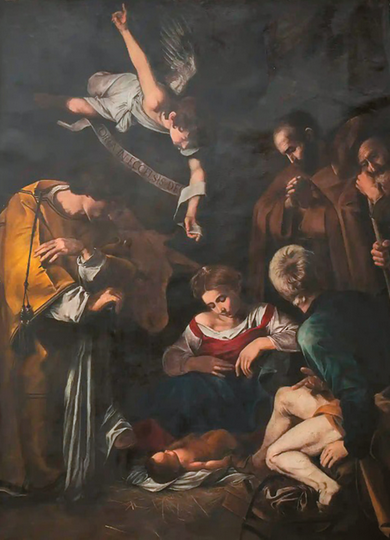
It looked early in the afternoon on that Friday in October that the weather was going to break, the older residents were sure of it and it was confirmed when in the evening – it was October 17, 1969 – the storm that hit the town of Palermo broke out. Its intensity made the task of the men who entered theChapel of St. Lawrence after midnight even easier.
This particular church was not a museum, but it might as well have been, since it housed the impressive 2×3-meter “The Birth of Christ” painting, a stunning masterpiece by Caravaggio. The men’s eyes were fixed on the painting for a few seconds, and immediately afterwards they wasted no time at all. Using sharp razors, they cut and removed the work from the frame, wrapped it up, opened the chapel door and disappeared into the rain.
It’s been 56 years since that night of the storm and the painting is still missing, despite shocking details about its theft, which were revealed in 2019 thanks to a video that came to the attention of The Guardian. In it, the priest who bore the title of monsignor Rocco Benedetto revealed that Caravaggio’s stolen masterpiece had been in the home of a capo of the Skeleton Mafia, Gaetano Badalamenti, for a long time. In the same video, part of which was published by the Guardian, the priest pointed out that the mafia had twice contacted him by letter to return the painting, while collecting the appropriate price. In the second letter they included a small piece of the work to show that they were indeed in possession of it, a move inextricably linked to the tactics of the Cosa Nostra in Sicily.
The godfathers carried it around
Since the day it was stolen, Caravaggio’s painting has been listed as one of the world’s most valuable works of art sought and listed by the FBI, as few works by the Italian painter have survived. In the years that followed, the urban legends circulating about where this particular painting ended up in the art world and collectors’ world were perfectly contradicted.
Some insist it is well hidden somewhere in Switzerland, while others say it was abandoned in a warehouse or barn where it was destroyed by moisture and rats. The only certainty surrounding its fate is that it would be very difficult to sell it to any collector, since the noise from the theft and the mobilization of authorities around the world was such that no one would go through the process of acquiring it.
In the video of the interview, Benedetto talks about the two times he received letters from the thieves, the first to see how willing the Catholic Church was to negotiate its return. The mobsters asked that an ad with specific content be placed in a Palermo newspaper and the head of Cultural Affairs agreed. The second letter to Benedetto followed, which contained a small piece of the painting – a piece of land – and the phrase: “We have it and it is the original Caravaggio.” The letter ended with a request to the Church to publish a second advertisement in the “Giornale Di Sicilia”, and so the priest appealed again to the competent head. But not only did he not grant the mafia’s request, but he believed that Benedetto was involved in the theft and reported it to the police.
The authorities placed the priest under surveillance and he was brought in for questioning in which he was fingerprinted, and long afterwards the head of the investigation apologized. Any chance of recovering the painting was now gone, as the mobsters never contacted Benedetto again, who died in 2003.
His shocking interview, which had been kept in a drawer for years, took on special significance after the revelations of a defector from within the Sicilian mafia, Gaetano Grado. He told police that the painting had ended up in the hands of Badalamenti, while another godfather whose name is not being revealed contacted an art dealer in Switzerland, where it is speculated the Italian painter’s masterpiece may have ended up.
The role of the priest
Benedetto also revealed that in the early 1970s he was approached by another priest to confide something about the theft of the Nativity of Christ. This priest, who officiated at a church in Carini, a town near Palermo, informed him that when an icon from his own church was stolen, he was sure it was done by the mafia.
He contacted some godparents he knew personally because they came to his church and after a few days a young man met him. He showed him two pictures of paintings asking him which one was his and the priest showed him, but he never forgot that the other painting was the stolen work of Caravaggio that had ended up in the hands of the Cosa Nostra. He was corroborated years later by a former mobster turned police informant when he told officers that the painting was often displayed at godfather gatherings as a symbol of prestige.
The notorious Badalamenti, who died in jail in April 2004, never spoke about the stolen painting or the location where the famous Italian painter’s stunning composition might be. The one that awaits its return to the chapel of San Lorenzo, from which it was violently restored 56 years ago on an October evening when a storm was raging in Palermo.
Photos:Getty images / Ideal image , AFP / Visual Hellas
Ask me anything
Explore related questions




