





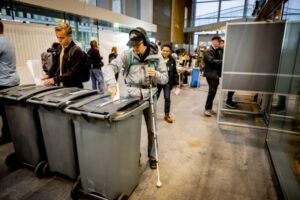
The polls have opened for parliamentary elections in The Netherlands, the third in less than five years. Here’s a guide to how the country’s parliamentary elections are being conducted and what to expect in the coming months
Why are new elections needed
The elections were deemed necessary after Gert Wilders unexpectedly toppled a fragile right-wing coalition government in June, whose party “Party for Freedom” (PVV) the largest party in parliament has pulled out because of disagreements over immigration policy.
Wilders won the previous election in November 2023 by a surprisingly large margin, but was forced to abandon his ambition to become prime minister and form a coalition government.
The government under Dick Schoff, a career independent bureaucrat, failed to implement important policy goals and was overthrown by Wilders in less than a year.
What is the process?
The vote for the 150 seats in the lower house of parliament takes place today. Most polling stations opened at 08:30 GMT, although some opened an hour earlier, and close at 22:00 GMT when a first six-pole indicative of the final result is released.
Ballots are hand-counted and the first results are released overnight.
Parties need around 70,000 votes to win a seat in parliament.
In 2023, 15 parties entered the lower house of parliament and about as many are expected to enter this time with 27 parties running.
What are the expectations for this election?
Wilders’ right-wing PVV party has been leading in the polls since the government collapsed, but in the last week before the election it narrowed its lead. It is expected to secure between 25 and 29 seats, up from the 37 it received in 2023.
Seat allocation projections for the other major parties are for the left-wing GroenLinks/PvdA (Green Left-Labour Party) and the center-left D66 (Democrats 66) about 25 seats and for the centre-right Christian Democrats (CDA) 19 seats.
The other right-wing party VVD (People’s Party for Freedom and Democracy) has lost the dominant position it held under the leadership of Mark Rutte, the current head of NATO and the longest-serving prime minister in Dutch political history.
After joining the turbulent alliance under the PVV, the VVD is now reportedly securing 15 seats out of the already small number (24) it received in the 2023 elections.
But recent elections have taught us that a lot can happen in the final days before the process as on the eve of the election more than a third of voters declared themselves undecided.
What happens next?
As no party secures an absolute majority, the Netherlands is always led by coalitions that take months to form.
And this time it is predicted to be difficult to form a government as many of the major parties have already ruled out working together and the electorate is highly polarised.
This gives Wilders very little chance of finally becoming prime minister as the CDA, VVD and the left-wing GL/PvdA have already rejected him.
The polls show that without the CDA, Wilders has no chance of an outright majority, leaving the final command either to the party that comes second to his own or the one that manages to beat him.
But even so, there are not many prospects for the quick formation of an alliance as the VVD has also stated that it does not intend to coexist in a coalition with GL/PvdA.
Is there a deadline?
There is no deadline for coalition formation and parties can decide to change potential partners along the way.
The last three government coalitions have taken more than seven months. The last coalition under Rutte set a record with 299 days from March 2021, when elections were held, to January 2022, when a government was formed.
Just two years later the government collapsed, paving the way for an election won by Wilders.
Ask me anything
Explore related questions




