





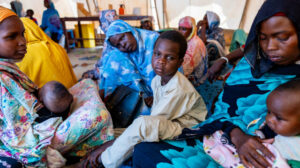
Telling and shocking are the testimonies coming from El Fasher, the capital of North Darfur state in Sudan, after the Rapid Support Forces (RSF) seized the city on Sunday following an 18-month siege.
Nawal Khalil, 27, a volunteer nurse at El Fasher South hospital, was on duty when RSF militants stormed the hospital. “They killed six wounded soldiers and civilians in their beds – among them women,” she described. “I don’t know what happened to my other patients. I had to run when they came in.”
Halil was wounded in the foot and thigh by bullets as fighters occupied the military command near the hospital. She managed to escape on foot, wounded and without food, walking a full day to Garney City. “They took my phone and money – they left me with nothing,” she said.
Mass flight and civilian executions
More than 1,000 people, including many women and children, walked for two days to reach the town of Tawila, about 55 kilometers (55 kilometers) west of El Fasher, after the city fell. The area is under the control of the Sudanese Liberation Army (SLA-AW), the organization of Abdul Wahid Mohamed al-Nour, reports the Guardian.
According to the Common Forces, working with Sudan’s regular army, more than 2,000 civilians have been killed since the city was taken. The UN confirmed that circulating videos show “dozens of unarmed men being shot or lying dead, surrounded by RSF fighters.”
Hostages and ransom for freedom</h3 Witnesses said thousands of civilians remain trapped in Garney, southwest of El Fasher, under the RSF and its allies. Among them are former soldiers of the Sudanese army and members of armed organizations that fought alongside it.
Survivors who arrived in Tawila report that the militants are demanding a ransom of 5 to 10 million Sudanese pounds (6,000 to 12,000 pounds sterling) to release the prisoners.
Those who cannot pay are held for days, and some are released only when they become seriously ill.
“They wanted to cut off my head.”
Adam Yagub, 28, a driver from Senar in central Sudan, said he was miraculously spared when he was captured by three enforcers on camels near Garney. “They wanted to cut my head off with a knife,” he said, pointing to his arm that was hit with a Kalashnikov stock.
“I was saved by one of them, who recognized me because his brother was working with me.”
“We left 18 people from El Fasher – only eight of us made it to Tawila alive. The others, I believe, are dead.” He claimed to have seen 22 bodies near a “fake well” used by RSF fighters to trap people.
“You walk all day without water, you get there, and civil guards are waiting for you. They killed 22 men and hid their bodies.”
Hospitals under siege
A second nurse who was at El Fasher South described that RSF militants entered the hospital through the main gate and opened fire on the emergency ward, killing at least eight patients.
“We ran out of the back door, but they hit me on the head with the stock of the gun,” he said.
RSF chief Gen. Mohammed Hamdan Dagalo, known as Hemendi, said in a video message Wednesday that any soldier or officer who “violated the rights of any human being” will be held accountable, but organizations dispute his pledge.
Exhaustion and starvation for refugees
Those who managed to escape described nights hiding near the military gun battery and marching in the dark to avoid gunfire.
Families already displaced from the Abu Shuk camp were forced to flee again, this time to the Darajah Ula neighborhood, before finally reaching Tawila.
Médecins Sans Frontières (MSF) said their hospital in Tawila received over 1,000 newly displaced people overnight.
“People arrived exhausted, dehydrated, many in a state of extreme weakness,” said Sylvain Penicount, MSF’s programme coordinator.
Continued conflict
SLA-AW has deployed additional forces around Tawila to protect refugees and prevent clashes should RSF forces attempt to pursue retreating groups with their weapons.
Meanwhile, parts of the Sudanese army and allied forces continue to resist in the northwest, in the Jebel Wana region, following the loss of El Fasher.
The decades-long tragedy in Darfur takes on a new dimension of horror, with testimonies reminiscent of the worst war crimes of the early 2000s.
Government expels UN officials after El Fasher massacres
In this tense situation, the Sudanese government decided to expel Laurent Boukera, the director of the World Food Programme (WFP) in Sudan, and Samantha Chatarah, the WFP’s emergency aid coordinator in Sudan.
Samana WFP’s Humanitarian Aid Coordinator, Sanaja WFP’s Humanitarian Aid Coordinator for Sudan.
UN staff had 72 hours to leave the country. The government has yet to explain its decision.
It is not the first time the Sudanese government has resorted to such a measure, Spiegel recalls.
In June 2023, the UN special envoy, German diplomat Volker Perthes, was declared persona non grata. He was accused of inciting the conflict in Sudan.
The militants did not spare the Red Crescent staff: five Red Crescent volunteers were killed during a recent mission.
“The International Federation of Red Cross and Red Crescent Societies (IFRC) is shocked, disappointed and deeply saddened,” the Geneva-based umbrella organisation said.
The volunteers died in the town of Barra, about 300 kilometres southwest of Khartoum, wearing vests that distinguished them as members of the Red Crescent. Three of their colleagues are still missing.
Ask me anything
Explore related questions




