





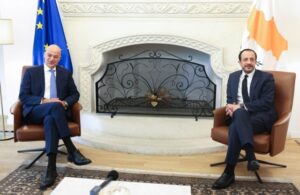
The one-day visit of Nikos Dendias to Nicosia had a double message. Firstly, Cyprus and Greece are moving in a coordinated way to make use of the European SAFE Regulation in joint procurement and investment.
Second, cooperation is being raised to a higher level with an emphasis on the promotion and coupling of the defence industries of the two countries, in view of the Cyprus Presidency of the Council of the EU from 1 January 2026. The programme of the visit included a meeting between the Minister of National Defence and his counterpart Vassilis Palma, followed by a meeting with President Nikos Christodoulides at the Presidential Palace.
Coordination for SAFE
At the Ministry of Defence in Nicosia, the two ministers stressed that SAFE provides a practical framework for joint moves that enhance deterrence and operational readiness. Nikos Dendias spoke of a “tight schedule” and an opportunity to deepen bilateral cooperation, while Vassilis Palmas described SAFE as a tool for upgrading the Republic of Cyprus’ defence capability.
Focus on domestic industry
At the Presidential Palace, President Christodoulides clearly set as a priority the promotion and interconnection of the Greek and Cypriot defence industry through EU tools, with the upcoming Cyprus Presidency acting as an accelerator. Nikos Dendias stood on the creation of a strong “ecosystem” of defence technologies and co-producers.
The SAFE (Security Action for Europe) regulation gives member states access to up to €150 billion in long-term, low-interest loans for major procurement and investment that strengthen the European defence base. European production preference is promoted and national investment plans are submitted and assessed by the Commission.
The open question of Turkey
Public statements again recorded the position that the mechanism cannot end up benefiting states that threaten members of the Union. Discussion of possible schemes with third countries is accompanied by strict clauses and political safeguards, with Athens and Nicosia pointing to the need for a common stance by the 27.
The European Union and Athens and the European Union are calling for a united front.
Responding to a question on whether steps are being taken to veto other EU member states from joining Turkey in the SAFE programme, N. Dendias said that “I and Vassilis are probably among the few people in Europe who have sat down and read the SAFE Regulation. An extremely complex Regulation, written in a strange language of the Brussels bureaucracy, just so that everyone can understand what they think and formulate what they think.”
In this context, however, he said there are value principles, which ought to be clear. “There is a clear commitment from the European Commission on how contracts between the EU and third countries will be brought up for discussion,” he noted. He said the European Commission itself, in a statement, has committed that these proposals will come to be voted on by unanimity, with a common understanding of all states. “This is self-evident, because if someone threatens the EU itself, it is obvious that he cannot participate in the mechanism to counter this aggression,” he said.
In this context, he continued, “we expect all European countries to line up against the self-evident concept of protecting the European space, but not only geographically, European values, democracy, the European approach to the protection of human rights.”
Nicosia is “running” the finalisation of the national envelope for SAFE, with a list of projects to be judged on the critical capacities and industrial added value axis. The Defence Industry Council will also reconvene to lock in priorities before the start of the Cyprus Presidency.
Ask me anything
Explore related questions




