





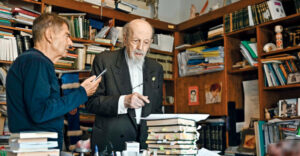
For months I tried to get a “yes” from Theodosios Tassios. At one point, he told me:
“What do you want with me? I’m a hundred years old.”
He isn’t — only ninety-five. And I’d bet he’ll surpass a hundred.
Eventually, he agreed. So I found myself in a high — very high — spot in Penteli. From his house, he overlooks Athens — white, crowded, breathless, drowned in concrete. After all, Tassios is the world champion of concrete. And not just that.
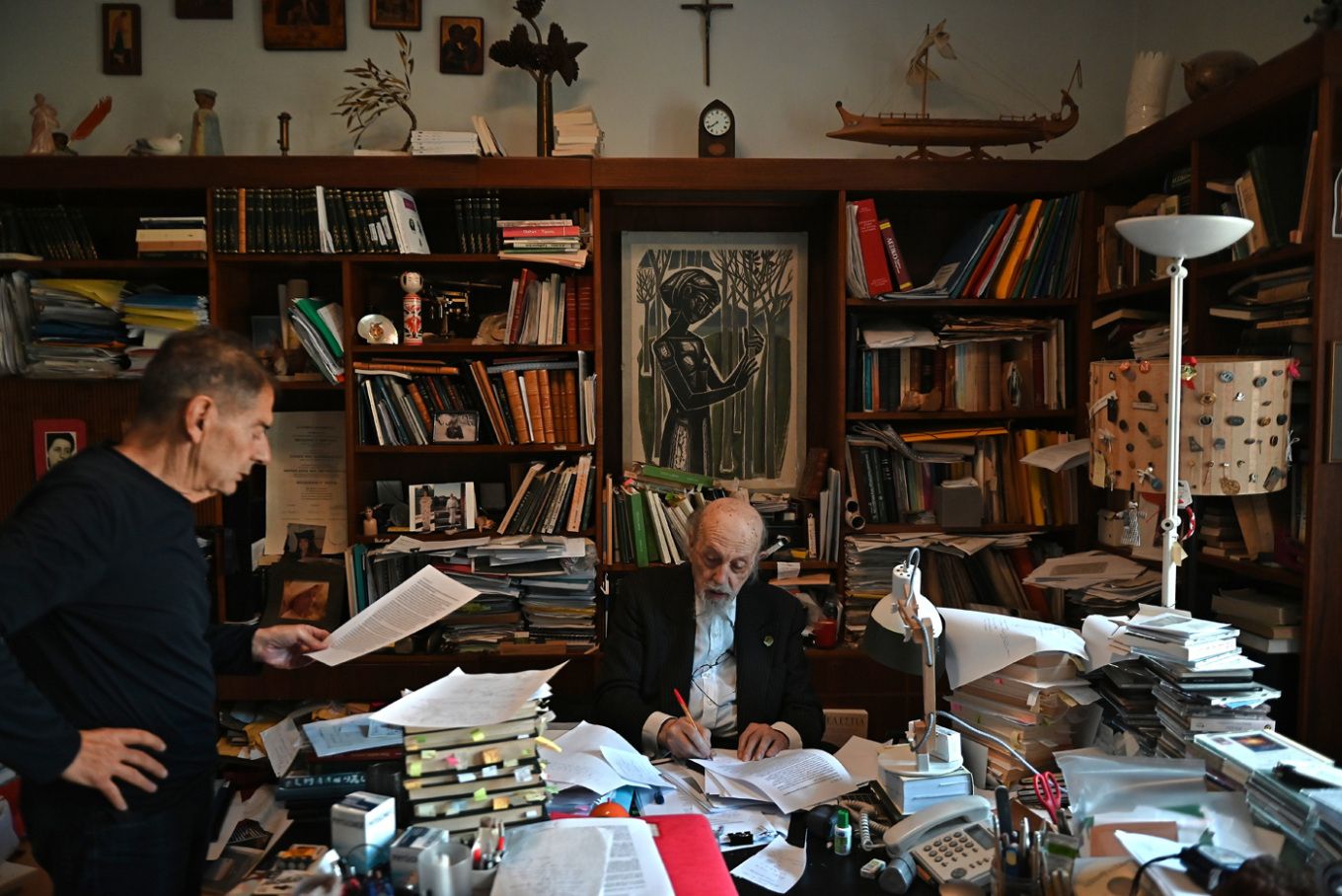
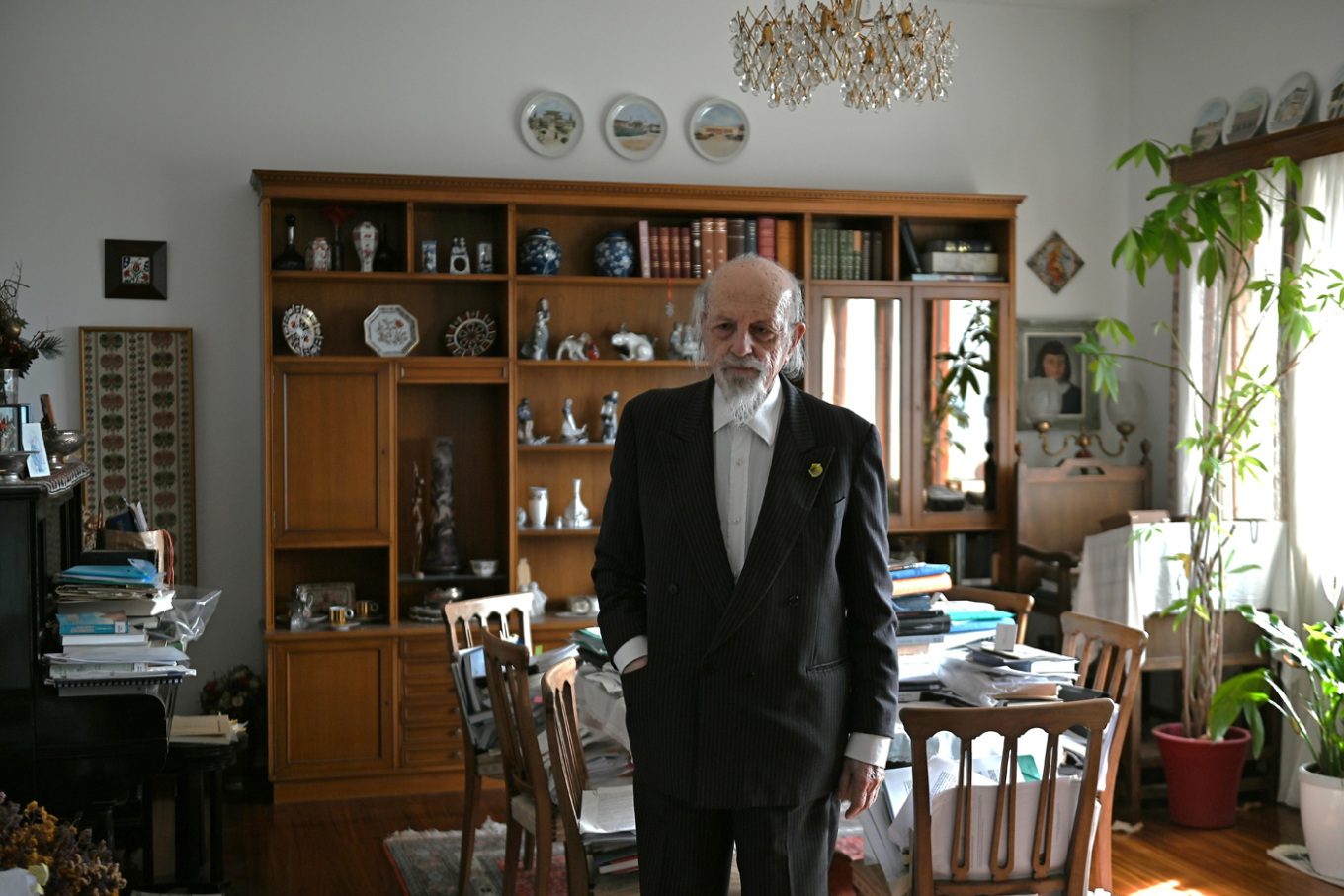
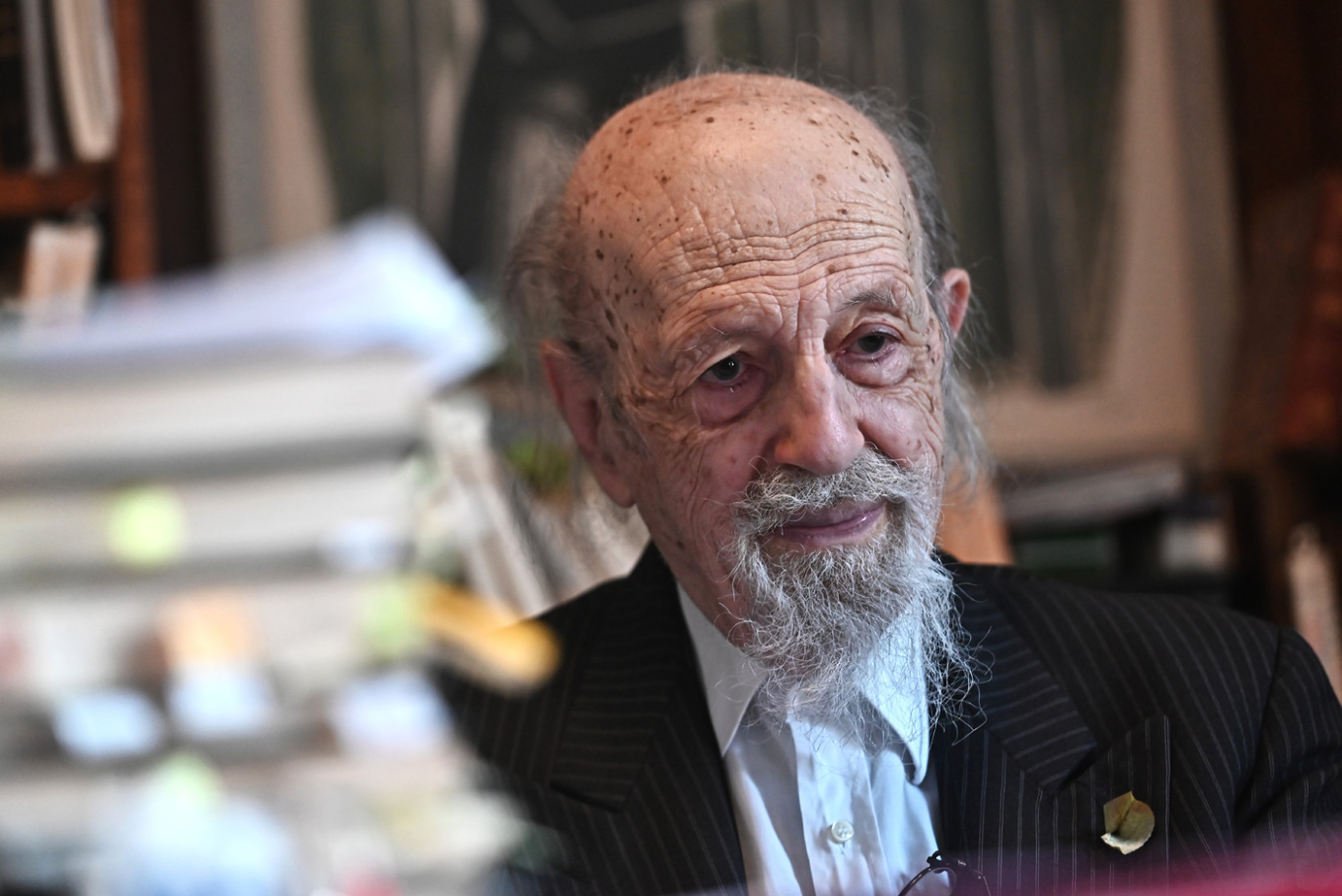
Up close, with his small beard, he looks like a figure from Tarkovsky’s masterpiece Andrei Rublev. As is known, Rublev was one of the pioneers of Russian iconography — Tassios could easily be his twin brother.
He lives alone. “Follow me,” he said, and I did — into a study buried under thousands of books. “I have six libraries in the house,” he noted.
Two things struck me. First, his immense breadth of knowledge — from technology to philosophy, from personal experiences to vivid metaphors that painted whole worlds. Second, the unfathomable depth of his thought.
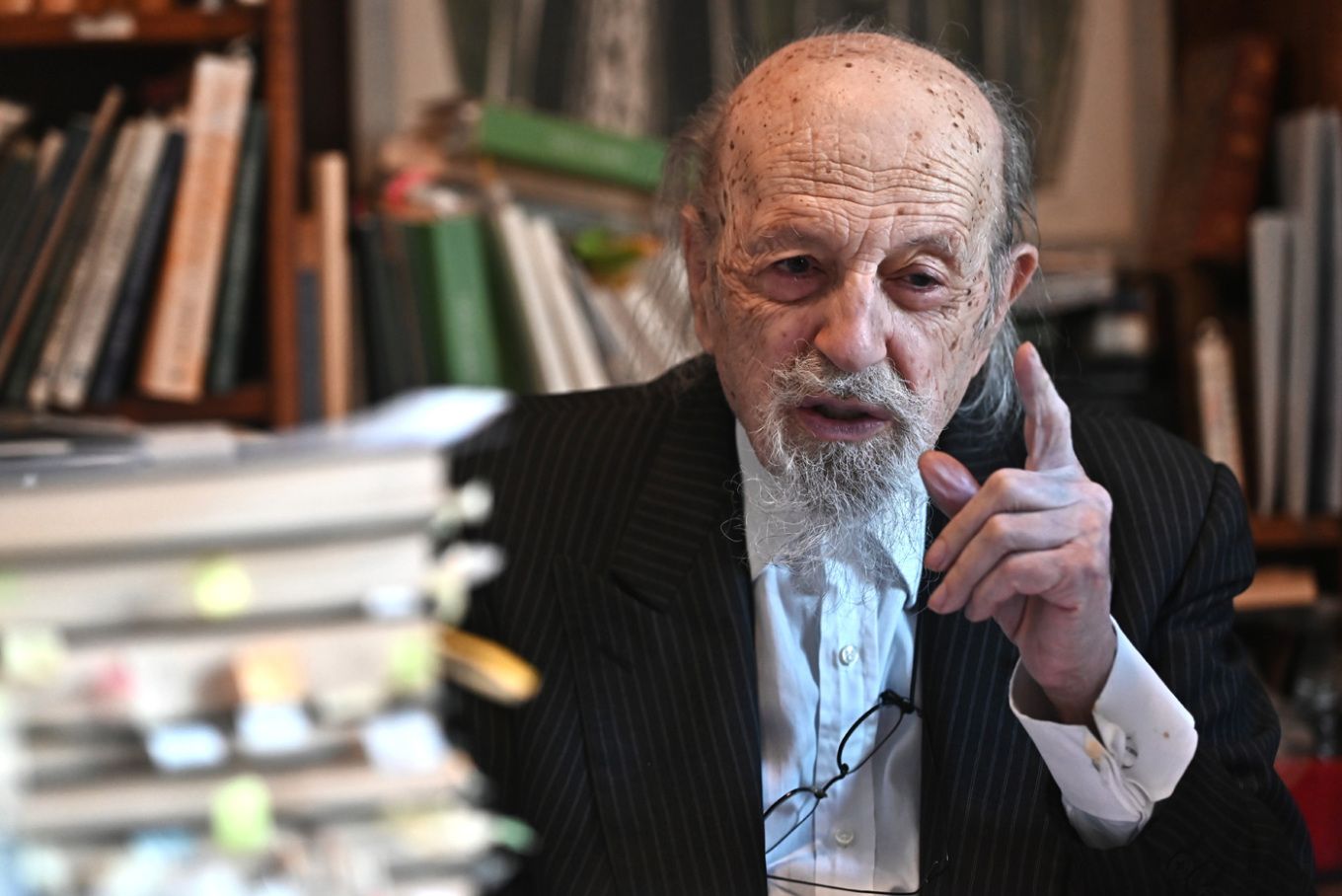
Before I left, after about an hour, he said:
“Please, for my biography, don’t copy Wikipedia — it has many mistakes. Use this instead.”
He handed me a printed sheet that read:
Professor Theodosios Tassios was born in Kastoria. He earned his civil engineering degree from the National Technical University of Athens (1953) and continued his studies at the Centre d’Études Supérieures in Paris. He received his PhD from NTUA in 1958 and went on to serve as lecturer, associate, and full professor. He founded NTUA’s Reinforced Concrete Laboratory and directed it until his retirement in 1997.
He has also taught at the universities of Baghdad, Shanghai, Nanjing, Pavia, and the College International des Sciences de Construction in Paris (1979–1989).
Among his landmark achievements is the “sliding” Evripos Bridge — a pioneering work in its time.
Scene 1: “In Love with Authoritarianism”
Dimitris Danikas: You’ve had that little beard for a long time?
Theodosios Tassios: Since the dictatorship. From the moment it began.
D.D.: Symbolically?
Th.T.: Yes. The government commissioner at the Polytechnic once said to Skoulikidis: “Mr. Tassios is a good man — why does he insist on that beard?” Skoulikidis, a close friend and a politically upright man, replied: “General, you know, Tassios has his own views. You should watch him — he loves this country deeply.” The general, of course, didn’t understand a thing.
D.D.: Who was the general?
Th.T.: His name was Belogiannis.
D.D.: No relation to that Belogiannis, I suppose.
Th.T.: None. This one was the second they appointed. The first was a saintly man — an engineer general and a personal friend. I don’t recall his name.
D.D.: Don’t you see differences from the past — the recent past?
Th.T.: Indeed, there are differences. All of history’s flow is a patchwork — a quilt of variations. But to return to your question: like all citizens, I have my own view. It’s clear I’m not at all pleased to see this great turn — now plainly visible — away from democratic regimes toward a kind of infatuation with totalitarian ones. And if someone asks me, “Which kind — of what color — do you mean?” I’ll say, “None in particular — both colors.”
Scene 2: “Giving Back What Society Gave Me”
D.D.: You remain tireless in your public involvement.
Th.T.: For example, I founded and served for nearly forty years as president of the Society for the Study of Ancient Greek Technology — a chapter of Greek history that is never taught, though it makes up half of ancient Greek civilization. I’ve given my soul to it.
I also created the entire institutional framework for preparing the National Program for the Seismic Strengthening of Existing Structures. For thirty years, at the Technical Chamber of Greece, we developed regulations, guidelines, lectures, and public outreach.
Another example — I’ve been vice-president of the Hellenic Humanist Society for decades, organizing lectures across Greece on modern culture and language.
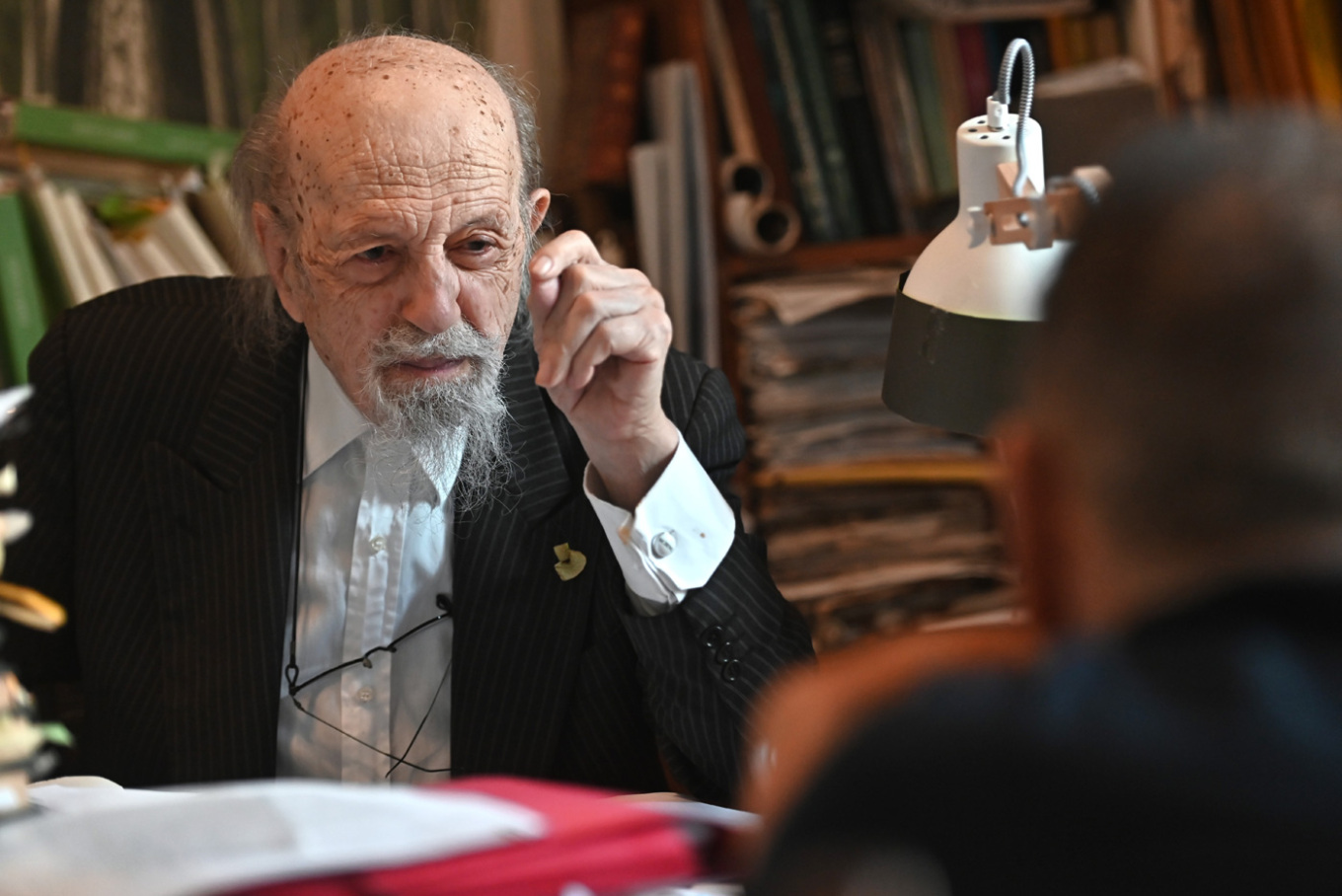
D.D.: You’re referring to your recent book on language, right?
Th.T.: Exactly. I recently published a book on the practical issues of Modern Greek, after noticing — especially among young people — a certain indifference, not universal, but growing, toward the immense, almost existential importance of language.
My books aren’t displays of knowledge — they’re attempts to take part in the shared effort to educate our fellow citizens. I feel the need to give back to society what it gave me. I can’t leave — and that will happen soon enough — with the feeling that I took everything for free.
When I published my book on Aristotle, people said, “Everyone knows Aristotle.” My book was titled Aristotle Again, a reading of Aristotle the engineer and physicist. I waited to see what would happen — and every week, five more copies sold, then five more. Word spread: “Something different is happening here.”
That’s deeply satisfying — the sense that one contributes to the moral and intellectual growth of society. That’s what it means to participate in public life.
I’m not involved in partisan politics and don’t comment on daily affairs — but I take comfort in knowing I haven’t become the isolated scientist in his lab. I went out into the world. And in that sense, my engagement in civic life is itself a political act.
Scene 3: “Zeus’s thunderbolt was the atomic bomb of its time”
D.D.: Shall we talk a bit about technology in antiquity?
T.T.: Of course! And I even have some good news to share. Thanks to what we’ve been doing for the past 30–40 years with the Society for the Study of Ancient Greek Technology, and the two or three museums that now exist, public understanding of this subject has greatly improved. People’s perception has changed dramatically. However, in ordinary schools, almost nothing is taught about this aspect of civilization. But is it possible to teach the history of civilization without teaching about economics and technology?
D.D.: Certainly not.
T.T.: Exactly. Because half—no, 51%—of civilization is economy and technology. And yet, there isn’t a single history textbook in our schools with even one chapter about ancient technology, even though the ancient Greeks loved and mastered it. First of all, their mythology is full of technology. They had two engineer gods—Hephaestus and Athena. Athena, with her chisel, built the keel of the Argonauts’ ship with her own hands. Hephaestus, after spending nine years on Lemnos, taught humans to work iron. Even in Hesiod’s Theogony, the divine triad consisted of the Olympians, the Hundred-Handed (the forces of nature), and the Cyclopes—the blacksmiths, representing technology. They helped Zeus in his war against the Titans by giving him the atomic bomb of that era—the thunderbolt. It was thanks to technology that Zeus could win.
Going even further back: how did Gaia rid herself of Kronos? By crafting a sharp sickle! Imagine the automata—the ancient Greeks loved technology so much they envisioned a time when machines would move on their own! Since they couldn’t make them yet, they imagined their gods had done so.
D.D.: Automata?
T.T.: Robots. Olympus was full of them. When Zeus whistled, automatic tables rolled in so they could dine. Hephaestus, being lame, built two robotic maidens from iron—yet alive, almost human—to help him walk. These were living robots! At one point, Zeus gave his beloved Europa a gift—the famous Talos, a bronze giant, a robot of enormous size and strength. He patrolled the hills of Crete and, upon spotting an enemy ship, would hurl massive rocks at it—until Medea finally defeated him.
D.D.: And the Trojan Horse?
T.T.: Exactly, that too! It stands between myth and history. Later, in actual history, the Greeks’ technical genius became clear. The Mycenaean civilization couldn’t have existed without advanced technology. First, there were the land reclamation works—river diversions, earthen dams—from the draining of Lake Kopais to the diversion of the river that destroyed Tiryns, which still exists today. Then there were the vaulted tombs: humanity had to wait another 2,000 years to build domes of similar size—14 meters wide! And of course, the greatest Mycenaean creation, the penteconter—a 25-meter-long ship that reached the ends of the Mediterranean and enabled widespread trade.
Moving to the Classical and Hellenistic eras—did you know that the fire pumps we used until recently, the hand-operated “touloumpes,” were invented around 260 BC in Alexandria by Ctesibius? The double-piston pump was his invention. The first Suez Canal was also built under the Ptolemies—from Pelusium, the last branch of the Nile Delta, to almost the same area where today’s canal reaches.
D.D.: When will the first volume of your new book be published?
T.T.: It should come out in early December. It’s very important that young people, once they learn about ancient Greek technology, also learn to love modern technology. So that instead of dreaming only of becoming doctors or lawyers—the traditional dreams of mothers in the villages—they might also aspire to be engineers, programmers, mechanical designers. That way, we can develop strong, homegrown innovation and production.
Scene 4: “Not one, but nine ‘yeses’”
D.D.: What’s your opinion of today’s technology—of artificial intelligence?
T.T.: I’m not an AI specialist, but I don’t share the apocalyptic fears—“oh, what disaster awaits us.” I’ve given a lecture in Crete on protecting ourselves from AI’s potential side effects—it’ll soon be published. There are always ways to defend ourselves, as we’ve done before with other technological and scientific moratoriums.
D.D.: Such as?
T.T.: Well, there’s a difference between research that improves algorithms—feeding the machine—and the phase where those technologies are applied for specific purposes. It’s in that second phase where social oversight can—and must—be exercised. It’s still early, but I believe enough experience is being gathered to shape a responsible framework.
D.D.: People say many professions will disappear because of AI within a few years.
T.T.: They’ve said that with every invention. Every technical breakthrough brings fears of “technological unemployment.” And yes, new inventions always displace some jobs—but new ones are born to support the new industries. In the long run, continuous innovation has never led to lasting unemployment. Short term, sure—like when steamships replaced small ferryboats, and the poor Jewish boatmen of Thessaloniki lost their livelihoods. But even that sorted itself out. So if we look at the arc of history, we can remain cautiously optimistic. Not blindly so—but observant and ready to intervene where needed.
D.D.: You know AI can already write a text almost as if you had written it?
T.T.: (laughs) Let me tell you something funny. Recently, working with the Institute for Language Processing, we analyzed the prosodic curves of nine different “yeses”—each expressed differently!
D.D.: Nine “yeses”? I can’t even imagine that!
T.T.: Indeed—there’s the neutral “yes,” the questioning one, the affirming one, the sad one… nine total, each with unique meaning. The Institute mapped sound curves for each, measuring pitch, duration, loudness, harmonic content—all scientifically recorded thanks to modern technology. While working there, the director said: “Professor, we’re also training an AI model. It’s still early—we’re feeding it data.” And just for fun, he typed in: “Tell us about Theodosios Tassios.” The AI, not yet well trained, replied confidently: “Of course, Mr. Tassios is a well-known engraver.” (laughs) It confused me with the artist Tassos!
Scene 5: “Enceladus is a Titan—he cannot die!”
D.D.: Let’s talk about earthquake safety—a big concern for Athenians. Are our buildings safe?
T.T.: You’re absolutely right to ask about seismic preparedness. Earthquake protection isn’t just about building strength—it’s a whole policy framework. Greece isn’t just seismogenic—it’s seismogenic in the literal sense; it produces earthquakes constantly.
D.D.: What’s the difference?
T.T.: “Seismogenous” means earthquake-producing; “seismogenic” means created by an earthquake. According to mythology, when Zeus defeated the Titan Enceladus, he didn’t kill him—Titans can’t die. He trapped him beneath Sicily, and every time he moves, the earth trembles. Aristotle, in his Meteorologica, was the first to explain earthquakes logically—without invoking divine causes.
D.D.: Are our buildings really prepared?
T.T.: I’ve spent much of my life on seismic safety, even helping draft regulations for South America. Greece has made huge strides. Our seismic codes were among the best—even before EU standards were introduced. But our weak points are inspection and supervision. Plans are good; laws are good. But no one checks whether they’re followed.
D.D.: And of course, some Greek fraudsters too…
T.T.: Exactly. Who checks that rebar ties are properly spaced? That concrete was poured and compacted correctly? There’s little oversight. Supervision of private works must be independent and mandatory. Currently, owners can fire engineers who insist on safety because it costs more. That’s unacceptable. Without proper supervision—engineers, foremen, technicians—working around the clock, we don’t truly know what we’re building.
Epilogue: “Velouchiotis said, ‘Hands off Tassios!’”
He seemed tired now. After an hour of conversation, anyone—even a 30-year-old—would be exhausted.
D.D.: How did young Theodosios Tassios from Kastoria decide to become an engineer?
T.T.: I wanted to be a philologist or archaeologist. My father was an agronomist-engineer—a man of the land, a true fighter, dirt poor, and classmate of Aris Velouchiotis at the Larissa Agricultural School.
D.D.: The Aris Velouchiotis?
T.T.: Yes. And that connection saved our family during the Occupation.
D.D.: How so?
T.T.: I was active in E.P.O.N. (the leftist youth resistance). I organized fundraisers, leaflets, even moved weapons for the British. But by 1943, I resigned. I told my leader, “I quit—murders are increasing, and all the songs are now in Russian. The movement’s turning in a direction I can’t follow.” Naturally, that endangered my father—but Velouchiotis intervened: “Hands off Tassios!”
D.D.: Incredible story! But how did you end up an engineer after all that?
T.T.: My father owned a book showing how, through higher mathematics, one could calculate the ideal shape of a plow’s blade—the curve that moves the most soil with the least force. That idea—that mathematics could ease a farmer’s labor—astonished me. I was 15, and I thought: “This is what I’ll do. I’ll become an engineer.”
D.D.: That’s the best part of this entire interview.
T.T.: (smiles) Perhaps it is.
Leaving his home, I felt as though I carried with me the farmer’s plow, Athena’s Argonaut ship, and Enceladus trembling under Sicily’s weight. Out there, amid the noise of modern cynicism, Theodosios Tassios’s thought will remain—steady and luminous.
Ask me anything
Explore related questions




