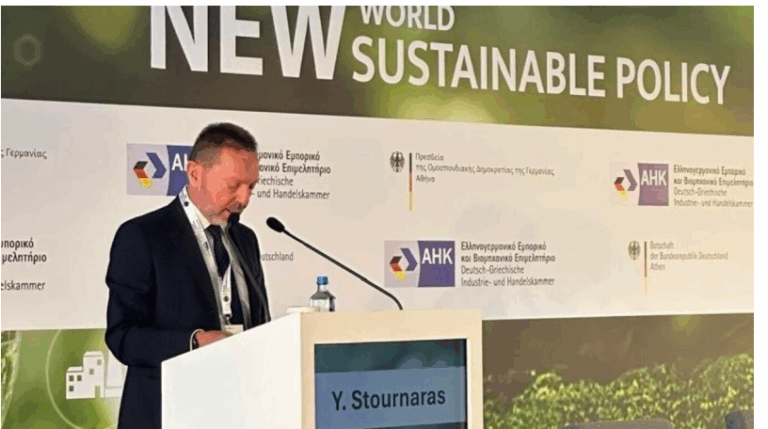
Citing a study, Stournaras noted that for every dollar invested in climate adaptation, the benefit over a decade was ten dollars — a tenfold return.
The head of the Bank of Greece highlighted three key benefits of climate adaptation:
- Reducing future losses — by limiting the impact of disasters linked to extreme weather events and protecting lives and infrastructure.
- Boosting economic activity — through job creation and innovation in sectors such as construction and agriculture. This economic momentum can lead to higher productivity and growth.
- Social and environmental gains — such as strengthening biodiversity, improving public health, and reinforcing social cohesion as societies become more resilient.
Full Speech by Yannis Stournaras
“I am especially grateful for the invitation to address the 1st Helleno-German Sustainability Forum titled ‘NEW World – NEW Sustainable Policy.’
Since its establishment in 1924, the Helleno-German Chamber of Commerce and Industry has been a steady channel of cooperation between Greece and Germany, strengthening bilateral trade relations, promoting extroversion, and supporting business ties between the two countries.
The Chamber’s role is even more important today, in an era of challenges and transformation, where connectivity and the exchange of know-how are crucial for achieving sustainability — the central theme of this conference.
As we all recognize, the issue of sustainability cuts across every aspect of our activity — our businesses, our economy, and ultimately our social well-being.
Alongside the many geopolitical, technological, and other challenges we face today, climate change continues to intensify. In this complex and shifting global landscape, it is vital that countries remain committed to reducing greenhouse gas emissions and adapting to climate change, creating opportunities for inclusive and sustainable economic and social development.
Adaptation to climate change is vital to managing its environmental, social, and economic impacts. While energy policies and the transition away from fossil fuels are rightly prioritized, it is equally important to strengthen the resilience of our economies, as we already experience the consequences of a changing climate — more frequent and severe weather events, risks to businesses and supply chains, extreme temperatures affecting productivity and crops, and new climate conditions influencing tourism.
The multiple benefits of adaptation are summarized in what I call the ‘triple dividend.’
First, it reduces future losses by limiting the effects of disasters linked to extreme weather, protecting lives and infrastructure.
Second, it strengthens economic activity by creating jobs and promoting innovation in sectors such as construction and agriculture, boosting productivity and growth.
Third, it delivers accompanying social and environmental benefits — enhancing biodiversity, improving public health, and strengthening social cohesion as societies become more resilient.
A recent study by the World Resources Institute, which examined 320 adaptation and resilience investments in 12 countries worth $133 billion, found that for every $1 invested, the return over a decade was $10 — tenfold.
Around the world, cities are preparing for more frequent and intense heatwaves. Phoenix, Arizona, is investing tens of millions of dollars in preparation — planting trees, revising building codes to require shade, and applying “cool materials” to streets. Cities such as Barcelona and Buenos Aires have established cooling centers, while Paris, London, and Athens are expanding urban greenery to combat heat.
In Athens specifically, the municipality is implementing a Climate Plan to 2030, emphasizing the restoration of nature, improved ventilation and cooling, and the creation of green and blue infrastructure.
Many cities are also expanding flood control efforts. Copenhagen is investing €1.5 billion to upgrade its drainage system and convert parks into temporary reservoirs. New York City is building new flood defenses and upgrading its sewer system. Lisbon is constructing two major rainwater tunnels to divert and retain stormwater.
As cities, infrastructure, and supply chains become more climate-resilient, adaptation also represents a clear investment opportunity. Construction companies are developing cool materials using nanotechnology, agricultural firms are creating drought-resistant crops and improved irrigation systems, and the financial sector is designing new instruments to fund adaptation — such as Tokyo’s first certified climate resilience bond, which finances projects protecting the city from natural disasters.
However, while the need for adaptation is increasingly recognized, funding remains limited — currently accounting for just 5% of global climate finance. Most adaptation funding still relies on public resources, which are insufficient to meet the vast investment needs. Private capital must therefore be mobilized through partnerships with investors and financial institutions.
To achieve this, we must use a wide range of financial mechanisms, including innovative instruments and derivatives to manage risk and hedge investments. Creating a favorable environment for private investment — with incentives, regulatory support, and transparency — is equally critical. Public-private partnerships can play a decisive role in leveraging private capital and expertise for adaptation projects.
At the Bank of Greece, we have recognized the significance of climate change and have been working actively on this issue for 17 years, in cooperation with the scientific community and policymakers. Our current focus is on developing strategies and policies that strengthen resilience, through our participation in the national LIFE-IP Adaptive Greece program, where we also promote awareness in the financial sector about funding adaptation.
Within this framework, pilot adaptation projects are being carried out in three regions and five municipalities across Greece — including flood management, coastal protection, water management, wildfire prevention, and urban redesign to address the “urban heat island” effect.
Greece has made progress in studying and implementing adaptation measures, particularly in water management, through regional and national adaptation strategies. The government has also launched new initiatives to manage water scarcity and secure water supply in Attica, the islands, and nationwide.
It is clear that the financial system plays — and must continue to play — a decisive role in supporting the green transition and resilience. Beyond the social and environmental benefits, climate adaptation also presents a business opportunity.
As we move through an era of uncertainty and transformation, integrating sustainability into the financial system can unlock growth potential and create competitive advantages. The work of institutions such as the Bank of Greece, the European Central Bank, and the Eurosystem reflects the growing recognition that environmental factors create financial risks — but also opportunities that financial institutions must manage responsibly.
Let us continue with focus and cooperation toward these goals.”
Ask me anything
Explore related questions