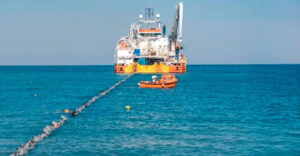
Yesterday’s meeting of the Greece-Cyprus Intergovernmental Summit at the Maximou Mansion was anything but formal, as Kyriakos Mitsotakis and Nikos Christodoulides both reaffirmed their political commitment to the implementation of the GSI (the Greece-Cyprus-Israel cable), but also decided to modify the economic and technical parameters of the project to shield it against the so-called “geopolitical risks”. In common, Turkey, which is threatening to stage a Casualty scene if the project is put back on the rails.
Mitsotakis and Christodoulides had also agreed in September, on the sidelines of the UN General Assembly, on the need to get the project “up and running”. But then came the wild clash between ADMIE and the Cypriot president and the Cyprus Energy Regulatory Authority, and subtle manipulations were required to prevent the important project from being “blown up”.
It is no coincidence that yesterday’s large Cypriot delegation, with 10 ministers and deputy ministers and 6 Presidency staff, did not include Finance Minister Makis Keravnos, who is an opponent of the project, citing viability studies, which he has not released.
The critical parameter in this regard is the modification of the project’s economics to possibly involve some American or even Israeli company. According to reports, contacts were also made in the past few days on the sidelines of the PTEC conference in Athens, where the 3+1 format at the level of energy ministers was convened again, with the participation of US Secretary Chris Wright.
Reportedly, the U.S. International Development Finance Corporation (DFC) is weighing its possible involvement in the project. It may be recalled that French company Meridien has also shown interest a year ago. The development was also photographed by Mitsotakis, who said that “this can potentially be enhanced by the entry of new strong investors, which will obviously be to the benefit of all of us.”
For the interventions in the project, it is taken for granted that an international consulting firm will be involved, which will be asked to re-evaluate the project, so that investors can then “button up” the project, which will also shield it geopolitically.
Energy Minister Stavros Papastavrou and his Cypriot counterpart Giorgos Papanastasiou, who had been in Athens a week ago, also briefed Brussels, which is co-financing the project, on the developments yesterday. In fact, Papastavrou indicated that things will move quickly, citing as a priority “finding that firm that will do the study so that we can put this techno-economic in the new environment, which is finding strong players and funds that can financially support the project”.
Ask me anything
Explore related questions