This magmatic intrusion, estimated to have a volume comparable to 200,000 Olympic-sized swimming pools, triggered hundreds of earthquakes, some exceeding magnitude 5 on the Richter scale.
Advanced machine learning techniques analyzed more than 25,000 earthquakes, allowing precise mapping of magma movement.
The research rules out tectonic fault slip as the primary cause, proving that the magmatic intrusion moved in waves, causing the earthquakes.
The findings suggest this wave-like intrusion is a fundamental mechanism for magma transport beneath volcanoes worldwide.
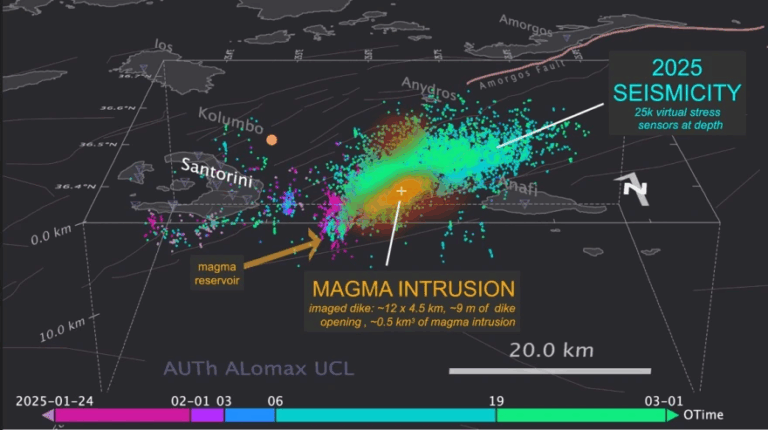
An international team of researchers, including Greeks, uncovered the hidden processes that led to the particularly active seismic activity near Santorini in early 2025. Their study, published in the journal Science, shows that the activity was caused by a massive magmatic intrusion—a vertical slab of magma—that spread in waves over a distance greater than 20 kilometers within the Earth’s crust, at depths greater than 10 kilometers below the sea floor.
According to the researchers, this volume of magma was enough “to fill nearly 200,000 Olympic-sized swimming pools, or 200 times the Great Pyramid of Giza, or about 200 times the Acropolis, or roughly 500 times the Empire State Building.” They add that it was enough to cover Manhattan in New York or the Bermuda Islands with a magma layer about 9 meters thick.
The activity, which was unique worldwide due to the large number of earthquakes within a very limited timeframe, included hundreds of felt earthquakes, some larger than magnitude 5. It “caused local emergencies, school closures, and alarm among residents and visitors.” There was intense uncertainty “whether the earthquakes were caused by volcanic activity signaling a possible upcoming eruption or tectonic fault slip and possibly a prelude to a larger earthquake (such as the devastating magnitude 7.7 quake that struck the same area in 1956).”
Scientists Uncovered What Caused the Intense 2025 Seismic Activity in Santorini
The research team revealed the cause of the activity through advanced machine learning techniques that precisely mapped the spatial distribution in the Earth’s crust of over 25,000 earthquakes. The study used these earthquakes as “virtual deep stress meters,” allowing them to visualize magma movement with unprecedented spatial and temporal detail.
This visualization, according to the research, identifies and maps the intrusion of a magmatic vein, which ultimately triggered the seismic activity. As the researchers emphasize, the visualization thus rules out tectonic fault slip as the primary cause of the 2025 seismic surge.
“The detailed spatiotemporal visualization of the 2025 seismic activity shows that magma intrusions cause earthquakes and can lead to dangerous volcanic eruptions; the process does not involve a simple one-way movement of magma horizontally or vertically,” they note. Most impressively, the intrusion did not move smoothly but rather in waves—opening new fractures, closing others, and pushing magma forward in pulses. “The wave-like magma intrusion and the consequent pulsating pressure changes affected the stress field and led to the genesis of such a large number of earthquakes, at a ‘cascading’ rate, meaning one earthquake after another in a very small spatial and temporal window,” the research team highlights.
The team’s findings suggest that this wave-like feedback process of magma intrusion is not unique to Santorini. Instead, it is likely a fundamental mechanism by which magma is transported beneath volcanoes worldwide. Moreover, as noted, the developed methods could help scientists monitor future crises in near real-time—especially in regions where the greatest activity occurs offshore or deep underground, beyond the reach of traditional surface measurements.
“Santorini, part of the Greek volcanic arc, has a history of catastrophic eruptions, including the ‘Minoan eruption’ around 1620 BCE. The 2025 seismic crisis, although not accompanied by an eruption, highlights the possible risks faced by local populations and underscores the importance of high-resolution geophysical monitoring,” the researchers conclude.
Ask me anything
Explore related questions