





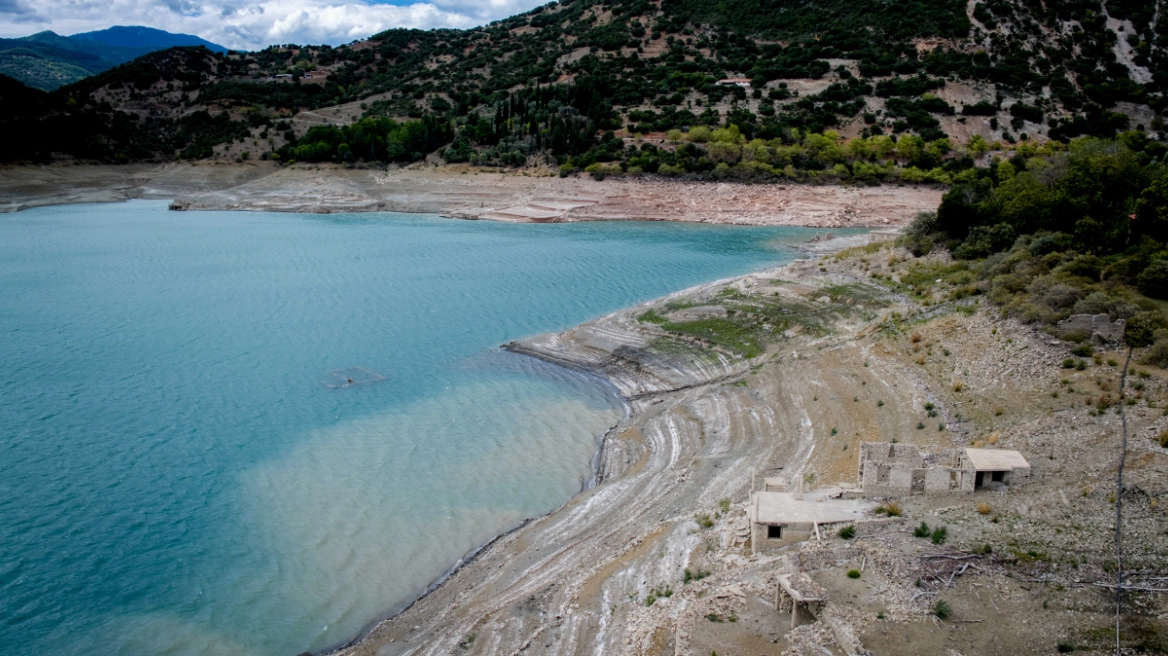
Leros and Patmos are entering a state of emergency due to water scarcity, with measures expected to be approved today by the sectoral Plenary of RAAEY – a development that opens the path for immediate activation of interventions on the two islands, as well as the acceleration of infrastructure works via fast-track procedures and more flexible procurement processes.
According to information, measures for Attica will also be evaluated in the same meeting, with corresponding decisions expected in the coming hours.
The Regulatory Authority for Waste, Energy and Water (RAAEY) has already activated its institutional powers following a request submitted by EYDAP to the Ministry of Environment and Energy, seeking urgent action regarding Attica’s water supply.
On 26 November, the Mornos reservoir contained 160,662,000 m³ of water, compared to 262,068,000 m³ a year ago — a decrease of about 40%.
The total reserves of EYDAP’s four main reservoirs (Evinos, Mornos, Yliki, Marathon) stood at 363,345,000 m³, down from 571,003,000 m³ last year — a drop of nearly 37%.
The NTUA study
A few weeks ago, the Authority also commissioned a study and legal opinion on Attica’s water reserves to Christos Makropoulos, professor at the Hydrology and Water Resources Management Laboratory of the NTUA School of Civil Engineering, and to a major Athens law firm (Flogaitis–Siouti). It is unclear, however, whether the deliverable has been completed and received — something considered crucial for making final decisions.
Emergency measures are deemed necessary because they allow the acceleration of studies and immediate implementation of infrastructure in areas at risk of hydrological collapse. In Attica, and increasingly also in the islands entering “red alert,” EYDAP and the Ministry are launching rapid contracting procedures, activating Article 55 of the recent law on nationally prioritized projects — similar to the Thessaly model — with compressed timelines and no delays.
The “Evrytos” project and the diversion of two rivers
At the center of the water-scarcity response plan is the €500 million “Evrytos” project, which provides for the partial diversion of the Karpenisiotis and Krikelotis rivers towards the Evinos reservoirs, along with network-upgrade works and desalination units. The tendering of the “Evrytos” plan is scheduled for summer 2026, with a technical design involving two tunnels of 14 km and 6 km in length and 4 meters in diameter, able to transfer up to 200 million m³ of water annually.
Water will be drawn only when river levels rise after rainfall, ensuring ecological balance, while the natural gravitational flow of Evinos will allow transport without energy cost.
Currently, water-reserve reductions reach 250 million m³ annually, alongside a 25% drop in rainfall, a 15% increase in evaporation, and a 6% rise in consumption. According to the government, these data accelerate decision-making.
Desalination if drought persists
If the drought continues, a parallel solution is being promoted involving the creation of desalination units in Thisvi, Nea Peramos, and Lavrio. The installations are planned to be modular, with a construction period of two to two-and-a-half years; however, the cost of producing desalinated water will be much higher than natural flow, a factor expected to burden future water bills.
Water tariffs – crucial decisions at year’s end
The next step in the complex equation of water management is tariff increases — an issue pushed strongly by EYDAP’s management in its last call with analysts. The company announced €5.5 million in losses in its half-year results, attributing them largely to its unsuccessful two-year attempt to adjust water tariffs, which remain among the lowest in Europe.
The regulatory framework and tariff decisions are not made directly by the government; the regulator — RAAEY — must approve the “allowed revenue,” as it does for energy operators (HEDNO, ADMIE, etc.), with the results reflected in electricity bills. Understaffing and the Authority’s long-standing leadership gaps were seen as major causes of delays, alongside political reluctance to raise prices.
RAAEY will assess the investment plans of water-supply companies, infrastructure needs, and operating costs, aiming for tariff increases that are gradual and not disproportionate for households. According to relevant sources, final decisions on water pricing are expected by year’s end.
Everything now depends on time
Greece is entering a new era of hydrological management. The declaration of islands under emergency status, the upcoming inclusion of Attica, the “Evrytos” project, the backup desalination strategy, and the consolidation of management into two major hubs together form a comprehensive response to a crisis that no longer concerns the future but the present. Whether the plan will be implemented within the required timeframe will be judged in the coming months. Winter, however, will be decisive.
Ask me anything
Explore related questions




