





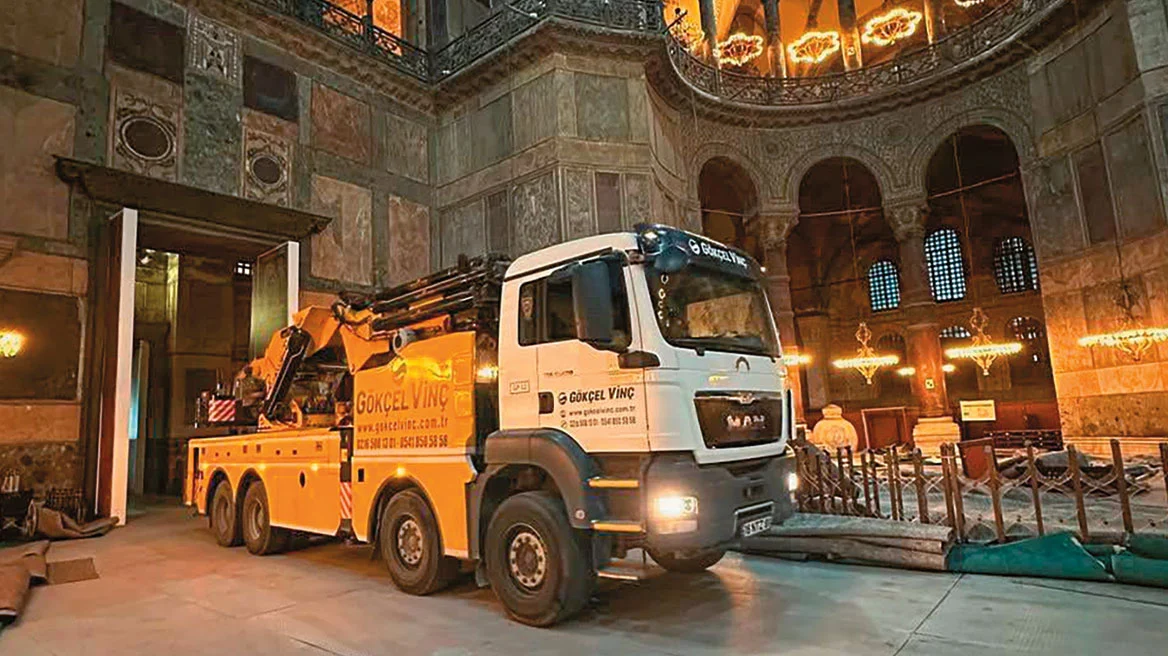
Hagia Sophia in Constantinople continues to be a gaping wound on the body of Orthodoxy and Hellenism, with provocations from the Turkish leadership showing no end. Recent images of heavy trucks entering through the Emperor’s Gate and…taking a tour inside the temple sparked an outcry even within Turkey. Archaeologists and other experts expressed—despite the risk of being targeted—astonishment, outrage, and strong concerns over potential damage to the floor and other parts of this unique monument.
To avoid or at least mitigate international criticism, the neighboring country’s leadership mobilized the relevant authorities, who, of course, assured that there was no danger, listing a series of protective measures taken for the “restoration” work. The indirect, yet arguably better, response came from Turkish scientists’ posts on social media, contrasting—with relevant photos—the exemplary restoration method followed in the case of Notre-Dame de Paris, which, as is well known, suffered near-total destruction in April 2019 and reopened its doors last December.
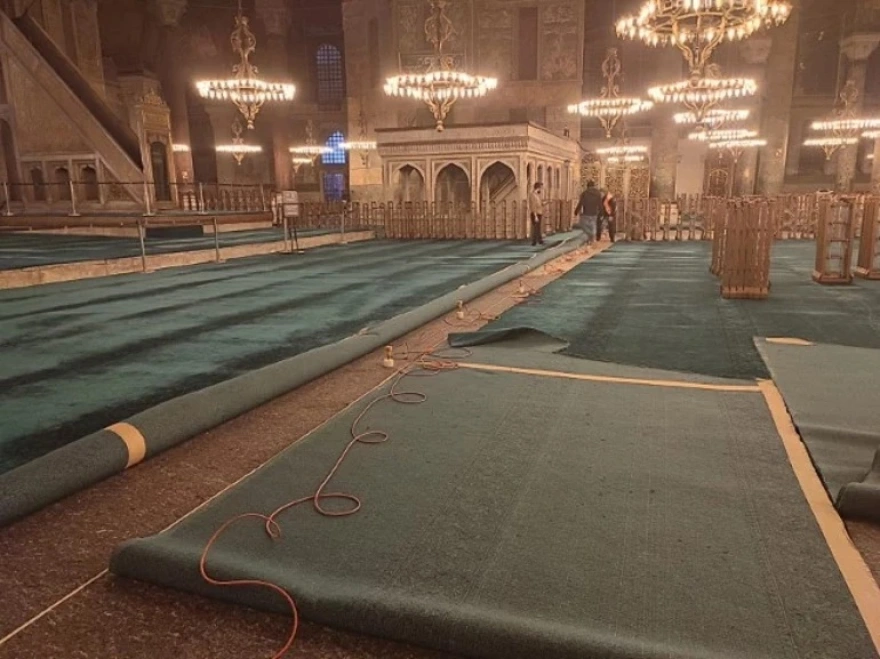
The official position of the Turkish state, through Minister of Culture and Tourism Mehmet Nuri Ersoy, refers to necessary reinforcement work, with the main apse and central dome entering “the broader and more comprehensive process of restoring their history,” aiming for greater earthquake resistance while preserving the monument’s authentic character. According to Turkish authorities, this is part of the second phase of restoration work that began in 2023, exclusively concerning the strengthening of the temple’s seismic protection.
However, the announced protective measures for the placement of temporary panels on the historic floor did not convince experts. In fact, according to an anonymous scientific assessment, the floor of Hagia Sophia is not a single layer but includes mosaics, ancient stone slabs, and in some areas voids that indicate underlying chambers. Therefore, the concentration of heavy loads or vibrations from heavy vehicles may cause damage over time.
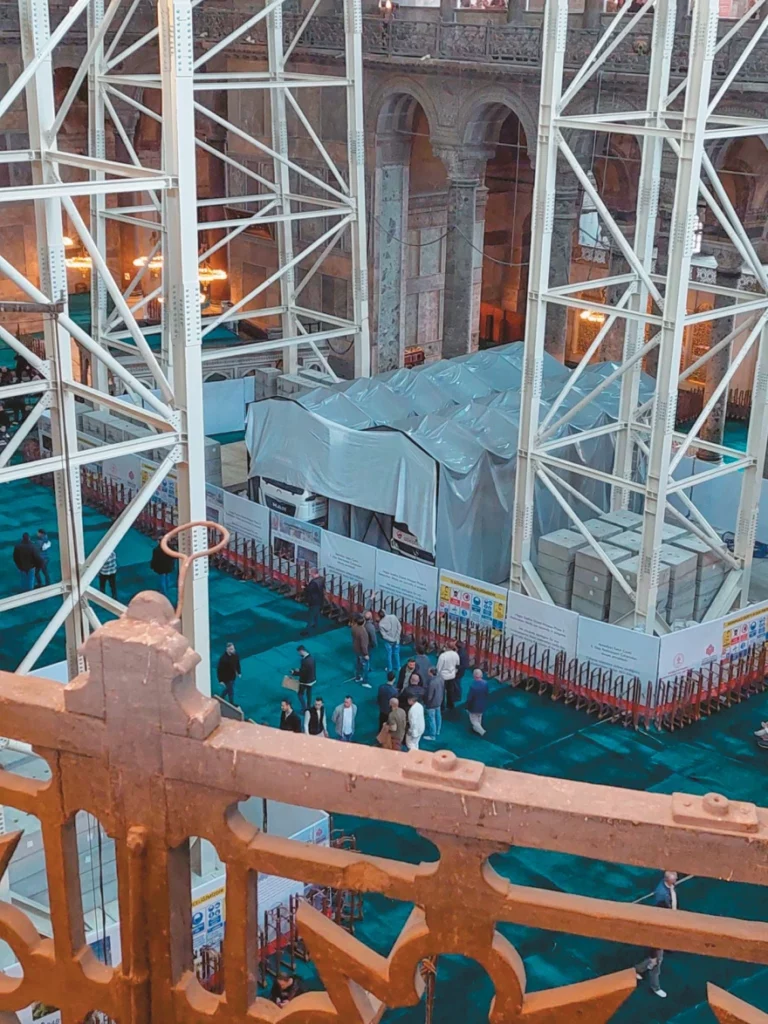
Concern is widespread in the messages of Turkish archaeologists on social media following the appearance of these photos. Some wrote that they could not believe their eyes, expressing hope that the images were not real. Others voiced objections more diplomatically, like a well-known Turkish archaeologist: “Can the entry of these vehicles into Hagia Sophia be accepted according to the principles of universal protection? I wonder if there really was no other way!” Some commented more pointedly, calling it shameful and disgraceful. “This is the value given to History; no period has been so destroyed. I hope the vehicle isn’t diesel,” “It’s very easy to kill History; the ignorant do not know its value,” are some of the reactions.
From the Latins to Muhammad
The long historical trajectory of this supreme spiritual and architectural symbol of the Byzantine Empire begins in 532, after the destruction of the Theodosian Hagia Sophia during the Nika Riots. At that time, Justinian commissioned the mathematicians and architects Anthemius and Isidore to build a new Hagia Sophia. The ambitious project was completed in December 537, delivering to history a unique architectural achievement destined to remain, despite the damages it suffered over time, as a cultural cradle of encounter between East and West, and a timeless reference point for many subsequent Orthodox churches and Ottoman mosques.
For example, the Blue Mosque and Sultan Ahmed Mosque were designed with inspiration from Hagia Sophia. Until 1453, it functioned as a Byzantine Christian cathedral of the city and essentially as the emblematic center of Orthodoxy, with the exception of 1204–1261, when it served as a Roman Catholic church. In September 1261, after the Byzantine capital was recaptured from the Crusaders, Michael VIII Palaiologos was crowned emperor at Hagia Sophia, inaugurating the last Byzantine Palaiologos dynasty. During the Palaiologan era in the 13th and 14th centuries, after significant damage, the church was restored and its interior redecorated, taking its final form that survives to this day.
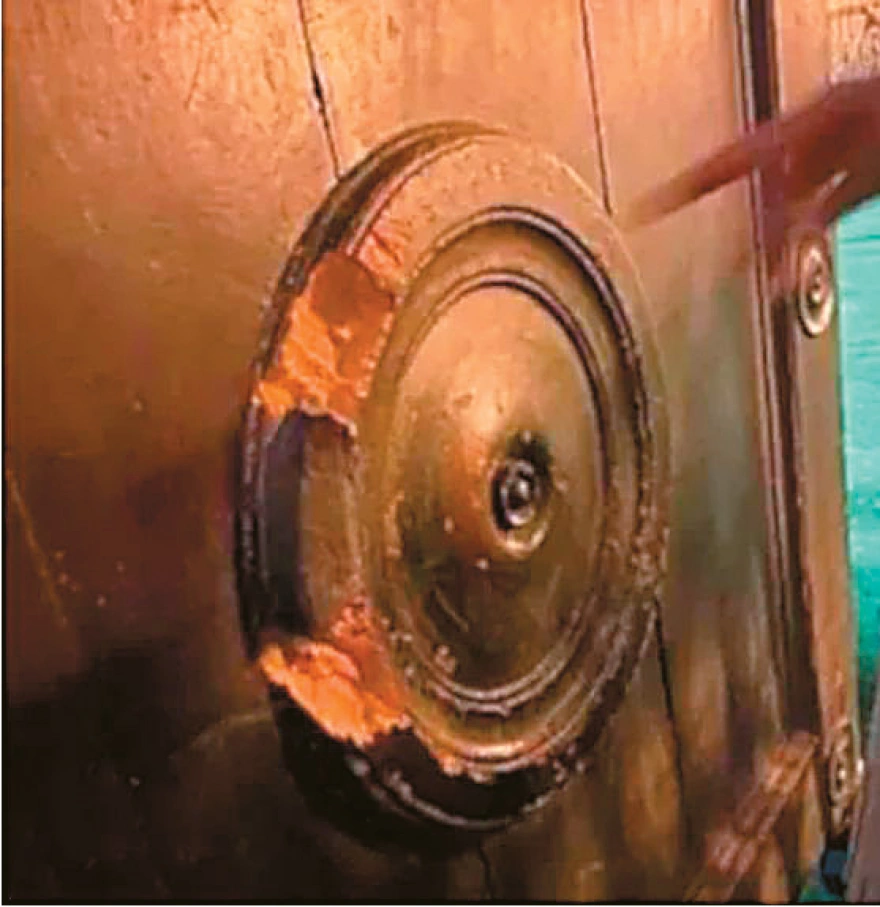
(Damage to the Emperor’s Gate. In 2022, it was recorded on video, along with the falling of parts of the dome)
The great adventures for Hagia Sophia began after the Fall of Constantinople on May 29, 1453, when it fell into the hands of Mehmed the Conqueror and the Ottoman authorities, suffering new major damages. From that period, the nearly 1,000-year symbol of Orthodoxy and pinnacle of Byzantine architecture was converted into an Islamic mosque. It functioned as such for five centuries until 1934, when Mustafa Kemal Atatürk decided to convert it into a museum. This was a decisive move in his strategy to give Turkey a secular character, separating state and religion, limiting Islamic influences, and aiming to highlight the country as a custodian of a global cultural heritage.
Under this regime, Hagia Sophia attracted worldwide attention and admiration for decades, and in 1985 it was recognized by UNESCO as a World Heritage Site.
The Erdogan Era
With Recep Tayyip Erdogan’s rise to power in 2002, the gradual restoration of Turkey’s Islamic character began, in line with his strategy to gain a dominant role in the broader Middle East and Arab world. Early signs of hostility toward Hagia Sophia—which, despite efforts, remained a symbol of Orthodoxy—had already emerged in the 1990s, with Islamist organizations calling for its conversion into a mosque.
Under Erdogan, Muslim prayers began in front of the monument, alongside inflammatory statements from government officials. This paved the way for July 10, 2020, when the Turkish Council of State annulled Atatürk’s 1934 decision and cleared the path for Hagia Sophia’s conversion into a mosque.
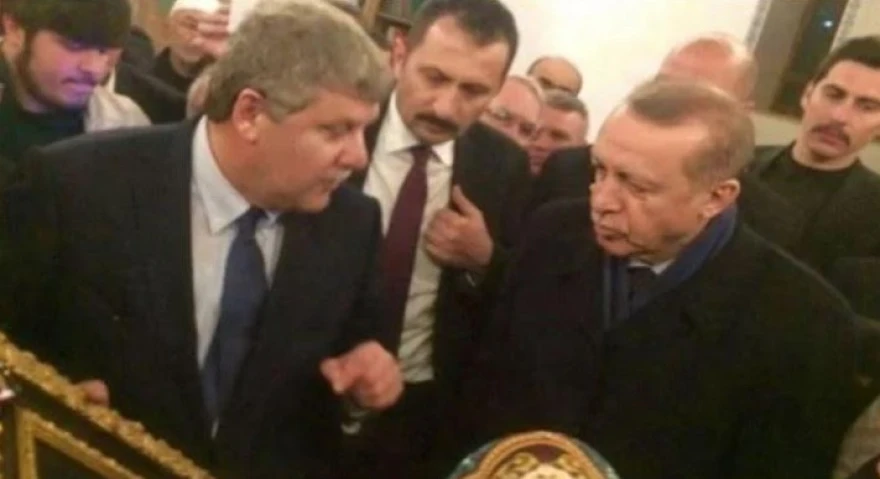
(Recep Tayyip Erdoğan with Hasan Gürsoy, the contractor who has handled all the contracts related to Hagia Sophia)
On the same day—without even observing formalities—Erdogan signed the decree integrating the monument into the network of religious sites. On July 24, the first Muslim prayer was held in the temple after 86 years, with Erdogan himself reading the Quran, consolidating his position domestically and, mainly, among the Muslim-friendly constituency, during a period of political pressure and economic instability.
Since then, the temple’s exquisitely beautiful interior floor has been covered with green carpets on which Muslims walk barefoot and pray according to their tradition; massive green Quranic inscriptions have been installed, as well as… fabrics to hide, as much as possible, the extraordinary mosaics, rare traces of the temple’s Byzantine origins.
Ineffective Condemnations
The conversion of the World Heritage Monument into a mosque and symbol of Islam provoked an outcry not only from Greece but also from UNESCO, the EU, the USA, etc., without any result. Since its reopening as a mosque, Hagia Sophia has suffered many visible—and who knows how many “invisible”—damages due to overcrowding, which have also been highlighted by some Turkish media. Even pieces of the dome began to fall, as recorded in a 2022 video. Several experts sounded the alarm, calling for restricted access to preserve the monument’s integrity.
Şerif Yaşar of the Turkish Art History Foundation stated that Hagia Sophia will collapse in the next earthquake, adding that before its conversion into a mosque, the Foundation’s board had proposed admitting visitors in groups of no more than 25, as the humidity from their breath was harmful to the interior. They also recommended extensive restoration, warning that the dome might collapse. However, the Foundation faced rejection from the then administration, as Hagia Sophia was the most profitable museum in Turkey. Consequently, damages have been increasing, as seen in 2022 with the vandalism of the Emperor’s Gate.
Beyond being a “political tool” in the hands of successive Turkish leaderships, with all that entails, Hagia Sophia has also been tested over centuries by natural phenomena, mainly major earthquakes that have struck Turkey numerous times, causing many victims and extensive material damage. Despite the severity of these events, it has endured and remains standing, with none of these events managing to “lower” it…
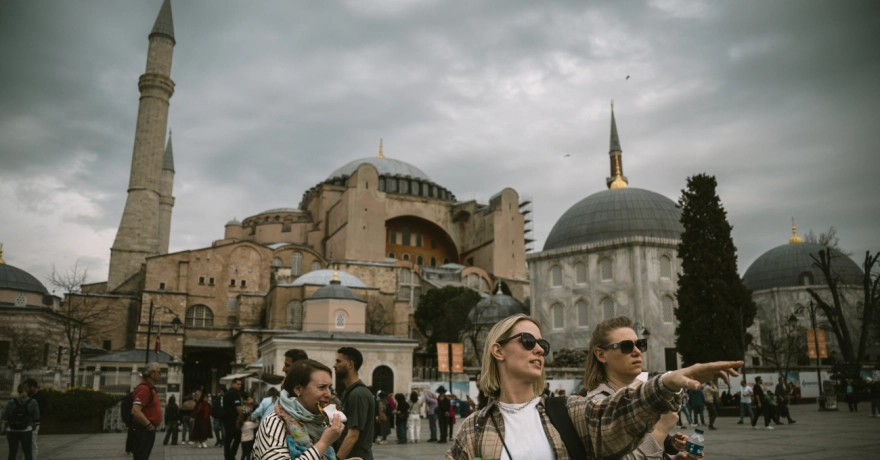
Significant Revenues
There is also an economic dimension, as Hagia Sophia, when functioning as a museum, was a major source of revenue for the Turkish state. According to figures, in the last year of its museum operation, 2019, it had 3.73 million visitors, generating $72 million, with entry tickets costing $15 and night tickets up to $365. The 2020 conversion into a mosque, which nullified revenues, caused internal dissent. Press reports and opposition MPs argued that the museum revenues exceeded the total toll revenue from all bridges in Constantinople.
Afterward, the Turkish leadership reconsidered, establishing the temple’s parallel operation as both a mosque and a visitable site. Specifically, visits and tours occur at the upper gallery (Visitor Gallery) with tickets costing €25–28 with no waiting, while visits to the main temple are limited and take place in the morning to avoid crowding, as the space is reserved for prayer in the afternoon. A dress code also applies: women must wear headscarves and long dresses, and men long pants and shirts, i.e., no summer attire.
“Party” for Cronies
A particularly distasteful revelation in January 2024 was that a new entrance for foreign tourists, as part of separating the worship and museum areas, was equipped with an industrial rolling door and shutters, normally used in garage doors and factories.
Restoration work at Hagia Sophia has also been a… golden opportunity for contractors close to Erdogan and his party. Chief among them is Hasan Gürsoy, a personal friend and schoolmate of the Turkish president, whose company Guryapi has almost exclusively handled all contracts related to the monument. His company, Guryapi Restoration Contracting and Trading, recently won a tender worth 218.5 million Turkish lira for Hagia Sophia, followed by additional contracts totaling 31.25 million lira.
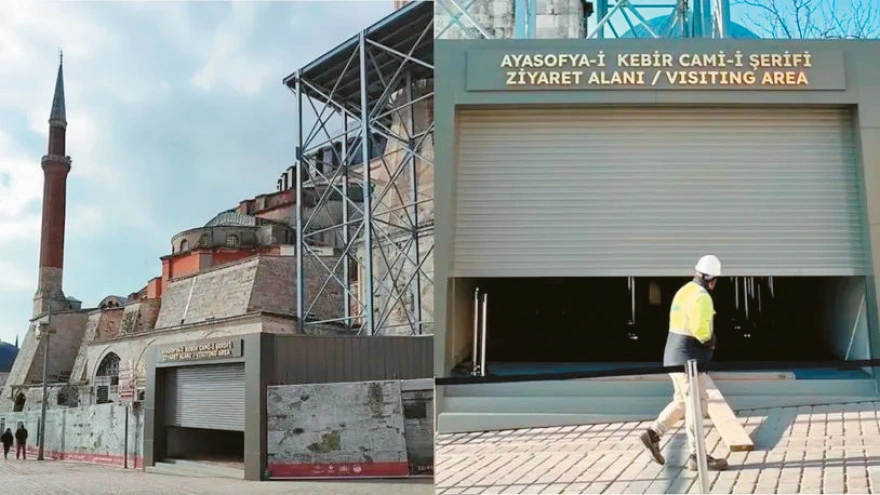
(And an industrial rolling door for the entrance of foreign tourists was revealed in January 2024)
During Erdogan’s long rule, Gürsoy’s companies have won dozens of public tenders, completing over 100 major projects in infrastructure, residential and commercial construction, and restoration of historic monuments. These include the Huber Mansion, Süleymaniye Mosque, Galatasaray University, Archaeological Museum, Topkapi, and a property linked to the president’s son Bilal Erdogan. The Guryapi Restoration company alone has won 20 public tenders since 2015, totaling 1.741 billion Turkish lira.
Additionally, Gürsoy undertook multimillion-dollar construction projects, such as Erdogan’s summer residence in the eastern province of Van, the Ahlat mansion, and Turkey’s largest mosque, Çamlıca. In the Hagia Sophia case, another close friend of Erdogan, Muharrem Hilmi Şenalp, architect and owner of Hassa Architecture Company, was involved. He won a restoration tender for the monument in 2022 and, according to Turkish media, has received more than 20 public tenders over the last decade.
Ask me anything
Explore related questions




