





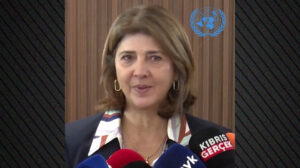
The UN Secretary General’s personal envoy for the Cyprus problem, Maria Angela Olgin, has been at the center of intense controversy after she made an unacceptable statement in the occupied territories where she called the occupied area the “Turkish Cyprus side”. The video was posted on the official UN account for Cyprus on the X platform and prompted an explosion of comments from Greek Cypriot users.
The report came after Olegin met with Turkish-Cypriot leader Tufan Erhurman in the occupied territories. In the video, the personal envoy appears to talk about her contacts with both sides on the island and at one point describes the occupied territories as the “Turkish Cyprus side”, adopting a term that refers to the division of Cyprus into “Greek” and “Turkish” sides.
At the same time, she says she is “happy to be back on the island”, congratulates Erhurman and calls the discussion “useful” and “productive”, announcing that she will host a joint meeting between the two leaders next week.
Sensitivity to the Terminology of the Cyprus Issue
The problem is not simply a matter of poor wording. In an issue like the Cyprus problem, where international legality relies word for word on Security Council resolutions, every phrase that could be interpreted as recognizing a separate “Turkish side of Cyprus” is considered particularly dangerous by Nicosia.
Security Council Resolutions 541 and 550 have made it clear that the unilateral declaration of the pseudo-state is legally invalid and call on all states not to recognize any other “state” besides the Republic of Cyprus, reaffirming its sovereignty and territorial integrity.
In this context, a UN Secretary-General envoy is expected to exercise almost surgical precision in wording, precisely because the UN presents itself as the ultimate guarantor of these same resolutions. When the envoy herself uses terms reminiscent of Ankara’s and the occupation regime’s rhetoric, the message reaching the Greek Cypriot side is not exactly reassuring.
Reactions on Social Media
Although no official reactions from the Republic of Cyprus have yet been made public, comments on social media have been overwhelming, with many users calling on the UN for clarification or even correction of the post.
The irritation is not only about the “language of the video,” but also the broader climate of distrust that has existed for years regarding the way various international actors describe the regime in the occupied areas. At a time when Ankara is openly pushing to elevate the pseudo-state to an international level, such a slip by the UN Secretary-General’s representative is recorded politically, not just communicatively.
A Few Days Before a Critical Meeting
The verbal slip carries added weight because it comes just days before the joint meeting of the President of the Republic of Cyprus, Nikos Christodoulides, and Tufan Erhürman under the auspices of Olgin, in an effort to “unfreeze” talks after years of stagnation.
The personal envoy has already warned in public statements that the failure of the process after Crans-Montana in 2017 has pushed the two communities further apart, not only politically but also socially, resulting in the loss of a shared vision for the island’s future.
Against this backdrop, word choice by the UN is not a trivial matter. Nicosia has invested politically both in Olgin’s mission and in the role of the European Union, which seeks to become more actively involved in the Cyprus issue through its special envoy, Johannes Hahn. Any phrase that seems to “grey out” the international status of the Republic of Cyprus has a corrosive effect, even if it is attributed to human error.
The Substance Behind the “Mistake”
Even if the UN rushes to call it a “verbal slip” or a “bad translation,” the damage in terms of perception has already been done. For the Greek Cypriot side, the big picture remains the same: the only recognized state on the island is the Republic of Cyprus, and any negotiations are conducted based on Security Council resolutions, which explicitly reject any notion of two states.
In an environment where Turkey continually tests the limits of international legality in Cyprus, attention to words is not an exaggeration. It is part of the defense. And Nicosia expects the UN to be the last to “mix them up.”
Ask me anything
Explore related questions




