





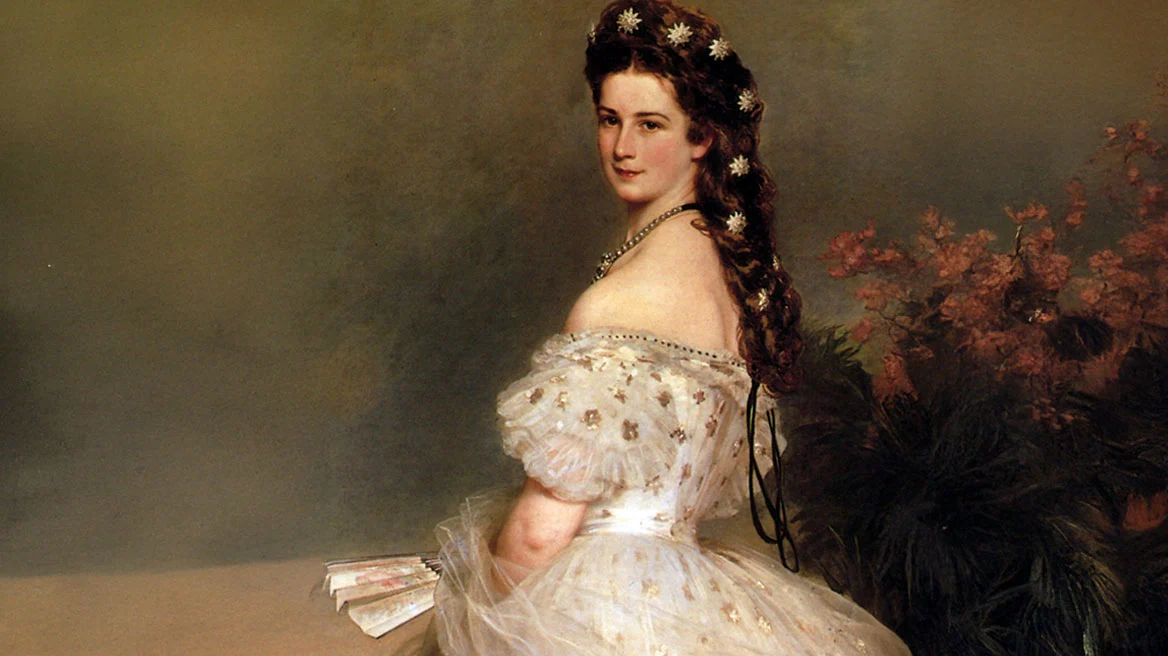
In the autumn of 1888, an aristocratic lady left her yacht outside Nafplio and disembarked at the port with her entourage. She asked about the antiquities of the area. She stayed at the “Mykene” hotel, where she met the hotelkeeper’s son, Nikolaos Thermogiannis.
This lady was none other than Empress Elisabeth of Austria and Queen of Hungary, Princess “Sisi” a free and untamed spirit who felt stifled by the conventions of the court and of her era.
She had a passion for the Greeks, ancient and modern alike. She wanted to learn their language. It was shortly before she built her villa in Corfu, the Achilleion.
She had begun learning Greek with the Corfiot professor Ioannis Romanos, but she eventually preferred the young man. Nikolaos Thermogiannis was the second of a total of ten Greek teachers whom the empress employed over a decade, until her assassination in Geneva in 1898 by an Italian anarchist. She preferred to find them herself.
As she did with the last one, the melodious Frederik Barker, son of a Briton and a woman from Smyrna, whom she met at the port of Alexandria and who, among other things, sang Greek songs to her.
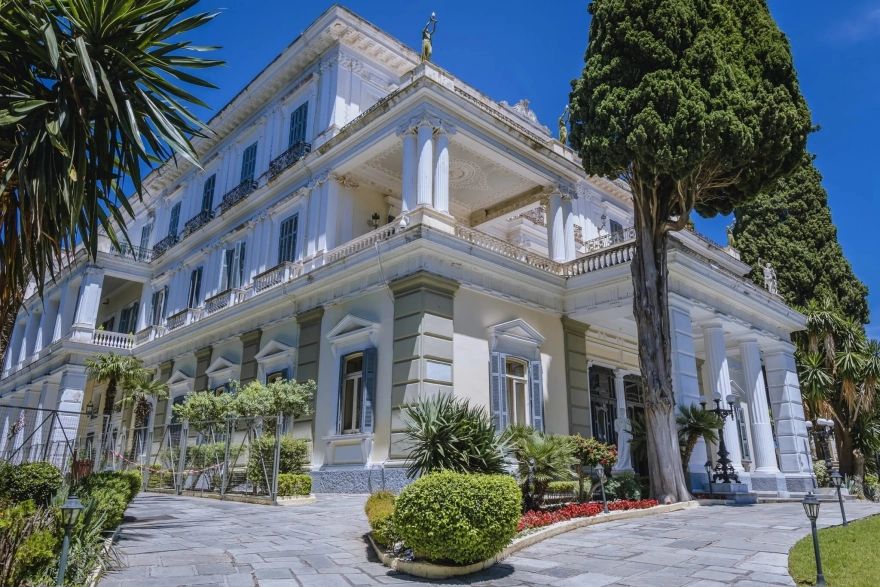
(The mansion of Empress of Austria and Queen of Hungary Elisabeth in Corfu, Achilleion)
Ancient and Modern Greek
She did not want them strictly as teachers. She wanted them as “readers” in the old sense of the word; she wanted them to speak to her and recite Greek to her while the ladies-in-waiting were curling her hair, while she was doing her exercises, while she was out on her walks.
And she learned Greek well, both ancient and modern; in the end she even translated foreign literary works into Greek.
The third in line, Roussos Roussopoulos, she did not discover herself; he was recommended by Baroness von Perfall, a now-forgotten intermediary of that period who supported worthy Greeks.
She was none other than Amalia Klaus, daughter of the well-known currant merchant Gustav Klaus and Thomaïs Karpouni, and she had captivated a German baron.
In any case, the constant presence of alternating young teachers around the empress caused great headaches at court, because they constituted an uncontrollable factor. At the very least, they might be spies.
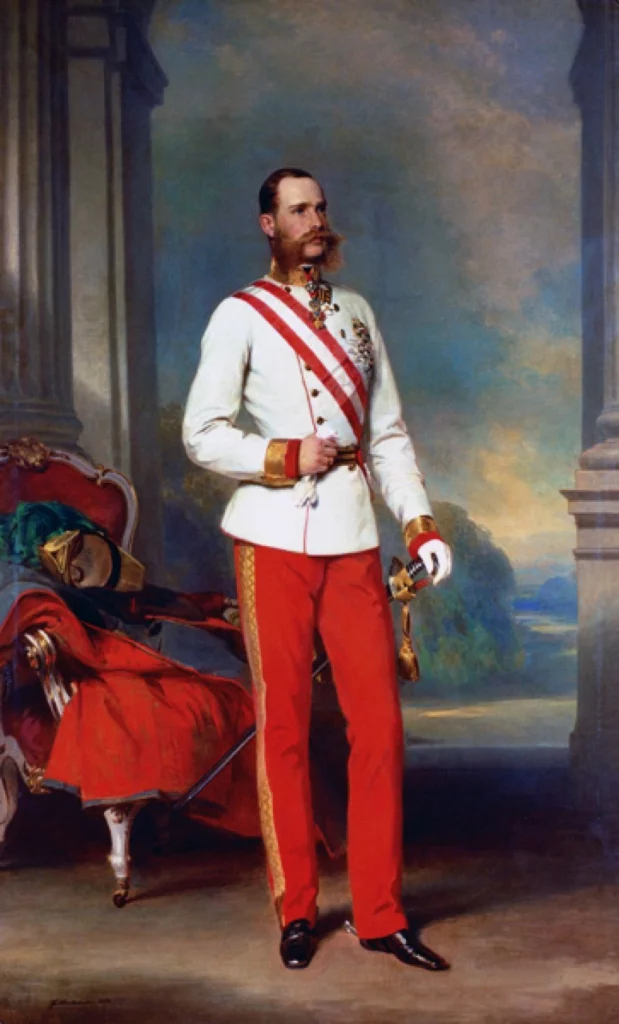
There was, of course, the husband as well, Emperor Franz Joseph I, the longest-reigning ruler in European history. But was he not jealous, with so many young men from Greece close to the hem of his wife’s skirt? Probably he was, but with decorum.
He was certainly not jealous of a reader like the poor Konstantinos Christomanos, the future founder of the New Stage in Athens, who was hunchbacked after a childhood accident.
He would, however, surely have been jealous of Roussos Roussopoulos, who was upright and slender. This is evident from the emperor’s secret correspondence with his close friend, the actress of Vienna’s Burgtheater and incorrigible card player Katharina Schratt.
Demotic and Katharevousa
This correspondence was published after the war. Here and there appear references by Franz Joseph to a certain “Greek with the legs.” In one excerpt the emperor reveals himself: “The Greek Roussopoulos, that tall blond one with the big legs.”
Beyond the family matters, however, this correspondence shows that, at the latest with the arrival of Roussopoulos, the linguistic dilemma of demotic versus katharevousa makes its appearance even at the court of the Habsburg dynasty.
For the emperor writes to his lady friend: “The new teacher claims that Nikos [Nikolaos Thermogiannis] had taught her excessively vulgar Greek.”
This was later confirmed by Roussopoulos himself when, in 1898, he delivered Elisabeth’s funeral oration at a memorial service in Budapest: “She knew demotic and understood it already after her first travels. But she wanted more; she wanted to command the literary language as well. And for that she needed a professional teacher.”
A qualification he himself possessed. And so the years passed little by little, with the empress spending her hours with her readers and her knowledge of Greek being practiced sometimes in demotic and sometimes in katharevousa. By temperament, the former moved her more.
A voice from the past
Thus the Greek language question found resonance even in the boudoir (bedchamber) of the empress of Austria.
After her death, Roussos Roussopoulos became a professor at the Academy of Oriental Studies in Budapest, where at some point they began experimenting with phonograph recordings.
These early recordings were preserved and are now being published by Christian Liebl of the Austrian Academy of Sciences.
In one of them, dated January 9, 1914, we hear Roussos Roussopoulos reading, in a somewhat rhythmic voice, the opening of Psycharis’s Journey. We will never know what he truly believed about the language question.
If he had been a convinced supporter of katharevousa, he would never have chosen to read into the phonograph the manifesto of demoticism.
And if he had been a convinced demoticist, then he probably pretended the opposite at court for reasons of professional security.
Ask me anything
Explore related questions




