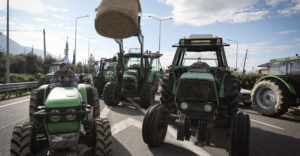
Farmers are choosing the path of escalation following the government’s latest announcements and, starting today, are setting up 48-hour blockades at key points of the national road network as well as on bypass roads, causing severe traffic congestion. As a result, blockades will take place today at the Tempi tunnels, at Malgara, and at Bralos. Farmers in Trikala will block the Mourgani junction on the Larissa–Ioannina national road.
Producers in Western Macedonia will proceed with a 48-hour blockade at the Siatista toll barrier on the Egnatia Odos from 11:00 a.m. At the same time, they have decided to block bypass roads from 12:00 to 16:00.
Similarly, producers at the Filotas junction block, also on the Egnatia Odos, will proceed with a 48-hour blockade starting at 10:00 a.m.
Farmers at the Kastro block decided, during their assembly, on a four-day blockade of the Athens–Lamia national road in both directions of traffic, as well as all bypass routes. As they announced, the escalation of mobilizations is expected to begin at 9:00 a.m.
Farmers from the Chalkida, Kirinthos, and Istiaia blocks will also proceed with a two-day blockade of the High Bridge of Chalkida starting at 10:00 a.m.
Roads closed, but dialogue requested
However, during yesterday’s assembly in Nikaia, beyond the escalation that was decided, a meeting with the prime minister was also requested for next week. In this context, a new nationwide coordination meeting may take place to determine the agenda of the discussion from the farmers’ side. The government, for its part, points toward a meeting with Kostis Hatzidakis and Kostas Tsiaras, who have an excellent grasp of the data, both in terms of demands and in terms of possibilities and solutions. As government officials noted, a meeting with the prime minister will take place only when those entering the Maximos Mansion represent all farmers.
The stance the police will take during today’s mobilization will also be crucial in shaping the climate for such a meeting, especially following the recent intervention of the Supreme Court calling for the imposition of fines on those who attempt to block points of the national road network.
Why farmers were not satisfied
It took 39 days of mobilizations for the government to specify measures that, more or less, had been discussed throughout this period but had not been announced in detail. For example, yesterday the government announced that from next November it will be able to provide farmers with agricultural electricity—through GAIA—at 8.5 cents per kilowatt-hour.
Farmers were not satisfied with these announcements, as they are far from the 7 cents they had requested from the government. At the same time, the package of detailed measures did not mention an increase in the €160 million allocated for income compensation for wheat and cotton, nor did it include alfalfa. They also consider the €80 million earmarked for Greek livestock farming to be insufficient.
At the same time, beekeepers and fishers are dissatisfied, as they receive not a single euro from this package.
What kind of dialogue the two sides want
After the announcements, the government made it clear that, at the economic level, there is no possibility of offering anything more to farmers; therefore, any discussion at this stage would concern only institutional issues related to the future of the primary sector.
For their part, farmers believe that through dialogue they can further improve the financial terms offered by the government. They will also request the inclusion of more farmers in the GAIA program for electricity, which currently applies to farmers with regulated debts. These farmers account for only 20%, they claim—meaning that only one in five farmers is able to access the low electricity rate.
In addition, they will seek more support for the livestock, fisheries, and beekeeping sectors.
Ask me anything
Explore related questions