





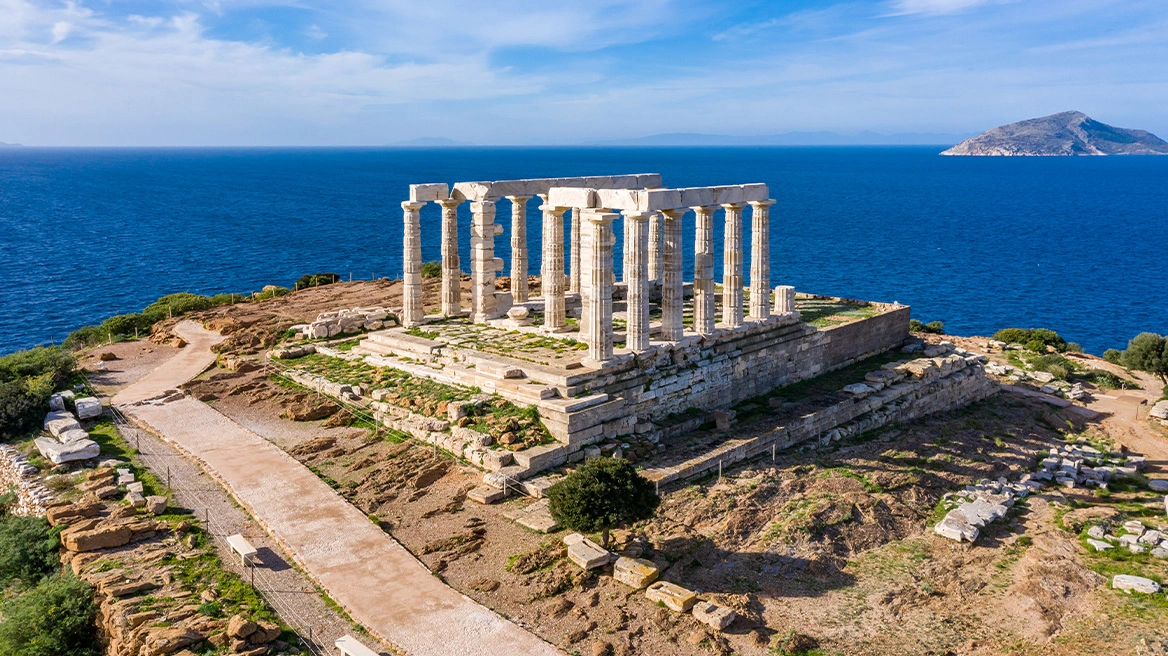
Sounion is a favorite destination for couples who swear eternal love at sunset, awakening within us a sense of sacred awe — a unique and unfamiliar feeling that connects us with our Ancient Greek ancestors.
A feeling both powerful and unprecedented fills the visitor, surrounding the human presence with pride and respect for the beauty left to future generations as a testament of worship by our ancient forebears.
There is evidence that sanctuaries were founded on the cape as early as the 11th century BC. The best-known temples of Sounion, the Temple of Athena and the Temple of Poseidon, are believed to have been built around 700 BC, with their kouroi dating about a century later. The building materials and the scale of offerings suggest that members of the upper and aristocratic classes frequented the site.
The Ancient Greeks regarded Poseidon as the “god of the sea.” Given the importance of maritime trade and naval power to ancient Athens, especially in the fifth century BC, Poseidon held particular significance for the Athenians.
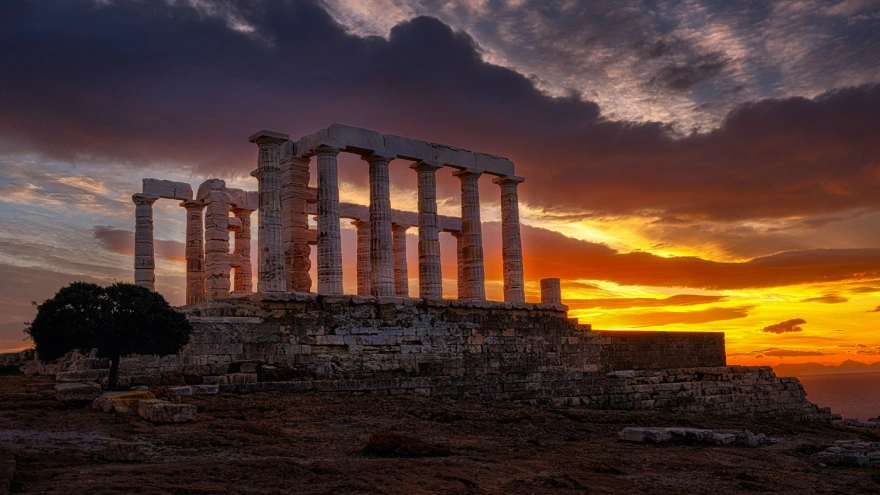
Sounion lies about 13 kilometers south of Thorikos, at the southernmost tip of Attica. Its location allowed it to function as a border district, visible to any ship approaching Attica.
The original Archaic-period Temple of Poseidon is believed to have been destroyed in 480 BC by Persian forces during Xerxes’ invasion of Greece. After defeating Xerxes at the naval Battle of Salamis, the Athenians placed a captured enemy trireme at Sounion as a victory trophy dedicated to Poseidon.
The Temple of Poseidon
The temple was built between 444 and 440 BC, during the era of Pericles, who also rebuilt the Parthenon. It was constructed atop the ruins of an earlier Archaic temple.
The Greek geographer Strabo wrote of Sounion that it was ideally located for travelers crossing from Asia to Attica and that it housed a remarkable sanctuary of Poseidon.
Scholars suggest that the temple’s placement was linked to its visibility from major sea routes to and from Piraeus, offering both strategic and symbolic advantages. Located at the entrance of the Myrtoan Sea and the edge of the Saronic Gulf, the temple is visible from multiple maritime passages.
The site likely served both military and economic needs. In antiquity, Sounion experienced heavy commercial and naval traffic, and the temple may also have functioned as a control point due to its wide visibility over the surrounding sea.
Architecture
Archaeological evidence indicates that worship at Sounion dates back to at least the late 8th century BC. Two sanctuaries dedicated to Athena and Poseidon were likely established around 700 BC.
The temple housed a windowless rectangular inner chamber containing a colossal bronze statue of Poseidon, approximately six meters tall. The structure was primarily built of Agrileza marble, quarried locally, which had a rougher texture than polished marble.
Notably, the classical temple was built directly over an earlier limestone structure from the Archaic period, a discovery made in 1884 by German archaeologist Wilhelm Dörpfeld.
The architectural design shares similarities with the Temple of Hephaestus in Athens, including rare marble ceilings and distinctive construction techniques.
Overall, the Temple of Poseidon at Sounion stands as both a masterpiece of classical architecture and a powerful symbol of ancient Athens’ naval strength, religious devotion, and strategic vision.
Ask me anything
Explore related questions




