





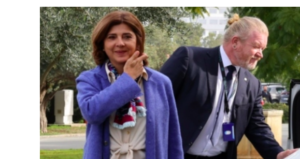
With the Cyprus issue once again moving along the fine line between process and outcome, UN Secretary-General’s Personal Envoy Maria Angela Holguín outlined today what to expect over the next 24 hours.
Following her meeting in the occupied areas with Turkish Cypriot leader Tufan Erhürman, Holguín described their contact as “good” and said preparations are underway for tomorrow’s trilateral meeting with the leaders of both communities. She characterized the meeting as “substantive,” while expressing hope for progress on Confidence-Building Measures.
The “Key” of Methodology
Attention now turns to tomorrow’s trilateral meeting, where Holguín, President of the Republic of Cyprus Nikos Christodoulides, and Tufan Erhürman will meet face to face.
As the UN envoy previously indicated, following her meeting with President Christodoulides, the main focus will be methodology, particularly the four points raised earlier by Erhürman.
While the term “methodology” may sound technocratic, in the context of the Cyprus issue, it often translates into a fundamental question: who accepts what as a starting point, what framework each side commits to, and what guarantees exist to prevent another politically costly failure.
“There Is Not Enough Progress”
Holguín was unusually direct for such a visit, stating that so far “there has not been significant progress” on CBMs. She stressed that without such progress, it would be “very difficult” to organize an expanded informal “five-plus-one” meeting (the two sides, the three guarantor powers—Greece, Turkey, and the United Kingdom—and the United Nations).
Erhürman’s “Four Points”
According to sources in the occupied areas, the four points raised by Tufan Erhürman—which he insists are not preconditions—include:
- Acceptance of political equality
- A time limit on negotiations
- Preservation of all previous convergences and agreements
- A form of UN guarantee that if the Greek Cypriot side withdraws again from the talks, procedures will be initiated to lift what the Turkish Cypriot side describes as “embargoes”
In Nicosia, Government Spokesperson Konstantinos Letymbiotis reiterated that the Greek Cypriot side has demonstrated a “widely recognized constructive stance,” pointing to specific proposals submitted, including new crossing points between the occupied and free areas. These proposals, however, were not accepted at the previous expanded meeting in New York in July 2025.
Confidence-Building Measures That Are “Dragging On”
The discussion on CBMs does not start from zero. In July 2025, UN-led talks failed to reach agreement on opening new crossing points, although progress was noted on other initiatives previously agreed upon, such as youth issues, environmental cooperation, cemetery restoration, and demining.
Following Erhürman’s election on 19 October 2025, defeating Ersin Tatar, expectations emerged for an improved climate. Nevertheless, the core issue remains unchanged: Ankara continues to pursue a two-state solution, while the Greek Cypriot side insists on a bi-zonal, bi-communal federation, in line with UN Security Council resolutions.
Maria Angela Holguín was initially appointed UN Secretary-General’s Personal Envoy for Cyprus in January 2024 and was reappointed in May 2025, in an effort to break the prolonged deadlock. Recently, her focus has been on rebuilding trust as a prerequisite for a multilateral conference. As recently as December 2025, she expressed cautious optimism but stressed that it was “premature” to discuss a multilateral meeting without a genuine climate of confidence.
Ask me anything
Explore related questions




